Making Progress: U.S. President Theodore Roosevelt

As a young boy, Roosevelt often struggled to breathe at night because of his asthma. Although modern doctors would be appalled, Roosevelt’s doctors suggested that the boy smoke cigars to improve his symptoms.

His family thought Roosevelt’s brother, Elliot (later father of Eleanor Roosevelt), was most likely to succeed. Elliot struggled with alcoholism, however. Theodore soon outpaced his brother both physically and mentally. He was a voracious reader and would read almost anywhere about almost any subject. Even as president he snuck a few minutes between appointments to read nature books.

512px-Theodore_Roosevelt_in_1918

Photo of Theodore Roosevelt 1918

After McKinley’s death the presidency was thrust upon Roosevelt. He was one of the few men who genuinely enjoyed the job. While in office he expanded the authority of the president. Roosevelt believed that the president could do whatever the law didn’t specifically prohibit him from doing.

Roosevelt engaged in a number of presidential firsts. He was the first president to understand and use the press to gain public support for his programs. In fact, Roosevelt enjoyed talking with the press so much that he spoke to a reporter during his morning shave. Roosevelt was also the first president to invite an African American (Booker T. Washington) to dinner at the White House.

Roosevelt’s administration was the first to actually apply the anti-trust law signed under President Benjamin Harrison. Roosevelt believed that while successful businesses could merge, their mergers needed to be regulated. By the time he left office, Roosevelt had brought over 20 anti-trust suits.

Although he loved being president, Roosevelt was disappointed to preside over the country in a time of peace. He believed that he could not be a great president without steering the nation through a great crisis. He also regretted that he promised not to serve for a third term. That did not stop him from running for the office several years later, however.

U.S. President William McKinley

One of many presidents who grew up in Ohio, William McKinley always believed he would be president someday. He inherited a poor economy from President Cleveland and wanted to focus on America’s domestic problems.

256px-Wmckinley

Official Presidential Portrait of William McKinley

Instead, he ended up presiding over a war with Spain. Having already witnessed the Civil War, McKinley had no desire to involve the country in Cuba’s fight for independence. Once the U.S. warship Maine exploded in Havana’s harbor, however, McKinley was pressured by the public to declare war. He finally gave in.

Once committed to a war, McKinley set out to win it. He set up the first modern war room in a corner office of the White House. By the war’s end the U.S. emerged for the first time as a world power. The United States not only served as protector of Cuba, but also took Puerto Rico and Guam from the Spaniards.

A confident president McKinley also sought to take the Philippines from Spain, but the Filipinos fought back. In order to subdue them, U.S. soldiers resorted to tactics such as burning villages in which innocent people, including children, were killed. McKinley disliked the atrocity stories but believed strongly in Manifest Destiny. He saw it as America’s duty to civilize the Filipinos and convert them to Christianity.

The bullet of an assassin ended the president’s second term during a cross-country tour. That trip was the last time a president traveled without the Secret Service.


Frequently Forgotten President Benjamin Harrison

In 1888 President Cleveland lost the election to Benjamin Harrison. Harrison ran on a pro-business platform and hailed from Indiana, a state that had a healthy number of electoral votes. The election was so close that without states like Indiana and New York, Harrison could not have won.

Throughout his life Benjamin Harrison wanted to be known as an individual. He did not want his presidential campaign to mention his grandfather, former President William Henry Harrison. Against his wishes his campaign supporters used references to “Tippecanoe” and his grandfather’s allegedly humble origins.

They also pointed out that the grandson had inherited his grandfather’s reputation as a fighter. During the Civil War Harrison fought in as many battles as possible. In 1864 he joined General Sherman’s Atlanta campaign.

Benjamin_Harrison_(official_Presidential_portrait,_1895)

Official Presidential Portrait of Benjamin Harrison

Harrison’s actions as president included generous pensions for Civil War veterans and the signing of an anti-trust law. Under Harrison and the next few presidents, the law, meant to prevent the establishment of monopolies, remained mainly symbolic. Harrison did not wish to anger the businessmen who helped elect him.

The American voters were unimpressed by Harrison’s spending of millions of dollars on pensions and his pro-business stance. As a result his opponent (former President Grover Cleveland) was re-elected in 1892.

Harrison’s personality did nothing to endear him to voters either. Nicknamed “The Icebox” for his cold manner, he disliked having to deal with people outside his family. In public he often looked up at the sky so he would not have to greet others, even if he knew them! He was, however, very devoted to his wife, who died of tuberculosis during his re-election campaign. Harrison personally nursed her through her illness and didn’t care at all when he lost the election.

After his wife’s death he went home to Indiana. In his loneliness he married his wife’s niece, a circumstance that shocked his older children. The couple had a daughter, and Harrison doted on her until he died.


Frequently Forgotten U.S. President Grover Cleveland

Young Grover Cleveland’s father was a minister, and he learned to be truthful from an early age. In politics Cleveland gained a reputation for reform as the mayor of Buffalo and governor of New York. He also gained weight thanks to his fondness for food and beer, though he was not a fan of the French cooking served in the White House.

During the 1884 presidential election the forthright Cleveland was accused of having an illegitimate son. Cleveland insisted on supporting the boy financially even though he may have been covering up for a married friend. (Cleveland did not marry until after he became president).

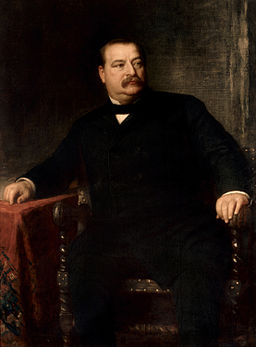
256px-Gcleveland

Official Presidential Portrait of Grover Cleveland

Cleveland’s decisions as president were somewhat contradictory. On the one hand, he refused to sign a bill that would have helped struggling farmers because he believed that government should take a limited role in people’s lives.

On the other hand, he created the Interstate Commerce Commission which eliminated the authority of individual states to set rates on interstate traffic. Cleveland’s subsequent fights with big business prevented him from being re-elected in 1888.

Yet Cleveland was not ready to retire. He ran again for president four years later and won, becoming the only president elected to non-consecutive terms.

His second term was marked by health problems and the worst economic depression up to that time. Though doctors successfully removed a tumor from his mouth, Cleveland’s poor health made him increasingly stubborn. During the Pullman strike in Chicago he sent in federal troops to break it up, asserting that presidents could interfere in a labor dispute if it endangered the country’s economy.