Racism in Coretta Scott King’s Childhood
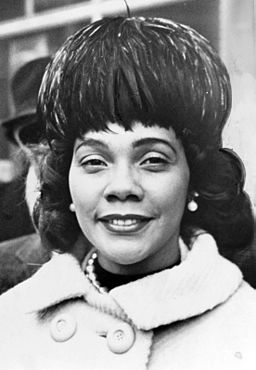
Coretta Scott King was born on April 27, 1927 in Heiberger, Alabama. During her early childhood, her family home had no running water or electricity. Her father Obadiah Scott worked hard to support his family. He always had several jobs going at once, including a barbering business, driving a taxi, and managing a farm. His home eventually made even whites in the area envious.
When Coretta was fifteen, her family’s home burned down. Coretta was convinced that white men were responsible, but the police never investigated. Coretta later wrote that “in the eyes of whites, we were a black family of ‘nobodies.'”
The day after the fire, her father went to work as if nothing happened. For Coretta, the example of her parents showing her how to live with fear but keep going was a lesson she applied for the rest of her life.
Work and Play
Despite racism, Coretta felt she had a mostly happy childhood. Her parents loved her and she loved her siblings Edythe and Obie. The children made their own toys because they couldn’t afford store bought ones. For example, they found an old tire, attached rope, and tied it to a tree to make a swing. They also climbed trees.
From age six, Coretta worked in her family’s fields. The family farm raised corn, peas, potatoes, and garden vegetables. She and her sister also milked cows.
During the Great Depression, she and Edythe worked as hired hands picking cotton in other people’s fields. They each made 60 cents per day which helped pay for their schooling.
Early Education
Coretta’s mother believed in the importance of education for all her children. “I cannot remember a time when I didn’t know I was going to college,” wrote Coretta.
In Perry County Alabama the public school system separated black and white children. Coretta’s school was one room filled with over 100 children from grades one through six. Just getting to and from school was a challenge. “I saw white children riding yellow-checkered buses to their school, yet, in all kinds of weather, we black children walked three miles to our one-room schoolhouse and three miles back home.” Although they had outdated books and no labs, Coretta’s teachers were good people who “loved us and expected us to excel.”
Fortunately, Coretta’s education improved after sixth grade. She attended Lincoln Normal School which had an integrated faculty. White faculty members cared for their black students. Coretta learned from them that some white people were kind–something she hadn’t experienced before.
Her music teacher introduced Coretta to classical music and told her about black concert performers. Through the encouragement of her teachers, Coretta wondered if she could do something with music when she grew up.
College and Graduate School
In 1945, Coretta followed her sister to Antioch College in Yellow Springs, Ohio. To her dismay, she discovered that her high school education still wasn’t as good as most white students. She persevered, however, and eventually caught up through hard work.
In college Coretta met people of different races, cultures, and religions. She dreamed of a world in which all kinds of people lived in peace together.
Unfortunately, even the North in the 1940s didn’t offer the utopia she wanted. Coretta majored in elementary education with a minor in voice. Her major required her to teach one year in an Antioch private elementary school and one year in a Yellow Springs, Ohio public school. Coretta wasn’t allowed to teach in the Yellow Springs public school because there were no black teachers there. She appealed to various school officials, the school board, and the college administration. Her protests were denied and she had to teach another year in private school.
Even though she wasn’t successful, Coretta’s protests taught her something. “This was the first time I stood publicly against discrimination, and I found that I rather liked making waves and being a catalyst for change,” she said.
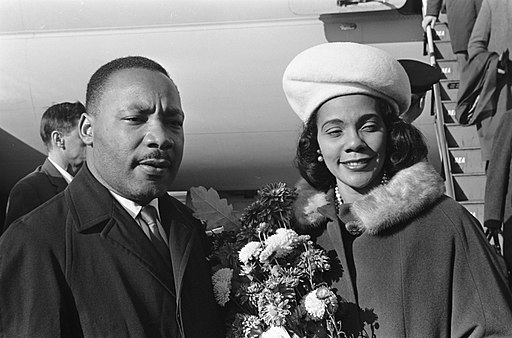
At the time, Coretta thought she was meant to fight racial discrimination through her music. “I saw myself as a concert singer, paving the way for other blacks.” She received an early acceptance to the New England Conservatory and began her voice studies. During her second semester in Boston, she met a young man named Martin Luther King, Jr. As their relationship became more serious, Coretta wondered if she could sacrifice her musical ambitions to support Martin’s racial justice work.
Sources:
King: A Life by Jonathan Eig
Coretta: My Life, My Love, My Legacy by Coretta Scott King
 Heather on History