
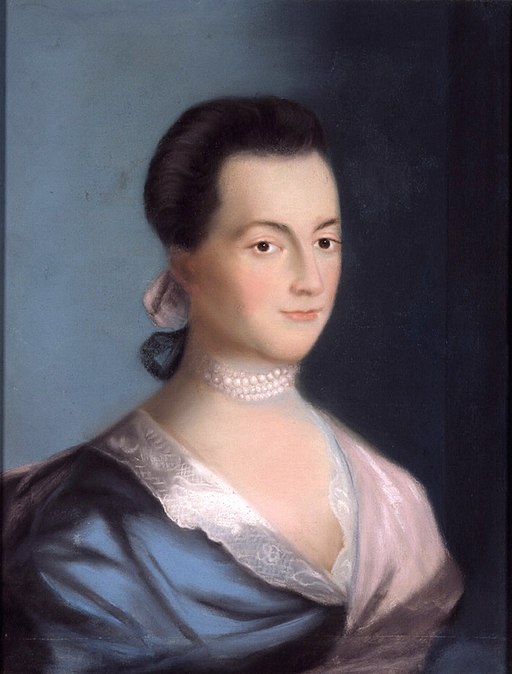
Abigail Adams (1744-1818), born Abigail Smith, was an early advocate for women’s rights in America through her extensive correspondence with her husband John Adams. Throughout her husband’s political career Abigail took on some roles that were traditional for women at the time and some that were not. Abigail was the second woman to serve as first lady and the first to occupy the executive mansion in Washington, D.C. She was also the first woman to become the wife and mother of U.S. presidents, though she did not live long enough to see her son John Quincy Adams get elected.
Abigail Smith was born on November 22, 1744, in Weymouth, Massachusetts—a farming community 14 miles southeast of Boston. Her parents, William and Elizabeth Smith, nicknamed her Nabby. Though she was small and frail as a child, Abigail was also stubborn. Abigail and her sisters did not go to school because the local ones were only for boys. Their father, who was the village parson, encouraged them instead to read from his extensive library. Abigail loved reading Shakespeare, Pope and Locke. The combination of her father’s encouragement and her love of reading made Abigail one of the best-read women of her time. Abigail’s mother Elizabeth disapproved of both her daughter’s stubbornness and her fondness for reading. She sent Abigail on visits to her maternal grandmother Elizabeth Quincy, who encouraged rather than corrected her granddaughter’s opinions.
John Adams and Abigail Smith met at a party when Abigail was fifteen. John was unimpressed by Abigail and her older sister Mary. He wrote that the Smith girls were “not fond, not frank, not candid.” Over time, John got to know Abigail better. He was basically forced into her company because his friend Richard Cranch courted Mary. At 17, Abigail was very attractive. She was tall and thin, with a dark complexion and dark hair and eyes. John was also impressed with her desire to learn. He brought Abigail books which they discussed. After a few years of courting, Abigail and John married on October 25, 1764, at William Smith’s parsonage. They moved into a cottage next door to John’s childhood home at Braintree.
The marriage was a love match as well as an intellectual one. Abigail said their hearts were “cast in the same mould [sic].” Abigail’s intelligence meant that they could converse on almost any topic. John recognized that his wife was the superior letter writer. “If I could write as well as you, it would be so, but, upon my word, I cannot.”
At the beginning of their marriage, Abigail was busy with traditional wifely duties such as caring for her children. Daughter Abigail (Nabby) was born in 1765, followed by John Quincy in 1767, Susanna in 1768 who died after one year, Charles in 1770 and Thomas in 1772. Abigail was responsible for the physical and moral well-being of her children while John worried about making more money on the circuit as a lawyer.
In June 1774 the Massachusetts legislature elected John to the Continental Congress. Abigail and John would be farther away from each other than ever. After John left for Philadelphia, Abigail confided that “the great anxiety I feel for my Country, for you and for our family renders the day tedious, and the night unpleasant.”
While John was gone, Abigail had even more responsibilities. For example, she made sure hired men on the farm did their jobs and she made decisions about harvesting crops. Abigail took so well to her farming tasks that a family friend said she “was like to outshine all the farmers.” In addition, Abigail saw to the children’s education. Dissatisfied with the schools around Braintree, she got a tutor for John Quincy. Abigail was also in some danger from the British who were quartered in Boston. John depended on her observations during the battles of 1775 and sometimes showed her letters to fellow delegates.
In the middle of all her other responsibilities, Abigail wrote John letters about women’s rights. She wrote: “I desire you would Remember the Ladies and be more generous and favorable to them than your ancestors. Do not put such unlimited power in the hands of the Husbands. Remember all men would be tyrants if they could. If particular care and attention is not paid to the Ladies, we are determined to foment a Rebellion, and will not hold ourselves bound by any laws in which we have no voice, or Representation.” In the eighteenth century, men had legal power over their wives. Women could not legally own property and some were in physically abusive marriages.
Abigail also wanted better education for women, who still did not attend school. She wrote, “If we mean to have Heroes, Statesman and Philosophers, we should have learned women.” John agreed on the education of women; after all, he married one of the most intelligent women of the time. He was not prepared to go any further for fear that everyone regardless of age, gender, or property ownership would demand equal rights. Independence from Britain would have to be won first.
Before John returned from Philadelphia, Abigail received a letter stating that he was elected commissioner to France. John took ten-year-old John Quincy with him, leaving the Adams farm even lonelier for Abigail. Both she and John had a great sense of public duty, but the lack of reliable letters from her husband depressed Abigail. She wrote of her “cruel destiny” and herself “siting in my solitary chamber, the representative of the lonely love.”
Despite her loneliness Abigail took on some unladylike pursuits on the home front. She managed the family finances. She acquired land when able and even started her own importation business. At first John sent her goods from France like handkerchiefs and linens that she consigned to her uncle. Later Abigail wrote to the merchants abroad herself and told them what she wanted. She used the profits for the taxes needed to fund the war or bartered for local goods.
By 1784 both John and Abigail were fed up with their separation and Abigail made plans to join John in Paris with Nabby. As a diplomat’s wife first in Paris and then in London, Abigail had a more public role to play in John’s career. She was expected to accompany him on all ceremonial and social occasions. Living in Europe gave Abigail an education in entertaining on a budget, since American diplomats were not paid as much as their European counterparts. She also managed to visit the wives of 15-20 government officials or foreign ministers each week.
Abigail and John returned home to Braintree in 1788, the same year that John was elected the first vice president of the United States. Abigail’s training in Europe helped her ease into the role of the vice president’s wife. She hosted a weekly levee, an open house where residents came and paid their respects. With time she managed to invite every senator and congressman to dinner.
After eight years as George Washington’s vice president, John was elected president in 1797. Before the election, Abigail worried about her ability to be as popular as Washington’s quieter wife Martha. “I have been so used to a freedom of sentiment that I know not how to place so many guards about me, as will be indispensable, to look at every word before I utter it, and to impose a silence upon myself, when I long to talk.” John thought she would do an excellent job and once elected, urged her to leave Massachusetts and come to him in Philadelphia.
As she had when John was vice president, Abigail organized her social routine as first lady, a term that had not been coined yet. The family ate breakfast together at 8am, and Abigail received visitors from 12-2 or 3pm. Dinner was at 3pm except on Tuesdays and Thursdays when she hosted company. After dinner she visited others. She was home by 7pm to spend time with family before an early bedtime. Abigail’s company dinners meant inviting 30-40 guests at a time. She could invite all the senators in one dinner but had a series of dinners for House members.
Her main complaint about entertaining came from a tradition George Washington started. On July 4th, all Congress and state officials were invited to the president’s residence. Washington was wealthier than the Adams family and Abigail resented the amount of cake, wine and punch she had to serve. She reported that guests ate 200 pounds of cake!
In addition to her traditional social duties, Abigail offered John political advice and helped promote his agenda. For example, she sent letters supportive of John’s presidential policies to friendly newspaper editors. Often these letters came from her son John Quincy. Abigail also received requests from office seekers asking her to influence John, many of which she answered.
Though mostly an asset to John’s work, Abigail erred in her support of the 1788 Alien and Sedition Acts. These laws permitted the arrest of newspaper editors publishing statements against the government and allowed the deportation of foreigners accused of seditious activities. Eager to protect her husband against the pro-French republican opposition led by Thomas Jefferson, Abigail was much more in favor of the acts than John. In fact, she wanted them to be harsher. She wrote that “they have had a salutary effect, weak as they are.” John later acknowledged that signing the acts was a mistake, but they remain a dark part of his legacy.
John and Abigail were the first president and first lady to move into the president’s house in Washington, D.C. Abigail was not impressed with the house since it was large and drafty. She described it as “a castle of a house” built “for ages to come.” In the meantime, it was impractical to live in. Abigail kept 13 fires going all day and used the east room to hang her laundry.
When John lost his bid for reelection, Abigail felt it keenly. She thought the public was ungrateful for John’s years of public service. Yet she was almost as busy in retirement as she had been as first lady. She had a house full of in-laws and grandchildren as well as some more distant relatives. Any family member who needed a place to stay was always welcome in John and Abigail’s home.
In 1814, one of Abigail’s sisters asked if she would marry John if she could live her life over. She responded, “Yet after half a century, I can say my first choice would be the same if I again had my youth and opportunity to make it.” On October 28, 1818, Abigail passed away surrounded by family including her beloved John.
Sources:
Carlin, Diana B., Anita B. McBride, and Nancy Kegan Smith. U.S. First Ladies: Making History and Leaving Legacies. Cognella, Inc., 2024.
Ellis, Joseph J. First Family: Abigail and John Adams. Alfred A. Knopf, 2010.
Holton, Woody. Abigail Adams. Free Press, 2009.
Withey, Lynne. Dearest Friend: A Life of Abigail Adams. The Free Press, 1981.

 Heather on History