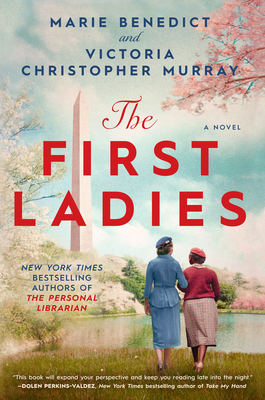
Book Review of The First Ladies by Marie Benedict and Victoria Christopher Murray

The First Ladies introduces us to two influential women of different races who become friends in 1927. Mary McLeod Bethune is an African American woman who founds Bethune Cookman College in Daytona, Florida on the site of a garbage dump. The school serves underprivileged black girls. She also finds funding for McLeod Hospital when her students are turned away by other hospitals due to their race. The book’s other main character is Eleanor Roosevelt, who by 1927 bought Todhunter School for girls and is teaching there. She also works with the Women’s Division of the New York Democratic Party to get women to vote for Democratic candidates.

Though they accomplished much by themselves, Eleanor and Mary accomplished far more together. As Eleanor’s husband Franklin Delano Roosevelt returns to public life after his polio diagnosis, Mary has Eleanor in the New York governor’s mansion and eventually in the White House to turn to when she wants more done about racism.

In the early 1930’s when FDR is still governor, Mary tells Eleanor details about lynchings that are happening in the North as well as the South. Eleanor says, “silence suggests agreement, and anyone who knows about these terrible acts—including me—should take a stand against them. Mrs. Bethune has offered me an entirely different lens through which I should be examining the racism in our country.” As a result of Mary’s friendship, Eleanor begins to take a stronger stance against racism. When FDR is elected president, Eleanor and Mary try to get his approval for an anti-lynching bill. Though FDR makes public speeches condemning lynching, they cannot get his support for the bill.
Despite some setbacks, Mary and Eleanor brainstorm ways to help blacks during the Great Depression. Eleanor asks, “How shall we begin to ensure that the New Deal is indeed for everyone?” They plan to get black people into administrative positions in the government as well as finding them jobs. For example, Eleanor recommends Mary to a position with the National Youth Administration. After Mary speaks to FDR about the importance of funding for black youth, he decides to create a division within the NYA to focus on the needs of blacks and puts Mary in charge. In three months, Mary doubles the funding for NYA’s Division of Negro Affairs.

Just as Mary changes Eleanor’s opinions on racial issues, her friendship with Eleanor changes how Mary votes. She voted against FDR when he first ran for president, but she votes for his second term because blacks are now included in New Deal programs.

During FDR’s second term, Mary makes a persuasive speech to him about including blacks in pilot and combat training and adding more black army units. Mary and her male allies in the black community also get FDR’s promise to issue an executive order ending discrimination in the military. Yet the bill languishes on the president’s desk for so long that the black community threatens to stage a mass protest in Washington, D.C. Fortunately, Eleanor convinces him to sign the bill, preventing the protest.

I always feel that the main job of historical fiction is to make readers interested in learning more about the topics in it. The First Ladies succeeded in making me want to find out more about Mary McLeod Bethune, who I knew almost nothing about before. The dual points of view of Mary and Eleanor worked well, though I could’ve done without some of the details of Eleanor’s childhood. To be fair, I know more about Eleanor Roosevelt from reading biographies about her, so less familiar readers may not mind the extra information.

My main criticism of the book is that it put Mary and Eleanor together in important historical situations when they were in different places. For example, Eleanor visits the Tuskegee Institute’s airfield to make a point about how safe it is to fly with an African American pilot. The book includes Mary on this trip even though she wasn’t there. Fortunately, incidents like this are rare in the book (it only happens twice). I realize the book is historical fiction but feel it’s important to maintain historical accuracy whenever possible.

This is the second historical fiction book I’ve read recently that explores the power of female friendships, and in this case, what female friends can accomplish together. I enjoyed the focus on friendship rather than a romantic relationship. The First Ladies shows Eleanor and Mary as true friends, despite the racism of the time. As Victoria Christopher Murray wrote in her author’s note, “at the core of any relationship is trust, and Eleanor and Mary had that. They trusted each other and felt free to share, to laugh, to cry…and sometimes even get annoyed with each other.” I recommend The First Ladies to anyone looking to explore the wonderful friendship between an influential black woman and an influential white one.

“Give-’em-hell-Harry” The Presidency of Harry Truman

Future president Harry Truman had a difficult childhood. A kid wearing glasses was a rare thing in the farm town of Independence, Missouri, and his schoolmates teased him. Since he was not very tall, they nicknamed him “little four eyes.”

Young Harry Truman also had different goals than most other children. He loved music and hoped to become a concert pianist. As a result of his father’s bad investments Truman could no longer receive piano lessons or even apply to college. Although he hated it, he worked the family farm until his father died. Truman then tried his hand at various business ventures, all of which failed.

Despite his poor eyesight and the fact that he was past the draft age, Harry managed to serve as a combat artillery captain in World War I. He discovered his ability to lead other people and gained the respect of his men. The experience boosted his confidence. He returned to Missouri as a war hero and married his sweetheart Bess Wallace.

512px-HarryTruman

Official Presidential Portrait of Harry Truman

Truman needed to support his family and had to find work. After another business failure, he decided to try politics. It helped that he had kept in touch with the other veterans he served with during World War I. With the help of his friends and Democratic Party boss Tom Pendergast, Harry got elected first as a judge and later to other county offices. Despite his association with Pendergast, who had criminal ties, Harry became known for his honesty and his desire to help the common man during the Great Depression.

In 1934 Truman was elected to the U.S. Senate. He served as chairman of a committee that uncovered the Defense Department’s wasteful spending. The public found Truman’s honesty and even his swearing so refreshing that they nicknamed him “Give-’em-hell-Harry.”

During the 1944 presidential election Truman was selected as President Franklin Roosevelt’s vice-president. Only a few months after he became vice-president, Roosevelt died and Truman had to take over. At the time he thought, “There must be a million other men more qualified for the presidential task. But the work was mine to do, and I had to do it.”

Chief among Truman’s tasks was to bring World War II to a successful conclusion. Even after Germany surrendered, the fighting with Japan dragged on. Truman believed that if the war in the Pacific continued, up to 100,000 American soldiers could die. He decided that if Japan refused to surrender, he would use the new atomic bomb.

On July 26, 1945, Truman warned Japan that it would be destroyed if it continued to fight. The Japanese Emperor still would not give up. In August, the U.S. dropped two atomic bombs, one on the town of Hiroshima and one on Nagasaki. Finally, the Japanese Emperor surrendered and the war was over.

Truman received criticism in later years for using the atomic bombs, which mostly killed Japanese civilians. He never regretted his decision, however. As Truman put it “The greatest part of the president’s job is to make decisions…he can’t pass the buck to anybody.”

After World War II Truman turned his attention to stopping the spread of communism. The start of a nuclear arms race with the Soviet Union worried voters, and Truman’s popularity suffered. In 1948 he was probably the only person who thought he would be re-elected president. He took the campaign seriously and made hundreds of speeches throughout the country on his “Whistle-stop campaign” tour. Truman’s confidence proved to be prophetic when he won.

Truman’s second term was dominated by his decision to support South Korea when it was invaded by communist North Korea. He never asked Congress for a declaration of war because he feared the public would be reminded of World War II. As the war went on, Truman’s popularity took a nosedive.

Even though he had a poor approval rating, the public was still shocked when he announced that he didn’t plan to run for president again. He took delight in returning to Missouri and becoming “Mr. Citizen.” Truman lived to see much of his reputation restored. He became known not only for overseeing the end of World War II but also for desegregating the military and banning racial discrimination in the federal government.


Andrew Jackson’s Apprentice: U.S. President Martin Van Buren

Martin Van Buren was the first president born in the official United States of America. His ancestors were Dutch. Van Buren’s father managed a tavern in Kinderhook, New York. Politicians often dropped by for a drink and talked about their ideas. Listening to them gave young Martin an early interest in politics. His family couldn’t afford to send him to law school, but he studied on his own while he worked as law office clerk. Soon he entered state politics.

Van Buren got his nickname “The Little Magician” for his talents as a shrewd negotiator and political organizer. By the election of 1836 Van Buren had already helped to organize the new Democratic Party. His former party, the Democratic-Republicans, was crammed with members who just wanted to argue with each other. The new Democratic platform extended Andrew Jackson’s policies of limited federal government and promotion of states rights.

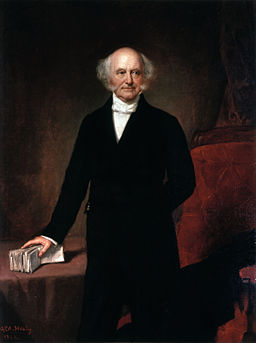
Official White House Portrait of Martin Van Buren

Official White House Portrait of Martin Van Buren

Though Van Buren was a gifted politician, he is largely regarded as a failure as president.

The economic crisis he inherited from Jackson only got worse under his watch. Not all of the factors were within his control: for example, England also had an economic depression and English banks stopped dealing with the United States. Unemployment among American workers soared and so did poverty.

Unlike future democratic president Franklin Roosevelt, Van Buren never offered the American people federal assistance. He thought the government should leave people alone. He did, however, want to make sure that the government had money. He proposed an independent treasury so the government wouldn’t have to keep its money in struggling individual banks.

The establishment of the U.S. Treasury would have been a victory for Van Buren, but it took him years to convince Congress to pass the bill. By then the public blamed him for the economic crisis and Van Buren was not re-elected.