
American First Lady Lucy Webb Hayes is most remembered as “Lemonade Lucy,” a nickname she received after banning alcohol from the White House. In fact, Lucy Hayes was much more than an advocate for abstinence.
Lucy was the first First Lady to graduate from college. She met Rutherford B. Hayes when she was a student at Ohio Wesleyan University, but at fifteen she was to young to be courted. Fortunately they met again in 1850 and married in 1852.
Despite her education, Lucy told Hayes that she thought she was “too light and trifling for you.” Hayes, though acknowledging his love for her, saw her as much more than a pretty face. He wrote in his diary, “Intellect she has too, a quick and spritely one, rather than a reflective and profound one. She sees at a glance what others study upon, but will not, perhaps, study what she is unable to see at a flash.”
Her college essays show that Lucy took a great interest in the issues of her time, including temperance and women’s rights. In one essay, Lucy compared men to women, with women coming out favorably. she wrote, “It is acknowledged by most persons that her (woman’s) mind is as strong as a man’s…Instead of being considered the slave of man, she is considered his equal in all things and his superior in others.”
Throughout their marriage, Lucy did not hesitate to share her opinions with her husband. An ardent abolitionist, she wrote to Hayes during the Civil War that President Lincoln was not doing enough to get rid of slavery. “The protection of slavery is costing us many precious lives,” she wrote. One of the lives she worried about was Hayes’s, since he was wounded more than once. Lucy traveled with Hayes, who was a Union officer, as much as she could during the war. She even brought two of their youngest children along, which may have contributed to their deaths before the age of two.
She developed an abiding interest in veteran’s causes as a result of her war experiences. When Hayes was elected governor of Ohio, Lucy established a soldier’s orphan’s home. Though she struggled to get the home funded, it became a state institution in 1870.
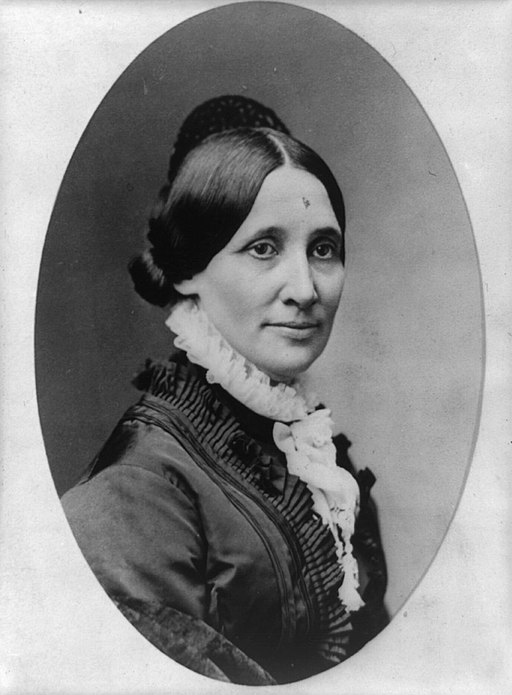
In 1877, Hayes was narrowly elected President of the United States. Lucy’s excellent skills as a hostess helped her husband entertain both political parties at the White House. Her love of music led Lucy to invite vocalists and musicians to the White House. The first black opera singer Marie Selika sang arias in the Green room. On more informal occasions, guests were invited to sing gospel songs with the First Lady.
Though Lucy later took the blame for it, Hayes announced that alcohol would not be served at the White House after spring 1877. He may have partly been trying to please his wife, but Hayes also disliked the way male visitors behaved when drinking. Although some colleagues accused the First Couple of being stingy, they still entertained lavishly. During one dinner, hundreds of guests were treated to expensive foods like salmon, turkey and truffles, ham, lobster salads, and oysters among other dishes.
Since she had no social secretaries to help her entertain, Lucy invited young friends and family to the White House. Though she claimed she was getting an unfair reputation as a matchmaker, more than one politician met his future wife at one of the Hayes’s parties. Even the press acknowledged Lucy as a warm hostess. One reporter wrote of Lucy that “she is so vivacious and so responsive that everybody leaves her presence with a vague idea that he is the one person whom she was longing to see.” To most contemporaries, Lucy was known as a good conversationalist and hostess.
Lucy disappointed some women’s groups by not joining their causes. Despite the fact that the White House no longer served alcohol, Lucy never officially joined the Women’s Christian Temperance Union. She also remained neutral on women’s suffrage.
Lucy Hayes took a more traditional view of the role of First Lady, preferring to support her husband’s decisions rather than making public statements. Yet through her example of a college education and her private influence on issues, Lucy Hayes paved the way for more progressive First Ladies.
Sources:
Greer, Emily Apt. “Lucy Webb Hayes and Her Influence Upon Her Era.” https://www.rbhayes.org/hayes/lucy-webb-hayes-and-her-influence-upon-her-era/
Hoogenboom, Ari. Rutherford B. Hayes: Warrior and President.
O’Brien, Cormac. Secret Lives of the First Ladies.
Trefousse, Hans. Rutherford B. Hayes.
 Heather on History