Coretta Scott King’s Childhood and Education

Racism in Coretta Scott King’s Childhood

Coretta Scott King was born on April 27, 1927 in Heiberger, Alabama. During her early childhood, her family home had no running water or electricity. Her father Obadiah Scott worked hard to support his family. He always had several jobs going at once, including a barbering business, driving a taxi, and managing a farm. His home eventually made even whites in the area envious.

When Coretta was fifteen, her family’s home burned down. Coretta was convinced that white men were responsible, but the police never investigated. Coretta later wrote that “in the eyes of whites, we were a black family of ‘nobodies.'”

The day after the fire, her father went to work as if nothing happened. For Coretta, the example of her parents showing her how to live with fear but keep going was a lesson she applied for the rest of her life.

Work and Play

Despite racism, Coretta felt she had a mostly happy childhood. Her parents loved her and she loved her siblings Edythe and Obie. The children made their own toys because they couldn’t afford store bought ones. For example, they found an old tire, attached rope, and tied it to a tree to make a swing. They also climbed trees.

From age six, Coretta worked in her family’s fields. The family farm raised corn, peas, potatoes, and garden vegetables. She and her sister also milked cows.

During the Great Depression, she and Edythe worked as hired hands picking cotton in other people’s fields. They each made 60 cents per day which helped pay for their schooling.

Early Education

Coretta’s mother believed in the importance of education for all her children. “I cannot remember a time when I didn’t know I was going to college,” wrote Coretta.
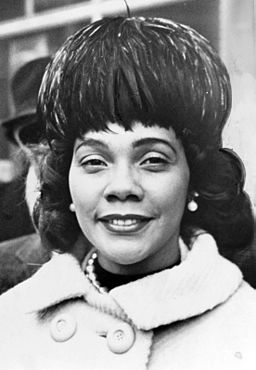
Coretta Scott King, 1964

In Perry County Alabama the public school system separated black and white children. Coretta’s school was one room filled with over 100 children from grades one through six. Just getting to and from school was a challenge. “I saw white children riding yellow-checkered buses to their school, yet, in all kinds of weather, we black children walked three miles to our one-room schoolhouse and three miles back home.” Although they had outdated books and no labs, Coretta’s teachers were good people who “loved us and expected us to excel.”

Fortunately, Coretta’s education improved after sixth grade. She attended Lincoln Normal School which had an integrated faculty. White faculty members cared for their black students. Coretta learned from them that some white people were kind–something she hadn’t experienced before.

Her music teacher introduced Coretta to classical music and told her about black concert performers. Through the encouragement of her teachers, Coretta wondered if she could do something with music when she grew up.

College and Graduate School

In 1945, Coretta followed her sister to Antioch College in Yellow Springs, Ohio. To her dismay, she discovered that her high school education still wasn’t as good as most white students. She persevered, however, and eventually caught up through hard work.

In college Coretta met people of different races, cultures, and religions. She dreamed of a world in which all kinds of people lived in peace together.

Unfortunately, even the North in the 1940s didn’t offer the utopia she wanted. Coretta majored in elementary education with a minor in voice. Her major required her to teach one year in an Antioch private elementary school and one year in a Yellow Springs, Ohio public school. Coretta wasn’t allowed to teach in the Yellow Springs public school because there were no black teachers there. She appealed to various school officials, the school board, and the college administration. Her protests were denied and she had to teach another year in private school.

Even though she wasn’t successful, Coretta’s protests taught her something. “This was the first time I stood publicly against discrimination, and I found that I rather liked making waves and being a catalyst for change,” she said.
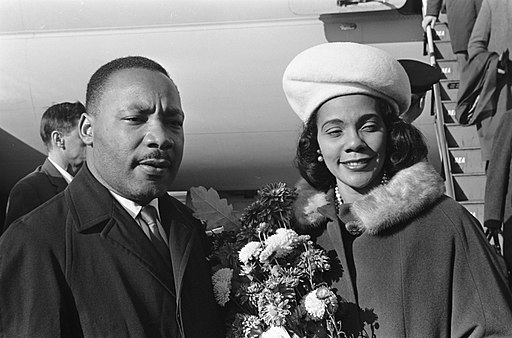
Martin Luther King, Jr. and Coretta Scott King, 1966

At the time, Coretta thought she was meant to fight racial discrimination through her music. “I saw myself as a concert singer, paving the way for other blacks.” She received an early acceptance to the New England Conservatory and began her voice studies. During her second semester in Boston, she met a young man named Martin Luther King, Jr. As their relationship became more serious, Coretta wondered if she could sacrifice her musical ambitions to support Martin’s racial justice work.

Sources:

King: A Life by Jonathan Eig

Coretta: My Life, My Love, My Legacy by Coretta Scott King

Martin Luther King Jr.’s Childhood and Education

Surprising Facts about Martin Luther King Jr.’s Childhood
and Education

Martin Luther King Jr. and Coretta Scott King, 1964

Martin Luther King Jr. and Coretta Scott King, 1964

  • King’s birth name was not Martin Luther. When he was born in 1929, King was named after his father, Michael King. When King’s father attended a conference for Baptist ministers in Germany, he decided to legally change his name to Martin Luther, and his son’s name was changed to Martin Luther King Jr.
  • Despite growing up during the Depression, King said that his family had enough money. His father, Martin Luther King Sr. was a pastor and his congregation respected him so much that they refused to see their leader’s family go hungry.
  • Although he grew up in the South, King didn’t experience violent racial prejudice. Atlanta offered education for African Americans through black colleges. There were also social bonds formed at church where his father preached. Though blacks and whites didn’t attend the same schools or share seats on buses, Atlanta was one of the few places in the South where both blacks and whites could dream about a better life.
  • King’s father taught him to talk back to whites. One day when the two of them were walking in the street, a policeman called King’s father “boy.” His father turned to the policeman, pointed at his son and said “No, that’s a boy.”
  • Martin Luther King Jr. was smart but didn’t get good grades in school. Even in college, King preferred going parties and dances instead of doing homework.
  • King worried about what white people thought of him. When he decided to attend a seminary in the North, King had white classmates. King admitted that “I was well aware of the typical white stereotype, and for a while I was terribly conscious of trying to avoid identification with it.” The stereotype said that blacks were lazy, stupid, and unclean. At the seminary King’s grades improved and he dressed well. Some people said he was vain.
  • Though he was ahead of his time in other ways, King thought a woman’s place was in the home. When he met his future wife Coretta Scott at school, he made it clear that he wanted her to raise their kids and keep house even though she was smart and politically active in college.

Martin Luther King, Jr.’s Letter from Birmingham City Jail

In April 1963, Martin Luther King, Jr. was arrested for taking part in a civil rights protest. African-Americans in Birmingham, Alabama had few rights. They were not allowed to enter certain stores and the police would not investigate the bombings of African-Americans’ homes or churches by angry whites. Martin Luther King, Jr. organized a non-violent protest in this city to draw attention to the injustices that blacks experienced.

While in jail, he wrote a letter to white Alabama pastors who thought that legalized separation of blacks and whites, known as segregation, should not be protested. They felt that the courts should decide whether the laws of segregation were just. In his letter, King explains that there are two types of laws: just (fair) laws, and unjust (unfair) laws.

He explains that a just law is one that all citizens have a vote on and must follow. An unjust law is a law that only a minority needs to follow whether they can vote on it or not.  For example, he was arrested for parading without a permit. While he sees nothing wrong with a requirement for parade permits, he points out that this law was being used to squash the right of African-Americans to protest for equal rights.

King does not, however, advocate that African-Americans break laws just for the fun of it or out of bitterness for their poor treatment. Instead, they would have to be willing to accept the consequences of their actions. He writes, “One who breaks an unjust law must do it openly, lovingly…and with a willingness to accept the penalty.” King was accepting the penalty of an unjust law by calmly sitting in jail for his part in the protest.

History, King points out, is full of unjust laws. For example, Hitler’s mistreatment of the Jews was legal for a long time. With the benefit of hindsight, it is obvious that Hitler’s laws were unjust. In the same way, segregation laws would be viewed as unjust someday. Thanks to King and other civil rights leaders, the injustice of segregation is obvious to Americans today.  


How Religion Shaped American History

Religion in America has been used to justify unforgivable actions against others. The treatment of Native Americans by the U.S. government is one example. In the nineteenth-century, Americans believed that it was their manifest destiny, or God-given duty, to spread their society across the continent. Americans’ godly mission, however, did not require them to care about the Native Americans who were displaced from their lands as whites moved closer. When President Andrew Jackson passed the Indian Removal Act with the approval of Congress in 1830, Native Americans were forced to move to land west of the Mississippi. In 1838, the Cherokee Indians journeyed west. Baptist missionary Evan Jones traveled with the Cherokee and described the experience: “The Cherokees are nearly all prisoners…In Georgia, especially, multitudes were allowed no time to take anything with them, except the clothes they had on. Well-furnished houses were left a prey to plunderers, who, like hungry wolves, follow in the train of the captors.” Although the U.S. believed that manifest destiny justified the seizing of land, this action led to the unjust treatment of Native Americans.

Despite the negative consequences of manifest destiny, religion in American has also served as a motivation for reform. Throughout our nation’s history, churches promoted various social reforms. In the mid-twentieth century, for example, African Americans found leaders for the civil rights movement in their congregations. Baptist minister Martin Luther King Jr. led the Montgomery, Alabama bus boycott during which African Americans refused to ride buses after Rosa Parks was arrested for refusing to give up her seat to a white person. He also organized the Southern Christian Leadership Conference to protest the treatment of blacks in white society. Today African American church leaders continue to fight for social justice. Reverend Jesse Jackson consistently brings media attention to issues of civil rights and other causes like welfare reform. Both King and Jackson demonstrate that religion can be a positive force when it is used to uproot injustices in society.