Why I Wrote A Book about The War Refugee Board

Picture it: Chicago, December 2001. I was looking for a topic for my honors thesis. I knew I wanted to work with my history advisor, who was a Holocaust historian. Since I spent most of my time studying U.S. history, I decided to dig for information on America and the Holocaust. My advisor told me that America and the Holocaust was too broad for my thesis. He also suggested that I look for a topic that hadn’t received much attention. I asked if I could write about Eleanor Roosevelt’s response to the Holocaust. He said yes, if I found enough information on it. A couple of hours at the library told me that my new idea was too narrow.

While sifting through books on U.S. and the Holocaust, I discovered a chapter here and there in several books about a government agency created in 1944 called the War Refugee Board. At first I thought, a thesis about a government agency? BORING. Once I started reading about the people behind the agency, though, things got interesting. These men were not household names (anyone familiar with John Pehle, and if so, how to pronounce his name?), but they were working their tails off trying to save the few Jews who hadn’t been murdered yet in the Holocaust. 

I started to ask myself questions like why wasn’t the War Refugee Board created sooner? What drove these men, who were mostly from Protestant backgrounds, to risk their jobs by going to the president and criticizing the administration’s lack of response to the Holocaust? So I wrote my thesis, and put it on my bookshelf. I always thought the topic would make a great book and that a well-known historian would write it.
FDR Library

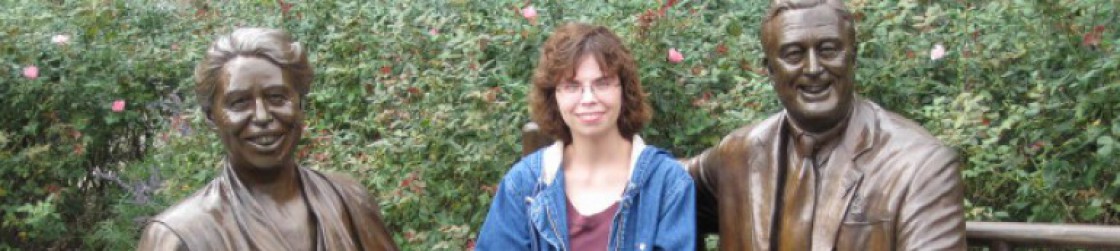
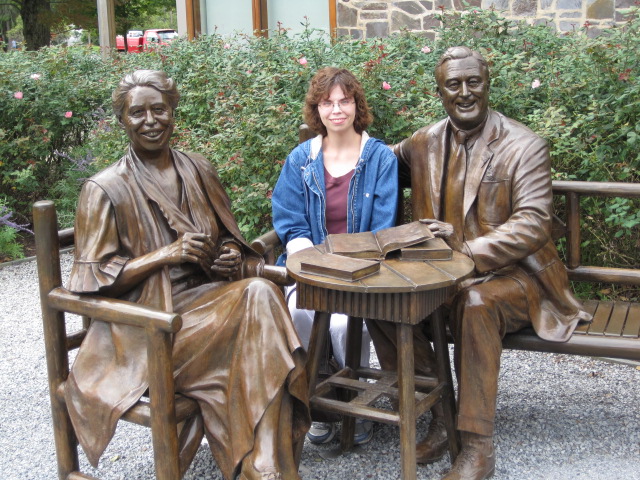
Fast forward several years, and no one else had written a book about the WRB. I contacted my former professor, who encouraged me to do more research on my old topic. Ironically, shortly after I wrote my thesis, a major project to collect the papers of the War Refugee Board was completed. I discovered that I could borrow microfilm from the Library of Congress and read the actual memos that FDR and Board representatives wrote. I spent at least a year of my life looking through those documents, and then I visited the FDR library in Hyde Park because I couldn’t borrow everything I needed. (The picture on the top of my blog and in this post is of me outside the library. I was one relieved researcher)!

My book wasn’t going to rehash my thesis, however. After studying the memos and other government documents related to the Board, I made an interesting discovery. Not only did the members of the War Refugee Board save Jews, but they also made an impact on American foreign policy that continues today. As I mentioned in a previous post, I hoped for a publishing contract, but decided to self-publish when that didn’t happen. Hopefully self-publishing will make my work available to the largest possible number of people, since that always was my main goal.

Eleanor Roosevelt: Champion for Youth

During the Depression, young people had little hope of finding work or attending college. In 1934 Eleanor Rooseveltshowed concern for 3 million unemployed youth. She said, “I have moments of real terror when I think we may be losing this generation. We have got to bring these young people into the active life of the community and make them feel that they are necessary.”

Eleanor Roosevelt's school portrait

Eleanor Roosevelt’s school portrait

Eleanor’s wish came true through a new government agency—The National Youth Administration. By 1935 President Franklin Roosevelt had received several proposals for youth aid programs. He gave these proposals to a private group, which included the future chairman of the NYA and Eleanor. The group advocated scholarship aid for high school and college students as well as a work program for youth who had graduated or dropped out. FDR established the NYA by Executive Order on June 26, 1935.

There was no greater supporter of the program during its eight year existence than Eleanor Roosevelt. She pressed the head of the NYA to do more during the NYA’s first year and received monthly reports on the status of youth projects.

Eleanor wrote extensively about the NYA in her newspaper column, “My Day.” She kept the country informed of the NYA’s progress by describing her visits to NYA project sites. On a trip to L.A., for example, Eleanor noted that the wood-working and sewing projects were set up like a real factory so that the boys and girls who worked there would be better prepared when they found full-time employment. Her visits to youth projects spanned the country. History Professor Margaret Rung points out that though Eleanor could be a controversial figure, her columns developed generally positive publicity for the NYA. Without her support, the program could have been marginalized.

Her columns reveal that Eleanor was not only interested in observing NYA projects, but she also attended NYA committee meetings. Eleanor invited both administrators and students to her Hyde Park, New York, home to discuss issues within the program. Through her invitations she gave everyone involved in the NYA a chance to be heard by someone who had direct access to the president.

Although Eleanor wanted the NYA to become a permanent organization, she realized its limitations. She wrote, “here, before our eyes, we see the proof that we have learned how to give these youngsters training…Yet, we have only developed this program for a limited number. The  NYA should cover every boy and girl coming out of school who is not able to obtain work in private industry, or who is not called to service under the selective draft.”

The NYA did not become a permanent program and could not cover all youth, but its accomplishments were aided by Eleanor’s enthusiasm. During the NYA’s eight year existence, 2,134,000 youth had the opportunity to continue their education. Students in the school program did clerical work, remodeled buildings, worked in libraries, and became lab assistants to earn money for school supplies and clothes. Students in the out-of-school program were often involved in construction work, but had other options such as clerical and agricultural training.

By 1942 work programs focused on producing materials needed in World War II. Students learned industrial sewing and how to repair planes and radios. In her column Eleanor shared a letter that five girls who worked on radios wrote to the director of the Kansas NYA after finding jobs: “On average we are making $50 a month and for the five of us it doesn’t cost very much for rent or groceries…The spirit of cooperation and working together [from their NYA experience] is largely responsible for the way we are getting along so well up here.”

Eleanor grieved when the NYA ended. She felt that young people would need job training after the war. By supporting the agency during its existence, however, she enabled millions of youth to earn wages during the nation’s worst economy.