Forgotten First Lady Lucy Hayes

American First Lady Lucy Webb Hayes is most remembered as “Lemonade Lucy,” a nickname she received after banning alcohol from the White House. In fact, Lucy Hayes was much more than an advocate for abstinence.

Lucy was the first First Lady to graduate from college. She met Rutherford B. Hayes when she was a student at Ohio Wesleyan University, but at fifteen she was to young to be courted. Fortunately they met again in 1850 and married in 1852.

Despite her education, Lucy told Hayes that she thought she was “too light and trifling for you.” Hayes, though acknowledging his love for her, saw her as much more than a pretty face. He wrote in his diary, “Intellect she has too, a quick and spritely one, rather than a reflective and profound one. She sees at a glance what others study upon, but will not, perhaps, study what she is unable to see at a flash.”

Her college essays show that Lucy took a great interest in the issues of her time, including temperance and women’s rights. In one essay, Lucy compared men to women, with women coming out favorably. she wrote, “It is acknowledged by most persons that her (woman’s) mind is as strong as a man’s…Instead of being considered the slave of man, she is considered his equal in all things and his superior in others.”

Throughout their marriage, Lucy did not hesitate to share her opinions with her husband. An ardent abolitionist, she wrote to Hayes during the Civil War that President Lincoln was not doing enough to get rid of slavery. “The protection of slavery is costing us many precious lives,” she wrote. One of the lives she worried about was Hayes’s, since he was wounded more than once. Lucy traveled with Hayes, who was a Union officer, as much as she could during the war. She even brought two of their youngest children along, which may have contributed to their deaths before the age of two.

She developed an abiding interest in veteran’s causes as a result of her war experiences. When Hayes was elected governor of Ohio, Lucy established a soldier’s orphan’s home. Though she struggled to get the home funded, it became a state institution in 1870.
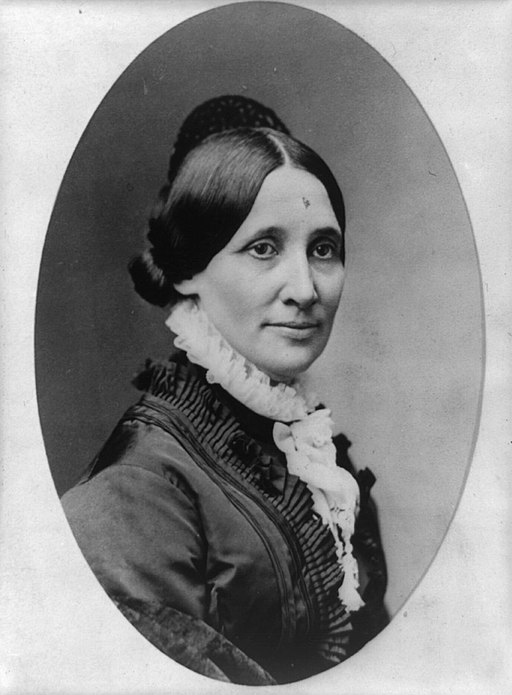
Lucy Hayes, circa 1877

In 1877, Hayes was narrowly elected President of the United States. Lucy’s excellent skills as a hostess helped her husband entertain both political parties at the White House. Her love of music led Lucy to invite vocalists and musicians to the White House. The first black opera singer Marie Selika sang arias in the Green room. On more informal occasions, guests were invited to sing gospel songs with the First Lady.

Though Lucy later took the blame for it, Hayes announced that alcohol would not be served at the White House after spring 1877. He may have partly been trying to please his wife, but Hayes also disliked the way male visitors behaved when drinking. Although some colleagues accused the First Couple of being stingy, they still entertained lavishly. During one dinner, hundreds of guests were treated to expensive foods like salmon, turkey and truffles, ham, lobster salads, and oysters among other dishes.

Since she had no social secretaries to help her entertain, Lucy invited young friends and family to the White House. Though she claimed she was getting an unfair reputation as a matchmaker, more than one politician met his future wife at one of the Hayes’s parties. Even the press acknowledged Lucy as a warm hostess. One reporter wrote of Lucy that “she is so vivacious and so responsive that everybody leaves her presence with a vague idea that he is the one person whom she was longing to see.” To most contemporaries, Lucy was known as a good conversationalist and hostess.

Lucy disappointed some women’s groups by not joining their causes. Despite the fact that the White House no longer served alcohol, Lucy never officially joined the Women’s Christian Temperance Union. She also remained neutral on women’s suffrage.

Lucy Hayes took a more traditional view of the role of First Lady, preferring to support her husband’s decisions rather than making public statements. Yet through her example of a college education and her private influence on issues, Lucy Hayes paved the way for more progressive First Ladies.

Sources:

Greer, Emily Apt. “Lucy Webb Hayes and Her Influence Upon Her Era.” https://www.rbhayes.org/hayes/lucy-webb-hayes-and-her-influence-upon-her-era/

Hoogenboom, Ari. Rutherford B. Hayes: Warrior and President.

O’Brien, Cormac. Secret Lives of the First Ladies.

Trefousse, Hans. Rutherford B. Hayes.
7 Great U.S. War Websites

5ea86-6a0128764e57aa970c01538e4fcdba970b-800wiFor this week’s post, I decided to share some of the best websites I’ve found on wars in which Americans fought. The list includes the websites themselves as well as the reasons that I chose them. My list is by no means comprehensive. If you have a favorite website that covers one of America’s wars, please feel free to add it in the comment section.

Note: I have not included blogs here; perhaps I’ll add those in a future post.

U.S. Civil War

Civil War Academy.com

http://www.civilwaracademy.com

This site is most helpful for finding information about battles. It includes a description of each battle and lists other pertinent information. Its most unique feature is that it allows users to search for battles by state as well as name.

The Spanish-American War

The World of 1898: The Spanish-American War

http://www.loc.gov/rr/hispanic/1898/index.html

This site from the Library of Congress has an extensive list of non-American participants in its subject index, as well as a section on the literature of the period. Primary documents such as maps of Cuba and the Philippines at the time of war and the papers of Theodore Roosevelt are online.

World War I

First World War.com

http://www.firstworldwar.com

This extensive site includes battlefield maps, a day-by-day timeline, primary documents, a complete listing of battlefields with descriptions, an encyclopedia (people, places, events, and terms), photographs, and first-hand accounts. The Prose and Poetry section is also an interesting place to learn about authors affected by World War I.

World War II

The World at War

http://www.worldwar-2.eu

The World at War is a nearly day-by-day history of World War II. It also includes extensive information about the events leading up to the war.

Generals of World War II

http://www.generals.dk/

This detailed site offers information on the military careers of generals in WWII from all participating nations.

Vietnam War

The History Place Presents the Vietnam War

http://www.historyplace.com/unitedstates/vietnam/

This site offers a detailed timeline with quotes and analysis. Information on My Lai, Gulf of Tonkin, Kent State, and other war-related topics is included.

The American Experience: Vietnam

http://www.pbs.org/wgbh/amex/vietnam/

This site provides a glossary of important figures in the Vietnam War, maps, and basic U.S. government documents relating to the war. The Weapons of War section makes the site an especially good resource for details about the weapons the combatants used.

What is your favorite U.S. war website?

What Did Girls Accomplish during the U.S. Civil War?

When people think of the contributions of children during the Civil War, they often think of the young boys that snuck into battle, but the contributions of girls were equally important. Girls at the home front displayed their loyalty to the North and South in a variety of ways. Almost all girls found themselves performing new roles around the house when their fathers and brothers went to battle. In addition, many girls found inventive ways to support the soldiers.

After their fathers and brothers left for war, girls learned to help their mothers with more tasks. Southern families had to do housework without the aid of slaves. Emma LeConte wrote, “This afternoon I washed the dinner things and put the room to rights…this is my first experience in work of this kind.” Northern children also did housework. An Iowa mother remarked how cheerfully the children, led by her thirteen-year-old daughter, helped her run the family farm.

A common task for older girls was caring for and teaching their younger siblings. Emma LeConte became a teacher to her younger sister Sallie. Emma took pride in her work, stating, “I am fairly launched as a school marm.”

Girls did whatever it took to help their families survive, even if the tasks were unladylike. Anna Howard of Michigan remembered, “I was the principal support of our family.” She and her mother took in boarders, sold quilts, sewed, and taught school. “It was an incessant struggle to keep our land, to pay our taxes, and to live.”

Northern and Southern girls also contributed to the war effort by aiding soldiers.  When Union infantry passed by her house during the Battle of Gettysburg, Tillie Pierce sprung into action. “I soon saw that these men were very thirsty…obtaining a bucket, I hastened to the spring, and there, with others, carried water to the moving column until the spring was empty. We then went to the pump standing on the south side of the house, and supplied water from it.” Tillie gave water to the soldiers during the first two days of battle. When the battle ended, she became a regular visitor at the makeshift hospital nearby, bringing treats to the soldiers. Just as Tillie gave out water to Union soldiers, Sally Hawthorne of Fayetteville, North Carolina handed out sandwiches to Confederate soldiers fleeing from Sherman.

Girls on both sides of the conflict participated in raising money for soldiers. In the North, the biggest fundraising efforts that included children were fairs given by the Sanitary Commission. Girls worked four hour shifts at some fairs dressed as the Old Woman who Lived in a Shoe and surrounded by dolls for sale. Southern efforts were not as massive as Northern fundraisers because of wartime shortages, but the girls who participated were equally enthusiastic. Emma LeConte helped with a bazaar that raised money for sick soldiers. She wrote, “I was at the State House helping to arrange the tables until four o’clock…Everything to eat can be had if one can pay the price—cakes, jellies, creams, candies.”

Often girls did not wait for a big community event to help raise money. Some held their own fairs in their backyards. The Chicago Tribune described one of these “fairs.” Tables were filled with fruit, lemonade and cake. The tables “were presided over by veritable fairy queens” charming “the quarters and dimes out of the purses of visitors.”

Though they worked for different causes, northern and southern girls both had the desire to help their families and the soldiers fighting for their side.