The Shamrock: A Symbol of St. Patrick’s Day

Next month on March 17, many people in Ireland and the U.S. will observe St. Patrick’s Day. You’ll probably see people wearing hats, shirts, and pins with shamrocks on them. But do you know how the shamrock became a symbol of St. Patrick’s Day?

shamrock 256px-

According to legend, Saint Patrick, after whom the holiday named, used shamrocks as a symbol of Christianity. St. Patrick converted many Irish people to the Christian religion around 432 A.D. Depending on what legend you believe, St. Patrick may have used the shamrock’s three leaves to explain the concept of the Trinity to the Irish. He pointed out that although
the shamrock has three leaves, it is still one plant. Similarly, the Christian god is made up of three persons (The Father, Son, and Holy Ghost).

Whether or not the story is true, shamrocks resemble the Christian cross, especially when drawn in the Celtic style. The similarity to a cross and the sign of spring remain two reasons why the shamrock is still worn today.

In ancient Ireland, the shamrock was a sacred symbol. The three leaves on the shamrock made it really special because people at the time believed that three was a magic number. Good things supposedly happened in threes. If one good thing happened, a person could expect two more. Historians discovered that the Celts also used the shamrock to help them grow crops. The shamrock’s three leaves represented three goddesses. By burning the leaves and spreading the ashes over their fields, farmers expected to grow many crops. In addition to the number of leaves on the shamrock, it also served as a sign of the coming spring.

In the nineteenth century, the Irish used the shamrock as a symbol of rebellion against English rule. Wearing a shamrock during this period was a serious statement of Irish national pride and was punishable by hanging.

The Irish also developed the custom of “drowning the shamrock.” Families with servants put shamrocks in a bowl and covered them with Irish whiskey. When the family finished drinking, the remainder of the whiskey was given to the servants. Despite the custom of drowning the shamrock, St. Patrick’s Day is not dedicated primarily to drinking in Ireland. Instead, people spend the day visiting family and attending church services.

George Wasington Carver: The Life of the Peanut Man

Interesting Facts about George Washington Carver

George Washington Carver, 1910

George Washington Carver, 1910

As a young slave in Diamond Grove, Missouri,

  • George Washington Carver knew very little about his parents. His mother’s name was Mary, but she and George were kidnapped when George was young and he never saw her again. His father died before George’s birth. After the Civil War ended, their former owners, Moses and Susan Carver, raised George and his
    brother Jim.
  • Young George got sick often as a child, so he did mostly household chores with Susan. The Carvers treated George like their own child, giving him free time to explore the woods on the family farm. They also taught him to read and George spent a lot of time with his spelling book.
  • George wanted to learn the names of plants, trees, animals, and flowers. Since he couldn’t find the answers in his spelling book, George sought other opportunities to go to school. His determination helped him walk eight miles to the Lincoln school for black children. Unfortunately, George soon discovered that the teacher didn’t know much more than he did.
  • George went to Kansas to finish his education, but he learned more about racial hatred there than anything else. At Ft. Scott, he saw a black man lynched and burned. Though he left Ft. Scott, he stayed in Kansas to finish high school.
  • To pay for his education, George worked a variety of jobs, including helping a black family with their laundry business.
  • Although he was accepted into Highland College in Kansas, when he arrived he was turned away because of the color of his skin. Eventually he graduated from Iowa State Agricultural College.
  • After graduation, George got an offer from Booker T. Washington to teach agriculture at Tuskegee Institute. He took the job because “It has always been the one ideal of my life to be the greatest good to the greatest number of ‘my people’ as possible.”
  • While at Tuskegee, George came up with new ways to help poor black farmers. For example, many farmers were only planting cotton, a crop that used up a lot of nutrients in the soil. George suggested that farmers plant crops like peanuts, which would nourish the soil. He said they should plant peanuts one year, and then plant cotton the next year.
  • After farmers started taking George’s advice, they had way too many peanuts. George had a solution, though—he found more than 300 uses for peanuts, including peanut milk and peanut soap!

Ida B. Wells: African American Activist

Before Rosa Parks and Martin Luther King, Jr., other African-Americans fought for black rights in the South. One of these activists was a young woman named Ida B. Wells.

Photo of Ida B. Wells

Photo of Ida B. Wells

Although she was born a slave in 1862, Ida B. Wells had advantages that other slave children did not. Unlike most slaves, both of Ida’s parents could read. They taught their oldest daughter Ida to read when she was very young. After the Civil War ended and slaves were freed, Ida’s parents got involved in the politics of the Republication Party, which promoted the rights of free blacks. Her parents died from yellow fever when Ida was just a teenager, but she inherited their interest in education and equal rights for blacks.

Ida went to college and became a teacher in Memphis, Tennessee. One day, she purchased a first-class ticket on the train and went to sit in her seat. A white conductor came up to her and told her to move to the black section, which didn’t have first-class accomodations. Ida refused and was removed from the train. She sued the railroad company and won her case in a lower court, but the railroad won in an appeal.

Although she didn’t make much money at first, Ida had a passion for writing. Eventually, she edited her own newspaper, which she named Free Speech. She wrote about the poor quality of schools for blacks and the need for black people to stand up for their rights. One incident, the lynching of a good friend Tom Moss, changed Ida’s life.

Moss owned a grocery store on the edge of the white and black parts of the town. In 1892, he and two other black men were shot when they tried to defend Moss’ store from a white mob.

After Moss’ death, Ida changed her position on black self-defense and told her readers to save their money so they could leave Memphis. Her articles were so effective that the city’s economy started to suffer because of the lack of black customers. Blacks who remained in Memphis started walking to work instead of paying to ride the streetcars that were owned by whites. The owners of the streetcar company asked Ida to tell her readers to start riding the cars again. Instead, she wrote an article calling for a black boycott of the streetcars.

Her friend’s death inspired Ida to expose the evils of lynching through writing and speeches. In one pamphlet, called “Southern Horrors: Lynch Law in All its Phases,” Ida wrote, “The mob spirit has increased with alarming frequency and violence. Over a thousand black men, women and children have been thus sacrificed the past ten years. Masks have long been thrown aside and the lynchings of the present day take place in broad daylight.”

During a trip to the Northeast, the offices of her paper were destroyed by a mob. While in New York, she learned that some whites threatened to kill her if she returned to Memphis. As she encouraged her former readers to do, Ida settled in the North. She continued to write and give speeches about the injustice of lynching. She traveled extensively throughout the North and even brought her anti-lynching campaign to England.

Related articles

Martin Luther King Jr.’s Childhood and Education

The History of Valentine’s Day

Everyone knows that Valentine’s Day is a holiday when people show love family and friends. Some people send cards, candy or flowers to each other. But do you know how Valentine’s Day got its name?

The ancient Romans dedicated February 14 as a day of love. On that day, Romans honored Juno, the goddess of women and marriage. If they praised Juno, Romans believed that the goddess would help young men and women find their future wives and husbands. On February 14, the boys each drew a girl’s name from a container. When all the girls’ names were picked the next day, each boy paired up with the girl whose name he chose for another holiday to honor the god Lupercus. Older adults hoped that each pair of boys and girls would fall in love during the festival.

As Christianity spread across Europe, church officials didn’t want to honor the Roman gods, but they knew that the yearly celebration of love was very popular. In A.D. 486, Pope Gelasius replaced the Roman holiday with another festival. He named it after the Christian saint of love, Saint Valentine.

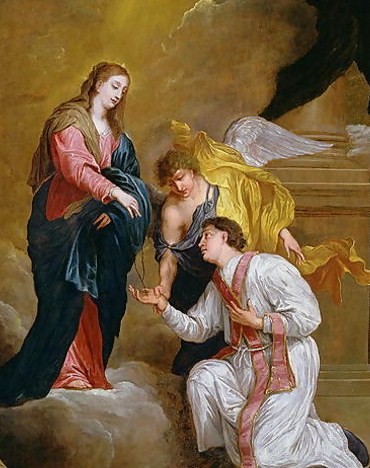
Painting of St. Valentine Kneeling

Painting of St. Valentine Kneeling

Saint Valentine is a mysterious figure. Some historians think that at least three different people in history shared the name Valentine. One legend says that Valentine was a Christian priest during the reign of Emperor Claudius II. Claudius had a hard time getting soldiers to fight his wars, so he forbid young men from marrying. Valentine disagreed with the emperor and performed secret marriages. When Claudius discovered Valentine’s actions, he threw the priest in jail. In this legend, Valentine was killed on February 14.

In another legend, Emperor Claudius wanted everyone to pray to the Roman gods. Valentine refused because he believed in the Christian religion. Claudius imprisoned Valentine for his disobedience. While Valentine was in jail, he fell in love with the prison guard’s blind daughter and gave her a note before he was killed. Suddenly, the girl could see again.

As time passed, people associated St. Valentine with lovers, and his day became a time when people hoped to find their sweethearts.