
How to Choose an Editor for a Self-Published Book

As those of you who read this blog regularly know, I am in the process of self-publishing my book, Passionate Crusaders: How the U.S. War Refugee Board Saved Jews and Altered American Foreign Policy during World War II. After reading some great books on self-publishing, I knew I needed a professional editor. It took a lot of work for me to find the editor that was right for my book. Hopefully this post will make the process of finding one easier for others.

Step One: Contact other self-published authors you admire and ask them for recommendations.

I’ve found that many self-published authors are happy to share the names of editors with whom they or someone they know has worked. Sometimes an author will include the name of an editor in the acknowledgements of his or her book, so that’s another way to build your list.

Step Two: Realize that you are not finished after step one.

Please don’t assume that you have the perfect editor for your book once you have a few names. You need to get to know your potential editors first by moving to step three.

Step Three: Visit the editor’s website to see how seriously this person views editing as a career.

If the spelling/grammar on the site is poor, you know it’s time to move on. (I’m not kidding—I’ve seen editor websites that had multiple spelling and grammar errors). Also, see what other services this person offers. Does he/she offer primarily editing and proofreading services, or is editing tacked on to a long list of other things? Most of the time, people who tell you that they can provide everything your book needs are better at some tasks than others. You don’t want to find out that their weakness is editing.  

Step Four: Find out if this person edits books in your genre/uses your style manual.

For example, as a history writer, I wanted someone with experience editing similar books and who could make sure my book conformed to the Chicago Manual of Style. An editor who worked exclusively on mystery novels might be talented, but not a good fit for my book.

Step Five: Initiate e-mail contact with a few editors and ask for basic information.

This will give you a chance to find out more about these people. You can ask about pricing, if they’re taking new clients, when they might be free to work on the book, etc. See if their writing style and personality fits with yours.

Step Six: Study the editors’ responses for mistakes or other quirks.

I got to this step with one editor and realized that she had misspelled my first name, which is in the dictionary. Needless to say, I didn’t hire her.

Step Seven: Ask the editors who are still on your list to copy edit a few pages of your book.

Before any freelance editors who are reading this get angry with me, I’m not saying that an editor can’t charge a fee for a sample of their work. However, self-published authors need to see how the right editor can transform their manuscripts. When I received my sample manuscript pages from the editor I later chose, I was amazed at how much he had improved my work. For example, after adding material to the first chapter, I forgot to include one historical figure’s title–secretary of war–the first time his name appeared. Fortunately, my editor saw my mistake, along with others.

Step Eight: Hire the editor who amazes you!

Catherine Ryan Howard Answers my Self-Publishing Question

My question: I’m told that my blogsite on (mostly) U.S. history should have an incentive for people to sign up and therefore learn more about my self-published book on the U.S. and the Holocaust. In your opinion, what’s a good freebie for a history blog?

Catherine’s answer: This wouldn’t be my area of expertise, Heather, but I think the simple answer is a preview of your book. Try to make it something that stands alone–like a chapter about a single topic–so they don’t HAVE to buy your book to appreciate it. Just a simple PDF will do. Make sure to put links in the end of it so if they want to buy your book, they can!

Guy Fawkes Day Celebrations in England and America

On November 5, 1605, Guy Fawkes planned to blow up King James I during a Parliament meeting by lighting over 20 barrels of gunpowder in the building’s cellar. The night before the planned attack, Fawkes hid in the cellar and covered the barrels with coals and fagots. Fawkes and a number of other Catholic men resented the anti-Catholic laws in England, and hoped to establish a Catholic government after they blew up the Protestant king. The plot’s mastermind, Robert Catesby, chose Fawkes for the task because he had recently returned from fighting a foreign war and wouldn’t be recognized easily.

Unfortunately for Fawkes and his co-conspirators, the Gunpowder Plot was discovered. Authorities arrested Fawkes that evening and tortured him on the rack to force him to name the other men. Catesby and four others were killed when they resisted arrest; Fawkes and the rest of the gang were found guilty of treason and executed.

In January of 1606, Parliament declared November 5 as a day of thanksgiving. According to tradition, children carried straw effigies of Guy Fawkes through the streets, asking passersby for “a penny for the Guy” so they could buy fireworks for the celebration. They recited verses from the poem “The Fifth of November,” which states “Remember, remember!/The fifth of November,/The Gunpowder treason and plot;/I know of no reason Why the Gunpowder Treason/Should ever be forgot!”

The holiday even spread to the American colonies, where it was referred to as Pope’s Day. Colonists did not focus on the figure of Guy Fawkes, but they did burn effigies of the Pope, the devil, and political enemies.

Lewes_Guy_Fawkes_Night_Celebrations_(7)_-_geograph.org.uk_-_1570233

Guy Fawkes Night Celebration in England. Photo by Peter Trimming.

Unlike Britain, which still celebrates the original holiday, America does not. During the American Revolution, the colonies needed the support of France, which was a Catholic country. It became politically incorrect for colonists to hold an anti-Catholic celebration.

In England, however, people celebrate Guy Fawkes Day with fireworks, bonfires, parties, and burnt effigies of Fawkes and unpopular politicians. Children still go door-to-door before the holiday asking for “a penny for the Guy,” which is similar to the American custom of trick or treating on Halloween. Guards also continue the tradition of searching the Houses of Parliament, just in case any plots like the one Fawkes and his conspirators planned are afoot.

7 Great U.S. War Websites

5ea86-6a0128764e57aa970c01538e4fcdba970b-800wiFor this week’s post, I decided to share some of the best websites I’ve found on wars in which Americans fought. The list includes the websites themselves as well as the reasons that I chose them. My list is by no means comprehensive. If you have a favorite website that covers one of America’s wars, please feel free to add it in the comment section.

Note: I have not included blogs here; perhaps I’ll add those in a future post.

U.S. Civil War

Civil War Academy.com

http://www.civilwaracademy.com

This site is most helpful for finding information about battles. It includes a description of each battle and lists other pertinent information. Its most unique feature is that it allows users to search for battles by state as well as name.

The Spanish-American War

The World of 1898: The Spanish-American War

http://www.loc.gov/rr/hispanic/1898/index.html

This site from the Library of Congress has an extensive list of non-American participants in its subject index, as well as a section on the literature of the period. Primary documents such as maps of Cuba and the Philippines at the time of war and the papers of Theodore Roosevelt are online.

World War I

First World War.com

http://www.firstworldwar.com

This extensive site includes battlefield maps, a day-by-day timeline, primary documents, a complete listing of battlefields with descriptions, an encyclopedia (people, places, events, and terms), photographs, and first-hand accounts. The Prose and Poetry section is also an interesting place to learn about authors affected by World War I.

World War II

The World at War

http://www.worldwar-2.eu

The World at War is a nearly day-by-day history of World War II. It also includes extensive information about the events leading up to the war.

Generals of World War II

http://www.generals.dk/

This detailed site offers information on the military careers of generals in WWII from all participating nations.

Vietnam War

The History Place Presents the Vietnam War

http://www.historyplace.com/unitedstates/vietnam/

This site offers a detailed timeline with quotes and analysis. Information on My Lai, Gulf of Tonkin, Kent State, and other war-related topics is included.

The American Experience: Vietnam

http://www.pbs.org/wgbh/amex/vietnam/

This site provides a glossary of important figures in the Vietnam War, maps, and basic U.S. government documents relating to the war. The Weapons of War section makes the site an especially good resource for details about the weapons the combatants used.

What is your favorite U.S. war website?

A Short History of American Opposition to Immigration

New Colossus: Emma Lazarus' poem at base of Statue of Liberty

New Colossus: Emma Lazarus’ poem at base of Statue of Liberty

“Give me your tired, your poor/Your huddled masses yearning to breathe free.” The words of Emma Lazarus inscribed at the base of the Statue of Liberty must have sounded ironic to many hopeful American immigrants. Even Lazarus’ poem hinted that immigrants would not be completely welcome, however. The poem’s next verse refers to them as “The wretched refuse of your teeming shore.” Refuse is another word for garbage. Immigrants throughout America’s history have been treated like garbage—often turned away from the country they saw as their only hope for a better life.

In the late nineteenth and early twentieth centuries, Asian and European immigrants trying to enter the U.S. faced strict immigration laws. The 1882 Chinese Exclusion Act, for example, suspended all Chinese immigration for ten years.

During the 1930s, Jews fleeing the Nazis received little aid from the U.S. government. In 1939, the St. Louis, a ship carrying over 900 Jewish refugees, was not allowed to land in Cuba. For weeks, the ship hovered near the U.S. coast, but President Franklin Roosevelt refused to give the passengers even temporary sanctuary. The ship returned to Europe, and many passengers later died in Nazi concentration camps.

Any immigrants who managed to come to America still experienced discrimination. Ironically, other immigrants who arrived in  America somewhat earlier often mistreated newcomers. In 1890, Jacob Riis wrote in How the Other Half Lives, “the once unwelcome Irishman has been followed in his turn by the Italian, the Russian Jew, and the Chinaman, and has himself taken a hand at opposition…against these latter hordes.”

Anti-Semitism was prevalent in the U.S. during the 1930s and 1940s. A poll from 1938 showed that Americans not only opposed Jewish immigration, but they disliked Jews more than any other minority. Even Jewish children were unwelcome. In response to a Congressional bill that would allow Jewish children to enter the country under the immigration quota, FDR’s cousin, Laura Delano, stated, “twenty-thousand charming children would all to soon turn into twenty-thousand ugly adults.”

Today many people still object to the immigration of people who are fleeing from poverty and violence in their home countries. Immigration reform is a hot-button issue in political campaigns across the U.S. Even with the background checks, fines, the requirement to learn English and having to wait in line for years behind legal immigrants under the comprehensive immigration reform bill, some Americans want to deport the eleven million immigrants who are living in the United States illegally. That number includes children who were brought to the U.S. by their parents.

The mindset of Americans toward immigration hasn’t changed much since the nineteenth century. The immigrants that some are seeking to keep out or deport may look different, but the desire to turn them away remains the same.

President Franklin Roosevelt and Few Civil Rights for African Americans

Despite the efforts of his wife Eleanor and African American leaders, President Franklin Roosevelt’s administration made little progress on civil rights.

New Deal programs discriminated against blacks. For example, under the Works Progress Administration, blacks received less pay than whites for the same work. This was especially true in the South. The discrimination was somewhat eased by the intervention of Eleanor Roosevelt, who personally viewed the struggles of blacks during visits to WPA projects. She wrote, “It is all wrong to discriminate between white and black men!”

FDR agreed to sign an executive order barring discrimination in the WPA. One million black families benefited from WPA wages. However, discrimination in other parts of the New Deal persisted. The Federal Housing Authority refused to help blacks trying to buy houses in white neighborhoods. The National Recovery Administration persisted in paying black workers less than whites. Even the Social Security Act excluded the menial jobs that most blacks held.

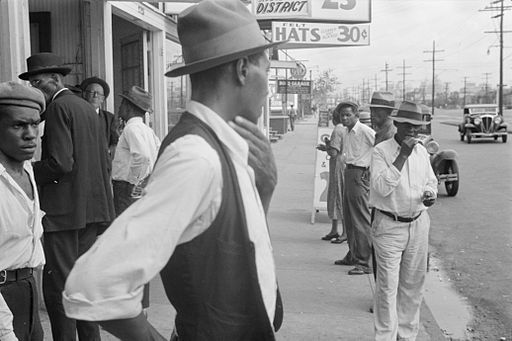
Applicants waiting for jobs in front of Federal Emergency Relief Administration office

Applicants waiting for jobs in front of Federal Emergency Relief Administration office, 1935

For black leaders, however, the most frustrating issue was FDR’s stance on the anti-lynching bill introduced in Congress in early 1934. Although twenty-six African Americans were killed by mobs the year before, FDR took no stance whatsoever on the bill. The Amsterdam News commented on FDR’s lack of support for the bill using the headline “Here’s Mr. Roosevelt’s Message on Lynching.” The article contained one sentence, “In his annual message to Congress last Friday President Roosevelt had the following to say about lynching:” That sentence was followed by a large blank space.

FDR tried to explain to African American leaders why he could not back the bill. He told NAACP Executive Secretary Walter White, “I did not choose the tools with which I must work.” In order get votes for New Deal programs, FDR felt he couldn’t antagonize Southern Democrats by supporting a bill they found offensive. He told critics “you have to wait, even for the best of things, until the right time comes.” Apparently FDR never thought there was a right time to support an anti-lynching bill. Although members of Congress proposed other anti-lynching bills during his long presidency, he never backed them.

In contrast to her husband, Eleanor publicly backed the anti-lynching campaign. When Walter White asked her to attend a NAACP art exhibit called “A Commentary on Lynching,” Eleanor lent her support. Interestingly, FDR did not attempt to stop his wife’s actions. Perhaps FDR agreed with her privately, but Eleanor’s actions also encouraged to blacks to switch their allegiance from the Republican party of Abraham Lincoln to FDR and the Democrats. Ever the politician, FDR was likely happy to have his wife express her feelings to get the African American vote while he placated Southern voters by saying nothing.

Sources:

The Eleanor Roosevelt Papers Project at George Washington University

The Roosevelts: An Intimate History by Geoffrey Ward and Ken Burns

No Ordinary Time by Doris Kearns Goodwin