
The Building of the Washington Monument

Washington Monument, Photo by David Bjorgen

Washington Monument, Photo by David Bjorgen

On December 6, 1884, the Washington Monument was finally completed. The word “finally” is appropriate since construction on the monument ended 85 years after George Washington’s death.

While Washington was still alive many people wanted to dedicate statues to him, but he declined. He thought the country should spend its money on other things. Shortly after Washington’s death, John Marshall proposed a memorial to the first president. The memorial was to be built in the style of the ancient Egyptian tombs with a pyramid serving as Washington’s burial place. However, Congress could not agree on the design.

Thirty-seven years later John Marshall, who was now Chief Justice of the Supreme Court, continued to fight for a memorial. In 1832 the Washington National Monument Society was formed. The society decided to hold a competition for the best design while collecting donations from citizens across the country.

Designs came in from around the world. The society required only that each design be “durable, simple, and grand.” Finally they chose a design by Robert Mills, a church architect from Charleston. Mills’ design included a temple with an Egyptian obelisk on top. Inside a colossal statue of Washington and a museum about Washington’s life were to be placed. Because the design was so expensive ($1 million in the 19th century), the society decided to start with the obelisk first.

The monument’s cornerstone was laid on July 4, 1848 with the same trowel that Washington used for the cornerstone of the capital. In a crowd of over 20,000 people that day were three future presidents, including a young congressman named Abraham Lincoln.

To raise money for the monument states were encouraged to donate commemorative stones to its interior. Even foreign countries donated stones to show their respect for the Revolutionary war hero and president. A controversy arose, however, when the Pope tried to donate a stone. Anti-Catholic groups stalled the construction.

During the Civil War the monument was again abandoned. Cattle grazed around it and soldiers practiced maneuvers in its shadow.

Congress decided to resume construction during the centennial of the Declaration of Independence in 1876. All the arguments about the design resurfaced. Congress was still short on money. This time, however, the US Army Corps of Engineers under Lieut. Col. Thomas Lincoln Casey was put in charge of the construction.

The country’s anniversary made both Congress and Casey eager to finish the monument. The design was scaled back. It was decided that the temple would not be constructed–only the obelisk. Despite these cost-cutting measures Casey still had several issues to deal with. For example, the scaffolding was rotted and there were flaws in the foundation of the monument. Casey’s crew reinforced the foundation with concrete. He also carried out the original plan to include the 193 memorial stones donated by states and countries into the interior walls.

The outside stones for the monument presented other problem for Lieut. Casey. The quarry used for the initial construction was no longer available. The builders ended up using two additional quarries with varying colors of stone. Today visitors can see three slightly different colored stones from the three different quarries on the outside of the monument.

On December 6, 1884 Lt. Col. Casey supervised as the capstone was brought out through a window and set on top of the monument. The aluminum tip made by Tiffany‘s was put into place by the lieutenant himself. At 555 feet and 5 inches the monument was the tallest structure in the world. However, the Eiffel Tower surpassed it the following year. Nevertheless, it is still the tallest structure in Washington DC and serves as a landmark for everyone who visits the National Mall.

The Washington Monument’s exterior and interior have endured quite a bit over the years. For example, in 2011 an earthquake struck 90 miles southwest of Washington DC. Though the monument was significantly damaged it was repaired successfully. The durability of the monument was anticipated at its dedication. During the ceremony, a speech by Robert Winthrop who had attended the opening ceremony in 1848 was read by Rep. John Long of Massachusetts. He said, “the storms of winter must blow and beat upon it…the lightnings of heaven may scar and blacken it. An earthquake may shake its foundations…but the character which it commemorates and illustrates is secure.”
My Book’s Back Cover Copy: Thoughts?

I’m looking for my readers’ opinions on my back cover copy for Passionate Crusaders: How Members of the U.S. War Refugee Board Saved Jews and Altered American Foreign Policy During World War II. Comments welcome!

Passionate Crusaders tells the gripping story of a few righteous Americans who sought to do what many thought impossible in 1944—save Jews who had not yet been murdered in the Holocaust.

By January 1944, Treasury Department officials Henry Morgenthau, John Pehle, and Josiah DuBois had already convinced President Franklin Roosevelt to create the War Refugee Board, an agency with the authority to provide rescue and relief for Jews and other groups persecuted by the Nazis.

Scholars have criticized the Board for its inability to save more Jews and maintained that the agency should have been created sooner. Heather Voight’s research shows that despite its shortcomings, the War Refugee Board changed history and forever altered American foreign policy. Its creation ended the cycle of indifference that the government and the American public had shown to victims of the Holocaust. In the words of Henry Morgenthau, from 1944-1945 “crusaders, passionately persuaded of the need for speed and action” risked their reputations and sometimes their lives to save Jews.

In addition to saving more than 100,000 lives, Board members also made a lasting impact on international law. They pressured the War Crimes Commission to broaden its definition of war crimes by including the murder of civilians by their own countrymen. This definition of war crimes was applied to genocides committed many decades later in Bosnia and Rwanda, and continues to be used today.

“[Passionate Crusaders] shows that the efforts of an honorable and courageous few can create small steps to change history. This detailed, well-told, and inspiring story will be of value to students of the Holocaust, American history, and human rights.” –From the Foreword by Dr. Leon Stein, Professor Emeritus of History and Education Director Emeritus, Illinois Holocaust Museum and Education Center.

Heather Voight is a successful freelance writer and history blogger. Since 2009, she has published articles on a variety of topics including the Gibson Girl, healthcare, and the writings of C.S. Lewis. She has a B.A. in History and English.

http://www.heathervoight.com

Why Isis the Ancient Egyptian Goddess has nothing in common with ISIS (Islamic State of Iraq and Syria)

Before the name ISIS (an acronym for Islamic State of Iraq and Syria) became synonymous with public executions and terror, a goddess with the name Isis was popular in ancient Egypt. The ancient Egyptian goddess Isis represented many positive values, such as protection, healing, and the importance of family. Clearly, she had nothing in common with the ISIS we read and hear about today.

According to ancient Egyptian mythology, Isis was the wife and sister of the god Osiris. Osiris ruled Egypt, and Isis supported his endeavors. Unfortunately for the couple, Osiris’ brother Seth wanted his brother’s power so badly that he murdered and then dismembered Osiris. Isis and her sister Nephthys mourned Osiris, but they did not sit around crying for long. Instead, the two women travelled to the ends of the earth to find Osiris’ remains and revive him: “Rise up, Osiris, for Isis has your arm and Nephthys your hand.” After Osiris’ resurrection, Isis conceived a son with him whom she named Horus. Osiris left Isis to care for their son and became the god of the underworld.

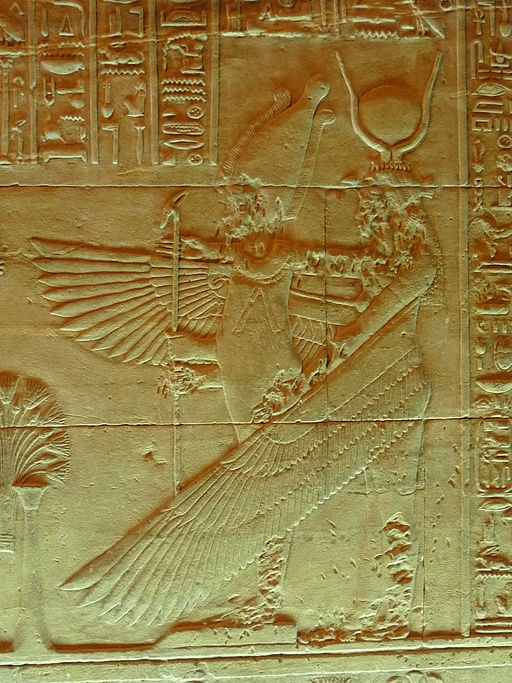
Osiris and Winged Isis, Isis Temple, Philae Island, Egypt. Photo by Remin.

Osiris and Winged Isis, Isis Temple, Philae Island, Egypt. Photo by Remin.

Proving that a woman’s work is never done, Isis now had to hide her son from the evil Seth. She proved to be a wonderful and protective mother. For example, she healed Horus when a scorpion stung him. Isis continued to watch over her son until he was old enough to fight Seth. Horus successfully avenged his father’s death and became king of Egypt, but he couldn’t have done it without his mother.

Ancient Egyptians associated Isis with motherhood, especially as the mother of Egyptian kings. Early Pyramid Texts state “the king drinks milk from his mother Isis.” At first the goddess could only be called upon to help Egyptian pharaohs, but later the nobility and even commoners could ask Isis for assistance. In a time with high mortality rates, ancient Egyptian mothers often recited spells that included the goddess in the hope that Isis would heal their sick children.

In addition to her role as a mother, Isis also served as the protector of the dead in the afterlife. She was often depicted on the sides of royal coffins with winged arms. With the wings of the goddess to carry their deceased loved ones to next world, Egyptians felt comforted even though they mourned the dead.

A faithful wife, loving mother, a healer of children, and a comforting presence to those who mourn—all qualities that the ancient Egyptians gave to their Isis. Unfortunately, the organization that now uses her name stands for none of these admirable traits.

Sources:

Daughters of Isis by Joyce Tyldesley

The Complete Gods and Goddesses of Ancient Egypt, Richard Wilkinson