The Education of Alexander Hamilton

Alexander Hamilton grew up on the island of Nevis in the British West Indies. The island was famous for its sugar plantations.

He didn’t attend the Anglican schools on the island but he got some home schooling. He learned French from his mother and read all the books he could get his hands on. Hamilton’s mother bought books for him and his brother James. It’s unclear what kind of education Rachel Hamilton had, but she made sure her sons read Machiavelli and Plutarch, along with some poetry and sermons. The boys became orphans when their mother died after an illness; their father James Hamilton left the family when the boys were younger.

Young Alexander was taken in by a merchant named Thomas Stevens. Hamilton became best friends with Stevens’ son Edward. He also got a chance to use his natural curiosity by doing interesting work. The firm Beekman and Cruger supplied whatever the sugar planters needed. Hamilton always viewed his apprenticeship there as the most useful part of his education. He learned to track freight, chart courses for ships, and calculate prices in different currencies throughout Europe.

Despite his interest in business, Hamilton wanted to move up in society. He hoped to go to college like his friend Edward Stevens who was studying in New York. In a letter to his friend, Hamilton wrote, “my ambition is so prevalent that I…would willingly risk my life, tho’ not my character, to exalt my station.” Fortunately for Hamilton, some of his poems and a letter he wrote describing a storm on the island were published in The Royal Danish American Gazette when he was seventeen. The local businessmen were so impressed with his writing that they raised money for him to sail to America and attend college.
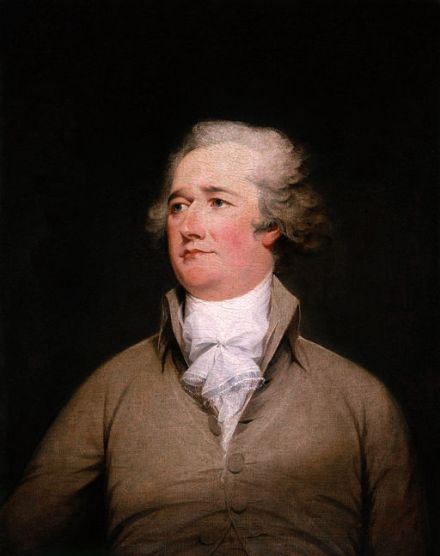
Alexander_Hamilton

Painting of Alexander Hamilton by John Trumbull, 1792

Though Hamilton was naturally intelligent, his lack of formal schooling meant that he needed to take some extra classes before applying to college. He studied Latin, Greek, and advanced math at Elizabethtown Academy (near Princeton). After completing those classes, he applied to Princeton. The school, however, wouldn’t let him take as many courses as he wanted. Hamilton attended King’s College in New York in 1773. King’s College was more conservative than Princeton and many staff members were Tories who supported the British monarchy.

Hamilton was in a hurry to catch up to other students who started college at a younger age than he did. Some speculate that he altered his birth year from 1755 to 1757 so he would seem closer in age to his fellow students. He spent his free time auditing classes and reading books in the university library.

While in college, Hamilton and his friend Robert Troup formed a club. The club focused on writing and debating—skills that Hamilton later drew on during his political career. The club also helped Hamilton refine his political views. He wrote anti-British pamphlets that clashed with the views of his college professors. Fortunately, his first political tract—a defense of the Boston Tea Party–was anonymous.
Play Ball! Introducing the Mesoamerican Ball Game

The Mesoamerican ball game became the New World’s first organized team sport. It seems to have started around 1600 B.C. No courts were discovered from that time—only balls. The first ball court was built by the Maya in 1400 B.C. at Paso de la Amada. 1,300 courts have been found all over Mesoamerica, though the size of the courts varies.

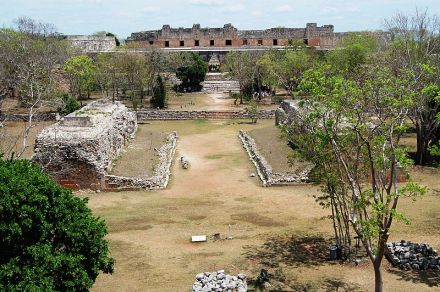
The only eyewitness account of the game comes from Spanish priest Diego Duran. He saw Aztec games played in the 1570s. At that time, courts were shaped like the letter I. They had a central alley with sloping walls. On top of the walls, spectators could watch the game. There was no standard size for the courts; they varied between 100-200 ft. Stucco floors painted with the city’s patron deity acted as a kind of mascot for the team.

800px-0104_Uxmal

A Mayan ball court in Uxmal, Mexico. Image by Tato Grasso, April 2007.

Aztec teams had between four and six players. They bounced a solid rubber ball back and forth using their buttocks and their knees. It was against the rules to use their feet or their hands. A center line was drawn down the court. The goal for each team was to get the ball back to the other side of the court by bouncing the ball only once on their side.

A team lost points if more than once bounce occurred or the ball went out of bounds. Points were earned by hitting the back wall of the opponent’s side. Most players guarded the back line so it was hard to score. A couple of players stayed up front to try and return balls. At the center line, rings were placed high up on the walls. If a team managed to get the ball through the ring they won automatically, but this was very difficult to do, especially without the use of their hands.

The ball was made of solid rubber and could kill a player if they were hit with it in the face or the stomach. Players who had survivable injuries viewed them as a badge of honor. Players often got injured because they didn’t have much protective gear. They wore only loincloths, thigh pads, and gloves.

Ball games were spectator sports. The audience bet on the outcome of the game, though nobles obviously bet more than the poor. People bet their land, crops, and some even sold themselves into slavery. Nobles had the best seats to watch the game. Afterward, the players expected them to throw gifts to the winning team. If some nobles tried to leave without giving anything to the winning team, those players were allowed to rob them.

The game served an important function in communities beyond just entertainment. Since each city had a team, disputes between cities could be resolved via a ball game. This solution was more practical and less bloody than starting a war.

Unlike many of today’s sports figures, Aztec ball players were unpaid and poor. They received some gifts and gambling earnings, but not enough to support themselves. Their payment came in the form of fame if they won. Many of the less successful players ended up as slaves to nobles.

The Mesoamerican ball game is still played today. It’s called Ulama de cadera, which means hip ball. Cancun brings in ball players to attract tourists. Guatemala has a national team and is trying to revive the game.

The Role of Aztec Kings

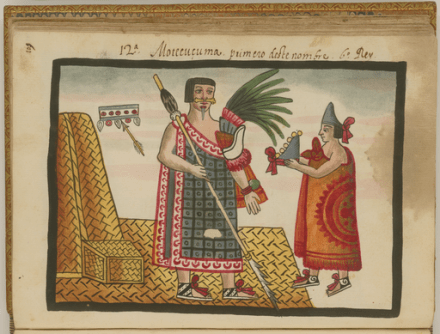
The king was at the top of the Aztec social hierarchy. They called him the Tlatoani, which meant speaker because he acted as a spokesman for his people. Unlike most European societies, the position was not hereditary. Nobles elected the king. At least in theory, the position was based on merit, though the son of a king might find ways to bribe the nobles.

An Aztec king had many privileges. He lived in a huge palace with hundreds of rooms. He also had hundreds of servants and slaves to tend to his every wish. The palace was decorated with handmade tapestries and murals. Since cleanliness was important to the Aztecs, the king had his own private bathroom where he bathed daily. If guests came to visit him, they also had their own bathrooms. Within the palace, the king housed his many wives. When he dressed, he put on embroidered clothing decorated with many feathers.

Moctezuma_I,_the_Fifth_Aztec_King_(Reigned_1440–69)_WDL6730

King Moctezuma I, reigned 1440-69. Image from Tovar Codex, 16th century.

Not only did he live in a palace, but he owned all the city lands. He gave grants of land to nobles, but only the king could decide who received a grant. Besides land grants, the king decided on all laws and taxes.

Despite all of the king’s privileges, he had great responsibilities. The king served as the high priest and oversaw many of the daily sacrifices to the gods. The Aztecs believed that their sun god, Tonatiuh, required regular gifts of human hearts to be made to him. Without these sacrifices, the sun would stop shining and the world would end. As high priest, the king was responsible for the continuation of the universe.

In addition to his religious duties, the king served as general of the army. He led his men into battle and made battle plans. He conquered other lands and generally enabled his people to feel secure.

The king not only led the army, but also led political relations with kings from other city states. He formed political alliances with their Tlatoanis. Alliances were often formed during elaborate state dinners. As many as 300 plates were set at the king’s table, which was piled high with the best food from the local markets. Singers and dwarfs provided entertainment during the dinner. After the feast, the king and his guests left and the servants who prepared the feast had their meal.

In general, the Aztecs expected their king to set a good example for others to follow and to provide them with a good life.

Travel Brochure for Aztec Capital of Tenochtitlan

The Aztecs didn’t have brochures in the fifteenth century. Based on their experiences with the Spanish conquistadors, they weren’t looking to attract many tourists, either. If they had a brochure for visitors to their capital of Tenochtitlan, however, it might have read something like this:

Welcome to Tenochtitlan!

The Aztec capital city of Tenochtitlan makes every city in the New World look small, and some in the Old World, too. An estimated 200,000 people live here, compared to 150,000 in fifteenth century Paris.

Murales_Rivera_-_Markt_in_Tlatelolco_3

Mural by Diego Rivera showing life in Aztec city Tenochtitlan

Places to visit include:

The City Zoo

Don’t miss seeing the zoo, the likes of which have never been seen by Europeans. The first section houses birds of prey such as eagles. The second section houses reptiles, mammals, and exotic birds. The Spanish call most of the mammals lions because they’ve never seen an ocelot or mountain lion before. These big cats are fed parts of sacrificial victims. The Spanish find this disgusting, but it is unwise to voice your opinion as a tourist. Among the reptiles you can see rattlesnakes, or as the Spanish like to call them, “snakes with music in their tails.”

Public Theater

Aztecs enjoy all kinds of art, and artists are treated with respect. The theater, or cuicacalli, which means house of song, has several different functions. It is both an opera house and a school of music for youth. Young people who have musical talent can come there and learn to play the drums, the flutes, or trumpets.

The theater is also the place where dances are performed for the community. Aztecs like to refer to dancing as “singing with your feet,” so singing and dancing are naturally performed under one roof.

Botanical Gardens

As you make your way around the city you will notice the fine public gardens. The finest garden in Tenochtitlan, however,  belongs to King Moctezuma. His palace houses plants from every part of Mesoamerica, even ones that should not be able to grow here. Between 300-500 gardeners check on the hundreds of plant species. If one species dies, then an expedition is sent out to get another sample.

Tlatelolco Market

Tlatelolco is the sister city of Tenochtitlan. When you walk through its marketplace, you can find merchants selling pottery, cloth, gold, and jewelry. Slave auctions also take place here. After shopping you will probably be hungry. The marketplace has many restaurants that serve food from all over Mesoamerica. Entertainment is available from street dancers and singers. Overall the marketplace is a great spot for families to spend time together and for residents to socialize.

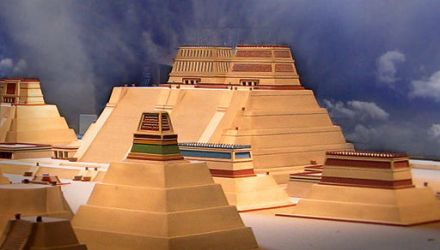
512px-Templo_Mayor_Tenochtitlan

Model of Templo Mayor by S. Shepherd, 23 Nov. 2006

Templo Mayor

Downtown you can see the Templo Mayor from a great distance. It is 60 meters tall, and has two flights of steps that lead to two temples at the top. Each temple is a different color–blue for the rain god, and red for the war god. Daily sacrifices are performed to appease the gods. The heart is cut out of the human being sacrificed. The Spanish are a bit queasy about this practice, but Moctezuma has warned them to act like the guests that they are in the city.