
Marriage in Ancient Egypt

Early marriage was encouraged in ancient Egypt. A suitable age for men was 20 but the bride would be younger, probably around 14 years old. There were no legal age restrictions on marriage so younger girls married too.

Ancient Egyptians usually married within the same social class. Marriages between cousins or an uncle and a niece were desirable because it would prevent splitting up family property. Though marriage between brothers and sisters happened within royal families, it wasn’t a widespread practice. Unfortunately the ancient Egyptian habit of using the words “brother” or “sister” as terms of affection made it seem that many more brother/sister marriages took place. Polygamy was also uncommon since a man needed to be rich to provide for many wives.

Marriages were agreed to by the father of the bride and the groom. Unlike modern weddings in western societies, there was no ceremony or exchanging of rings. The ancient Egyptians didn’t even have a word for “wedding.” The bride simply moved her possessions to her new husband’s home. Nevertheless, the ancient Egyptians loved parties so wedding banquets were likely.

The unceremonious nature of Egyptian marriage didn’t mean that couples felt no affection for each other. Indeed, the sheer volume of Egyptian love poetry indicates the opposite. One such poem begins: “My love is one and only, without peer, lovely above all Egypt’s lovely girls./On the horizon of my seeing, see her, rising,/Glistening goddess of the sunrise star bright in the forehead of a lucky year.” Ancient Egyptian statues and tomb portraits also portray husbands and wives sitting side by side. The husband’s arm might be around his wife’s shoulders or vice versa. Though the poses may not seem romantic to modern eyes, few other ancient civilizations showed that much affection between married couples.

Labit – A couple and their child – Reign of Thutmose IV – Egypt

Ancient Egyptian wives also had certain rights that other ancient married women did not. The wife was allowed to own property, and to have a share of any property acquired during the marriage. Ancient wisdom texts show the respect due to a wife. The Instructions of Ani exhort young men: “Do not control your wife in her house when you know she is efficient. Do not say to her ‘Where is it? Get it!’, when she has put it in the right place. Let your eye observe in silence. Then you recognize her skill.”

Wives, like husbands, could also initiate a divorce. Marriages dissolved in much the same way as they began. The wife usually returned to her family home, taking her possessions and her share of the property. Sometimes she received some financial support from her former husband. Marriages ended for various reasons. Sometimes the couple was incompatible, sometimes one party fell in love with someone else, or the wife was infertile and the husband wanted children. Having an infertile wife was not considered an appropriate reason for divorce, but it happened anyway.

Infertility was invariably blamed on women. The main point of ancient Egyptian marriage was to have children, especially sons who could continue the family name and make sure the proper rituals were performed for the parents after death. Wives needed many children to please their husbands, ensure security in marriage and to enhance their social status.

Yet children were not merely status symbols. Tomb scenes show affection of parents to both boys and girls. Though boys were preferred, there was no established tradition of female infanticide in ancient Egypt.

Marriages in ancient Egypt could also end through death. Young girls who married uncles were often widowed and women could die in childbirth. Tomb scenes show loving couples being reunited after death. Remarriage after widowhood was also common, with some ancient Egyptians remarrying multiple times.

Sources:

Ancient Egyptian Literature: An Anthology Translated by John L. Foster

Daughters of Isis: Women of Ancient Egypt by Joyce Tyldesley

Egyptian Life by Miriam Stead

Everyday Life in Ancient Egypt by Jon Manchip White
Tour of a Middle Class House in Ancient Egypt

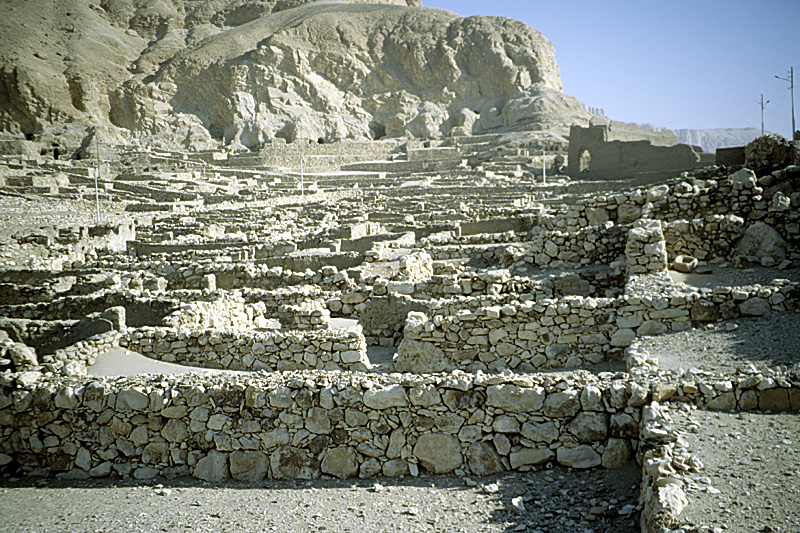
When historians discuss ancient Egypt, they often talk about how the pharaohs lived. Thanks to excavations at places like Deir el Medina, however, we know some things about the ancient Egyptian middle class. Deir el Medina was a village that housed craftsmen who worked on New Kingdom tombs of the Egyptian upper classes. Architects, carpenters, and other workers lived in this village with their families near the Valley of the Kings.

DeirMedinaVillage

Necropolis workmen’s village, Deir el Medina. Photo by Roland Unger.

Houses in the village were made of adobe brick. The houses stayed cool because windows were built into small rectangles and were high up on the walls to keep out direct sunlight. Doors were made of wood, and some could be locked from the inside. A would-be thief could easily break the fragile locks, but most workers in ancient Egypt had few goods to steal.

If you could walk into one of the workers’ homes, you would enter the hall first. This was a place where visitors were welcomed. You might compliment the lady of the house on the colorful drawings and shapes painted on the walls. This room would also have an altar to Bes, the goddess who protected families.

If your guest invited you to come farther into the home, you would enter the family space. This was the central room of the house where family members gathered each day. Most ancient Egyptians couldn’t afford furniture, though some of the workers’ families may have had wooden tables or stools in their family rooms. The room also had long benches built into the walls which were used as sofas or beds. Mats used for sleeping might also be in this room.

The house also had a basement for food storage, though guests probably didn’t go in there often.

In the back of the house was the kitchen. In ancient Egypt, this was one of the most important and busiest rooms. Here you would find a built-in clay oven and spaces for cooking utensils. Some ancient Egyptians even had a primitive refrigerator. They placed pottery filled with beverages in a pit deep in the ground. A tiny roof was placed over it to keep the drinks cool. Since the most common ancient Egyptian drink was beer, your guest would likely offer you one from his pit on a hot day.

Privacy was an unknown concept for the ancient Egyptian middle class. Their houses were small and usually only one story. Kids and adults didn’t have separate bedrooms. Ancient Egyptians also lived very close to their neighbors. There were no “backyards” because the next home was just feet away.


The Discovery and Translation of the Rosetta Stone

On July 19, 1799, a discovery was made that revealed much of what we know today about ancient Egypt. Napoleon Bonaparte
decided to extend his empire to the East and took forces with him to Egypt. In the process of digging a fort near the town of Rosetta, one of his soldiers found a strangely shaped black slab, which was inscribed with three different types of writing. The top, though damaged, contained Egyptian hieroglyphics; the center section was written in demotic, a form of shorthand writing of the Egyptian language; the lower part revealed Greek letters.

Rosetta Stone--British Museum by Nina Aldin Thune

Rosetta Stone–British Museum by Nina Aldin Thune

Until this discovery, almost nothing was known about the language of the ancient Egyptians. Ancient Greek was still familiar to scholars, however. The Greek part of the stone stated that the three sections of writing all said the same thing—they were descriptions of the decree issued by priests at Memphis on March 27, 196 BC to honor the anniversary of King Ptolemy V Epiphanes’ reign.  The British took possession of the Rosetta Stone in 1801 when they defeated Napoleon. Copies of the stone’s inscriptions were made and scholars all over Europe scrambled to be the first to solve the riddle of the hieroglyphics.

A breakthrough came when Thomas Young of England determined that at least some of the hieroglyphics represented letters of the ancient Egyptian alphabet. They were not purely a crude form of picture writing—for example, a hieroglyph that was shaped like a bird did not always refer to an actual bird. He identified the names of more than one Egyptian ruler in hieroglyphics.

Building on Young’s work, French Egyptologist Jean-Francois Champollion deciphered the hieroglyphics. He explained his findings in A Summary of the Hieroglyphic System of the Ancient Egyptians: “Hieroglyphic writing is a complex system, a script simultaneously figurative, symbolic and phonetic, in one and the same text in one and the same sentence, and I should say, almost one in the same word.” Some hieroglyphics represented letters of the Egyptian alphabet; some combined groups of sounds (for example, one hieroglyph represented letters that were commonly used together to save space), and some were added as pictures to clarify the meaning of a word.

Once the Rosetta Stone’s inscriptions were translated, scholars could learn more about the ancient Egyptians, their culture, daily lives, and religion. Since 1802, it has been displayed in the British Museum in London, though Egyptian archeologists are trying to bring the stone back to Egypt.