
The Childhood of U.S. President Jimmy Carter

On October 1, 1924, Jimmy Carter was the first future U.S. president to be born in a hospital. Most women at the time still gave birth at home, but Jimmy’s mother was a registered nurse.

Jimmy’s family lived in Plains, Georgia on South Bond Street. Their neighbors included Edgar and Allie Smith. When the Smith’s daughter Rosalynn was born in 1927, Jimmy went next door to see the baby. That marked the first time Jimmy saw his future wife.

In 1928, Jimmy’s father became a full time farmer. Jimmy and his sisters were raised on a farm two and a half miles from Plains in Archery. The town had a population of around 200 people. At first the farmhouse had no electricity or plumbing. Jimmy’s most vivid memories were of the cold because his room was the farthest from the stove and fireplaces.

Jimmy’s brother Billy wasn’t born until Jimmy turned twelve so he received a lot of attention from his father. He followed his dad around the farm whenever possible. His father encouraged him to earn money at an early age. Jimmy sold peanuts in Plains when he was only five years old. He maintained ten regular customers and also sold to shoppers visiting the town.

Most of Jimmy’s duties on the farm meant working in the field. He chopped cotton and hoed weeds. Jimmy felt restless doing small chores though. He wanted to “escape from the company of other children and women in just hoeing, picking cotton, and shaking peanuts and to graduate to the exalted status of a skilled plowman who could cultivate a crop.” In his father’s opinion, Jimmy never fully reached his goal. He was permitted to break land in the field at age twelve, however. Others viewed it as boring work, “but to me it was a great achievement.”
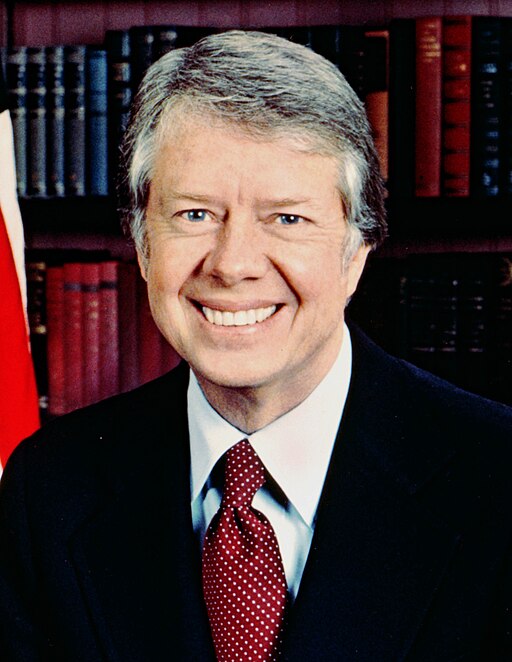
U.S. President Jimmy Carter, 1977

As Jimmy grew, he especially enjoyed doing carpentry with his dad. “I relished the repair of houses, barns, and storage places, and was eager to help when new farrowing pens were built for our sows and pigs,” Jimmy wrote years later.

In addition to his chores, Jimmy also played on the farm. Since the Carters were the only white family in Archery, his playmates were African American. They made their own toys, such as hoops, slingshots and guns. Even when he started school in Plains, Jimmy felt “more at home” with his black friends. The only rankings among him and the other kids revolved around who caught the biggest fish or performed best in the last baseball game.

At six years old Jimmy attended Plains High School where he had only white classmates. The school was one of the best in the state thanks to its superintendent. She took a special interest in Jimmy and gave him extra reading assignments. Jimmy’s parents also encouraged their children to bring books to the dinner table.

Jimmy was content on the farm, but his parents wanted him to finish high school, go to college, and join the navy. His mother’s youngest brother was in the navy and sent Jimmy souvenirs from countries like Australia and Japan. A naval appointment could only come from a senator or congressman, so Jimmy had to work hard in high school to get good grades. He didn’t receive an appointment when he graduated high school in 1941. Instead, he enrolled in Georgia Southwestern College and became a lab assistant.

The bombing of Pearl Harbor in December 1941 changed Jimmy’s life. After his sophomore year in college, he finally received his appointment and entered the Naval Academy in 1943.

Sources:

Jimmy Carter A Full Life: Reflections at Ninety by Jimmy Carter

Gift of Peace: The Jimmy Carter Story by Elizabeth Raum

Queen Liliuokalani: Hawaii’s Last Queen

In 1959, Hawaii officially became America’s fiftieth state. Before any Americans arrived, however, Hawaii was a free nation governed by one ruler. Hawaii’s last monarch, Queen Liliuokalani, sought a peaceful resolution with America but also wanted to keep her title. Instead, she lived to see her nation taken over by another country.

As early as age four, Liliuokalani felt the influence of Americans in Hawaii. In 1842, she attended a school for Hawaiian royal children, where she received lessons from missionaries from New England. Some of the lessons, such as English and music, were useful to Liliuokalani when she became queen.

The missionaries, Amos and Juliette Cooke, did more than insist that the children do homework, however. At the Royal School, Liliuokalani learned to pray to one god instead of many. No one at the school called Liliuokalani by her real name. Instead, she was given the Christian name Lydia. The Cookes also made the children wear more clothing than they were used to out in the warm climate of Hawaii, and they ate less. Liliuokalani wrote later, “It seems to me that they failed to remember that we were growing children. A thick slice of bread covered with molasses was usually the sole article of our supper.”

At age sixteen, Liliuokalani married an American named John Dominis. He served as an advisor to Hawaii’s king. King Kamehameha V noticed young Liliuokalani’s musical talent and asked her to write a national anthem for Hawaii. She wrote it in both Hawaiian and English. It read in part, “Grant Thy peace throughout the land/O’er these sunny, sea-girt Isles/Keep the nation’s life O Lord/And upon our sovereign smile.”

When King Kamehameha died, Liliuokalani’s brother became king. By the 1870s, more Americans came to Hawaii. These Americans were businessmen, not missionaries. They bought Hawaiian land and grew sugarcane on it. By shipping sugarcane around the world, Americans in Hawaii became rich.

Liliuokalani’s brother, King Kalakaua, wanted native Hawaiians and Americans to get along. To accomplish his goal, Kalakaua made a treaty with President Grant. The treaty said that American sugar growers could ship their sugar without paying taxes, and that only the United States could use Hawaii’s harbors. Kalakaua thought the treaty would create better relations with Americans, but it just made Americans richer by helping them stockpile their money. When her brother signed away Hawaii’s harbor, later known as Pearl Harbor, Liliuokalani wrote, “King signed lease of Pearl river to U. States for eight years. It should not have been done.”

One day, a group of Americans stormed Ionlani Palace where the king lived. They had weapons and demanded that he sign a new constitution that gave Americans the power to make Hawaii’s laws. A few years later, King Kalakaua, who had become only a figurehead in Hawaii, died with no heir.

His sister Liliuokalani was crowned queen. She worked hard to return her country back to native Hawaiians. She wrote a new constitution that gave her the right to rule. The Americans rejected it. When an American named Sanford Dole took over as Hawaii’s leader, she appealed to President Cleveland for help. Cleveland supported Liliuokalani, but failed to convince Dole to step down. Some of Liliuokalani’s loyal supporters in Hawaii tried to overthrow the new government, but they only managed to imprison themselves and their queen.

The new government locked Liliuokalani away for eight months, during which she was forced to sign away her rights to the throne. When she was released in 1895, she traveled the United States, unsuccessfully trying to gain support for Hawaii’s independence from America.