My History Book FREE on Amazon Kindle this Sunday

To my readers: My book, Passionate Crusaders: How Members of the US war Refugee Board Saved Jews and Altered American Foreign Policy during World War II, will be FREE Sunday, March 29 here:

http://amzn.to/1GDI2qq on Amazon Kindle. If you don’t have a Kindle but know someone who likes free books, spread the word! Thanks.

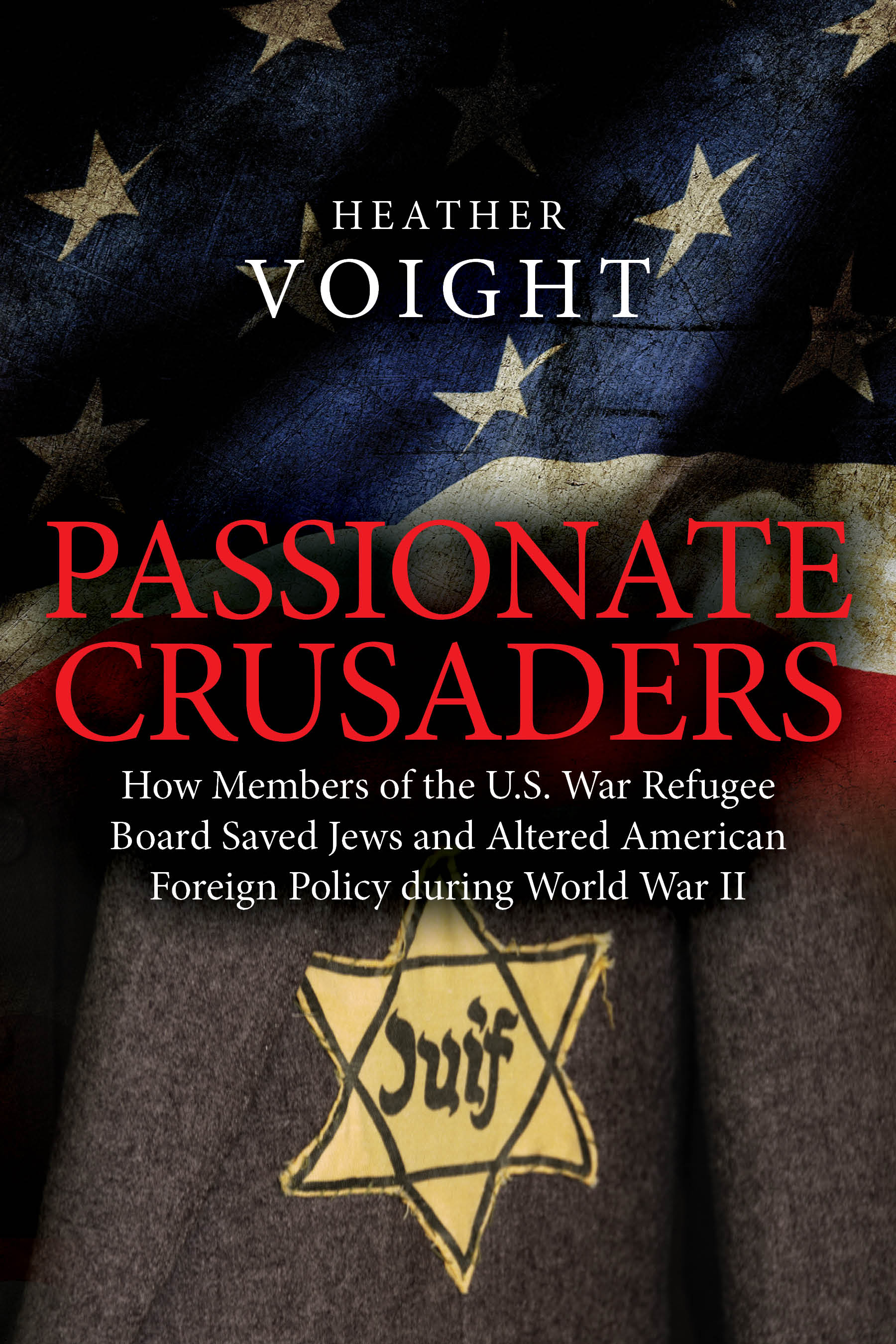
Passionate Crusaders: How Members of the US War Refugee Board Saved Jews and Altered American Foreign Policy during World War II

Passionate Crusaders Cover LARGE EBOOK

My book is now available on Amazon as a Kindle e-book and paperback:

http://amzn.to/1GDI2qq

My History Book is Finally Published!

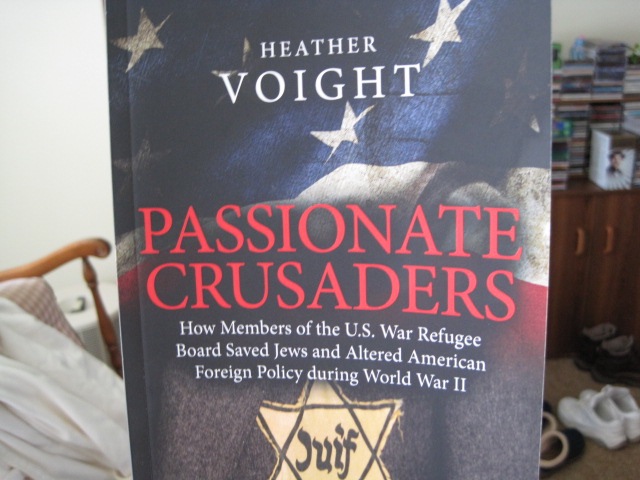
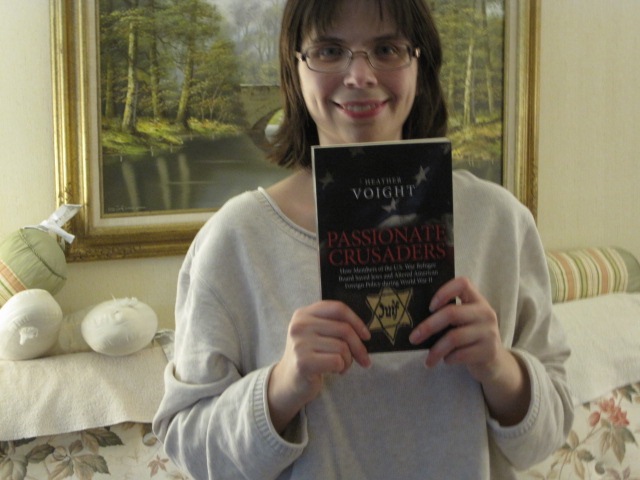
My proof copy of my book, Passionate Crusaders: How Members of the U.S. War Refugee Board Saved Jews and Altered American Foreign Policy during World War II arrived in the mail this week. After finding, as my friend’s daughter would say, a couple of “uh-ohs” in the proof, it’s finally done. I promised to limit myself to a few photos and my Amazon link for my fellow history buffs.

http://www.amazon.com/Passionate-Crusaders-Members-Refugee-American-ebook/dp/B00UEMCYQW/ref=sr_1_1?ie=UTF8&qid=1426289159&sr=8-1&keywords=passionate+crusaders

My book's selfie

My book’s selfie

IMG_0468

Reading my book with my favorite dog, Zoey

IMG_0469

One happy author!

Isn’t my cover designer (Jane Dixon-Smith) great?

My Book’s Back Cover Copy: Thoughts?

I’m looking for my readers’ opinions on my back cover copy for Passionate Crusaders: How Members of the U.S. War Refugee Board Saved Jews and Altered American Foreign Policy During World War II. Comments welcome!

Passionate Crusaders tells the gripping story of a few righteous Americans who sought to do what many thought impossible in 1944—save Jews who had not yet been murdered in the Holocaust.

By January 1944, Treasury Department officials Henry Morgenthau, John Pehle, and Josiah DuBois had already convinced President Franklin Roosevelt to create the War Refugee Board, an agency with the authority to provide rescue and relief for Jews and other groups persecuted by the Nazis.

Scholars have criticized the Board for its inability to save more Jews and maintained that the agency should have been created sooner. Heather Voight’s research shows that despite its shortcomings, the War Refugee Board changed history and forever altered American foreign policy. Its creation ended the cycle of indifference that the government and the American public had shown to victims of the Holocaust. In the words of Henry Morgenthau, from 1944-1945 “crusaders, passionately persuaded of the need for speed and action” risked their reputations and sometimes their lives to save Jews.

In addition to saving more than 100,000 lives, Board members also made a lasting impact on international law. They pressured the War Crimes Commission to broaden its definition of war crimes by including the murder of civilians by their own countrymen. This definition of war crimes was applied to genocides committed many decades later in Bosnia and Rwanda, and continues to be used today.

“[Passionate Crusaders] shows that the efforts of an honorable and courageous few can create small steps to change history. This detailed, well-told, and inspiring story will be of value to students of the Holocaust, American history, and human rights.” –From the Foreword by Dr. Leon Stein, Professor Emeritus of History and Education Director Emeritus, Illinois Holocaust Museum and Education Center.

Heather Voight is a successful freelance writer and history blogger. Since 2009, she has published articles on a variety of topics including the Gibson Girl, healthcare, and the writings of C.S. Lewis. She has a B.A. in History and English.

http://www.heathervoight.com

7 Great U.S. War Websites

5ea86-6a0128764e57aa970c01538e4fcdba970b-800wiFor this week’s post, I decided to share some of the best websites I’ve found on wars in which Americans fought. The list includes the websites themselves as well as the reasons that I chose them. My list is by no means comprehensive. If you have a favorite website that covers one of America’s wars, please feel free to add it in the comment section.

Note: I have not included blogs here; perhaps I’ll add those in a future post.

U.S. Civil War

Civil War Academy.com

http://www.civilwaracademy.com

This site is most helpful for finding information about battles. It includes a description of each battle and lists other pertinent information. Its most unique feature is that it allows users to search for battles by state as well as name.

The Spanish-American War

The World of 1898: The Spanish-American War

http://www.loc.gov/rr/hispanic/1898/index.html

This site from the Library of Congress has an extensive list of non-American participants in its subject index, as well as a section on the literature of the period. Primary documents such as maps of Cuba and the Philippines at the time of war and the papers of Theodore Roosevelt are online.

World War I

First World War.com

http://www.firstworldwar.com

This extensive site includes battlefield maps, a day-by-day timeline, primary documents, a complete listing of battlefields with descriptions, an encyclopedia (people, places, events, and terms), photographs, and first-hand accounts. The Prose and Poetry section is also an interesting place to learn about authors affected by World War I.

World War II

The World at War

http://www.worldwar-2.eu

The World at War is a nearly day-by-day history of World War II. It also includes extensive information about the events leading up to the war.

Generals of World War II

http://www.generals.dk/

This detailed site offers information on the military careers of generals in WWII from all participating nations.

Vietnam War

The History Place Presents the Vietnam War

http://www.historyplace.com/unitedstates/vietnam/

This site offers a detailed timeline with quotes and analysis. Information on My Lai, Gulf of Tonkin, Kent State, and other war-related topics is included.

The American Experience: Vietnam

http://www.pbs.org/wgbh/amex/vietnam/

This site provides a glossary of important figures in the Vietnam War, maps, and basic U.S. government documents relating to the war. The Weapons of War section makes the site an especially good resource for details about the weapons the combatants used.

What is your favorite U.S. war website?

World War II Begins as Germany Invades Poland

When Hitler invaded Poland on September 1, 1939, he felt sure of two things. First, he believed that Germany’s attack on Poland would be swift and successful. Second, he thought Britain and France would not respond to the attack with force. Only one of Hitler’s assumptions proved correct.

The attack was quick and it was a success. German air and armed forces were much more advanced than their Polish counterparts. Poland possessed 600 tanks to Germany’s 3,200. Unlike the Germans, the Poles still had cavalry as part of their army divisions.

In the early morning of September 1, German aircraft bombed Warsaw. Meanwhile, the German army invaded Poland from the north and south. During multiple air raids, the Germans targeted railroads, roads, and Polish troops. Villages were also bombed in order to terrify civilians. Hitler wanted the civilians to attempt to escape and thus block Polish reinforcements from using the remaining roads.

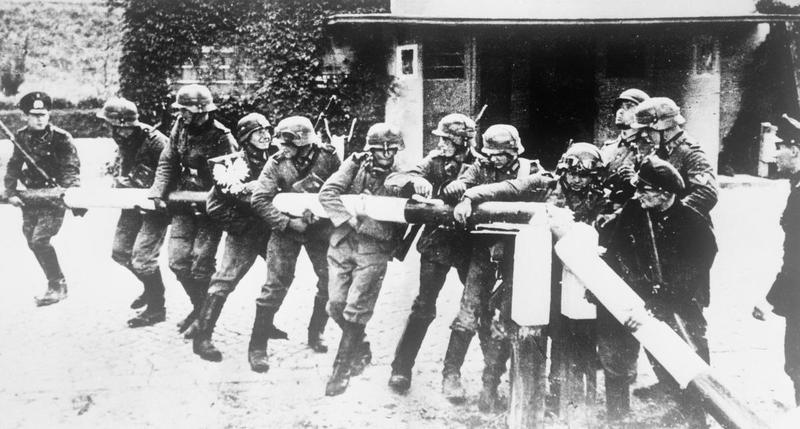
German troops breaking border barrier

German troops breaking border barrier in Polish town. September 1, 1939

Though he successfully conquered Poland a few weeks later, Hitler miscalculated British and French attitudes to his takeover. He knew that Britain and France had agreed to aid Poland in the spring of 1939 if she came under attack. Still, Hitler wasn’t very worried about a military response from either country.

To avoid war with Germany in previous years, Britain and France had already granted Hitler’s demands for German rearmament. They also allowed him to make Austria and Czechoslovakia part of the Third Reich. He thought a takeover of Poland would be followed by more peace talks, not war. Yet leaders in Britain and France had already concluded that Hitler’s demands might never end unless they threatened war.

On the evening of September 1, Poland asked Britain and France to honor their promise to defend Poland. That same day, British Prime Minster Neville Chamberlain delivered a speech to the House of Commons. He said, “Eighteen months ago in this House I prayed that the responsibility might not fall upon me to ask this country to accept the awful arbitrament of war. I fear that I may not be able to avoid that responsibility.” On September 3rd, Britain’s ambassador to Germany delivered an ultimatum stating that if Germany did not stop its attack on Poland by 11 AM, Britain would go to war with Germany. Germany did not respond, and Britain’s Prime Minster made an announcement on the radio that the country was at war with Germany.

The Detroit Race Riots of 1943

The riot that broke out on the evening of June 20, 1943 at a popular beach park wasn’t the first sign of racial tensions in Detroit. During World War II, Detroit, a town already known for its manufacturing plants, produced one-third of America’s military equipment. The demand for blue-collar workers grew, and thousands of Southern African Americans flooded the city. They wanted better pay and better treatment than they received in the South’s sharecropping system.

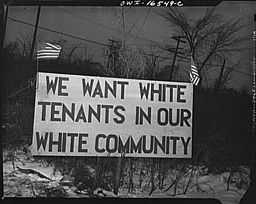
By the early 1940s, one major problem existed: the manufacturing plants provided jobs but not housing. Where would the new migrants live? White workers made it clear that they didn’t want to live next door to African Americans. Across town signs like “we want white tenants in our white community” were put up. Detroit Mayor Edward Jeffries finally succeeded in obtaining some additional housing for blacks, but his efforts required a show of force. Blacks moved in to their new neighborhood only after the Detroit police and the National Guard escorted the new tenants.

256px-White_sign_racial_hatred.

Life Magazine printed an article in August 1942 that predicted a larger clash between whites and blacks. The article said, “If machines could win the war, Detroit would have nothing to worry about. But it takes people to run machines and too many of the people of Detroit are confused, embittered and distracted by factional groups that are fighting each other harder than they are willing to fight Hitler. Detroit can either blow up Hitler or it can blow up the U.S.” The article proved to be prophetic.

On a hot summer day in 1943, tensions between the two races boiled over again. To escape the heat, over 100,000 Detroit residents went to an integrated beach called Belle Isle. The majority of the beachgoers were black. At first, small fights broke out among black and white teenagers. Black youths mugged whites, and white and black teens got into fistfights. By evening, however, the situation escalated. People tried to leave the island for the mainland, causing traffic jams. Stuck on the Belle Isle Bridge, a fight started between 200 blacks and white sailors. On the mainland, thousands of whites threatened blacks trying to cross. Though the Detroit police arrested dozens, rioting had already spread to other parts of the city.

Rumors only made the riots worse. Among whites, a rumor spread that blacks had murdered a white woman on the bridge. Among blacks, a similar rumor claimed that whites threw a black woman and her baby off the bridge. Whites attacked patrons exiting a theater patronized by African Americans. Streetcars filled with black people trying to go to work were stopped and passengers were thrown out. African Americans smashed windows of white owned stores and attacked anyone with white skin, including a doctor responding to an emergency call.

After nearly twenty-four hours of chaos, Michigan Governor Harry Kelly finally asked President Franklin Roosevelt to send in National Guard troops. Federal troops arrived the following morning and restored order. The riots left twenty-five African Americans and nine whites dead. Almost 1,000 people were injured.

Surprising Facts about Eleanor Roosevelt

Official White House Portrait of Eleanor Roosevelt

Official White House Portrait of Eleanor Roosevelt

  • She was very shy. Though she did a lot of public speaking as First Lady, Eleanor Roosevelt was a shy child. Even as a teenager, she worried that she would not attract a husband. Despite her worries, Eleanor became the first wife of a U.S. president to hold press conferences, speak at a national party convention, and write her own newspaper column. As she looked back on her life, Eleanor hoped others would see that “in spite of timidity and fear, in spite of a lack of special talents, one can find a way to live widely and fully.”
  • First wife of a president to drive a car by herself. As First Lady, Eleanor insisted on driving her own car, and wanted to go for drives without the Secret Service. President Franklin Roosevelt’s concern for her safety caused Eleanor to make some compromises. She sometimes traveled with a private bodyguard, and she also learned how to shoot a small gun. She admitted to the readers of her newspaper column that she was not an expert, but “if the necessity arose, I do know how to use a pistol.”
  • Loved to fly in airplanes and wanted flying lessons. Eleanor was the first president’s wife to ride in an airplane, and she told her friend Amelia Earhart that she hoped FDR would let her take flying lessons. FDR said no to the lessons, but that didn’t stop Eleanor from traveling by plane. Most Americans thought flying was dangerous in the 1930s, so Eleanor’s frequent plane rides helped airlines change some people’s minds.
  • Helped African Americans serve as pilots in World War II. In 1941, Eleanor traveled to the Tuskegee Institute, which provided education and job skills for African Americans. The Institute had an aviation program so students could learn to fly. Many hoped to be included in the air force in World War II, but the public doubted if blacks could really be good pilots. When Eleanor visited the program, she asked to fly with one of the Tuskegee pilots. He flew her over Alabama for an hour. After the flight, the pilot and Eleanor had their picture taken in the plane. The photo of the smiling First Lady sitting next to a black pilot made people think that African Americans might be competent airmen. With a little help from Eleanor, President Roosevelt decided to use Tuskegee pilots in combat.

Raoul Wallenberg and the Rescue of Jews During World War II

As a young man growing up in Sweden, Raoul Wallenberg couldn’t figure out what he wanted to do with his life. His family expected him to become a banker, but his grandfather also wanted him to travel Europe. Wallenberg thought traveling to foreign countries was exciting, so with his grandfather’s blessing he worked for a branch of the family’s bank in Haifa, Palestine. Since he arrived in Palestine during the 1930s, the boarding house where he stayed at night was filled with Jewish families who recently fled Germany. Adolf Hitler was in power and the Nazi party placed harsh penalties on the Jews, making it difficult for them to earn a living or even walk the streets without fear of being beaten.

 Traveling Europe after World War II

Bored with his work, Wallenberg left the bank. After World War II began, he met a Jewish businessman named Koloman Lauer from Hungary. Wallenberg’s home country stayed neutral during the war, but Hungary’s alliance with Germany made it impossible for native Jewish businessmen to travel in Europe. Instead, Lauer hired Wallenberg to travel on his behalf. Though Wallenberg enjoyed traveling, what he saw in Nazi-occupied territories like Hungary disturbed him. He encountered Nazis beating Jews in the streets and saw families rounded up and sent to so-called labor camps where they seemed to disappear. Wallenberg’s family was Jewish and he wanted to do something help, but he didn’t know what he could do.

 Wallenberg’s Assignment

Finally, in 1944, Wallenberg received the opportunity to aid Europe’s Jews. The United States had just formed the War Refugee Board, which was designed to provide rescue and relief programs for European Jews. The Board’s representative in Sweden needed a Swedish diplomat who could travel to Budapest, Hungary and rescue Jews there. Wallenberg’s boss mentioned his name to the WRB representative in Sweden, Iver Olsen. Olsen met with Wallenberg and warned him of the dangers of his mission. Wallenberg didn’t care about himself—he just wanted to do something to stop the Nazis.

 Efforts to Protect Hungarian Jews

When he arrived in Hungary, Wallenberg decided the best way to protect Jews was to provide them with Swedish identification badges. The badges proved that these Jews had ties to the neutral country of Sweden and therefore could not be deported by the Nazis. When Wallenberg ran out of official badges, he printed his own. Approximately 7,000 Hungarians received protective badges. Wallenberg also turned large houses in Budapest into Swedish safe houses and allowed Jewish people to live in them. Each house flew the Swedish flag, signifying neutral territory. The badges and safe houses all served the purpose of protecting Jews from deportation to concentration camps where Jews were killed. With the help of a Jewish staff, Wallenberg also worked on other projects, like setting up hospitals and soup kitchens for needy Jews.

Opposition

Despite Wallenberg’s best efforts to protect Hungarian Jews, the Nazis sometimes tried to defy him. On one occasion, he returned to the safe houses and discovered German troops rounding up all the able-bodied Jewish men. When the German patrol refused to leave, Wallenberg said, “As long as I live, none will be taken out of here. First you will have to shoot me.” The Nazis decided against making an enemy out of Sweden by killing Wallenberg, so the patrol left. Unfortunately, they returned later to snatch a handful of Jews and placed them on a train bound for a concentration camp. Undaunted, Wallenberg sped away in his car and caught up with the train. He shouted for the Jews onboard to show their papers, and anyone with Swedish papers returned to the safe houses with him.

Results of Wallenberg’s Work

Wallenberg’s massive efforts helped save tens of thousands of Jews. Though Wallenberg mysteriously disappeared when the Soviet Army arrived in Budapest in 1945, he left a legacy of helping others even when the task endangered his life.