Frequently Forgotten U.S. President Chester Arthur

As President Garfield lay dying, his vice-president Chester Arthur tried to avoid being seen in public. Arthur was initially blamed for Garfield’s death. Of course it didn’t help that Garfield’s killer wrote to congratulate him on becoming president!

In addition, Arthur and Garfield had a strained relationship. As vice-president he opposed Garfield’s defiance of Roscoe Conkling. Conkling had helped Arthur get a post as New York’s Customs Collector during the Grant administration. While Arthur was never charged with corruption, he cheerfully allowed it. When he was fired from his post by the reform minded President Hayes, Arthur became the president of New York’s Republican committee.

256px-Carthur

Official Presidential Portrait of Chester A. Arthur, 1885

Despite the rumors Arthur didn’t want to become president. He genuinely wept when Garfield died. The job bored him so much that he lived for fishing and vacations.

Yet Arthur was determined to clean up his image. He decided to break with his old cronies and actually expanded civil service reform. He also took an interest in preserving the country’s natural resources and was especially concerned with deforestation in the West.

One of the few things Garfield enjoyed about being president was entertaining. He sold almost anything in the White House in order to pay for redecorating projects and hired Tiffany’s to help. Once he thought the place was presentable, the president held black tie dinners every week. The dinners included up to 14 courses and various wines. He had no hostess, though. His wife died before he became president.

Arthur could not run for re-election because he had contracted Bright’s disease. He died soon after leaving office.

Frequently Forgotten President James A. Garfield

James Garfield was raised by a single mother in Ohio (his father died when he was two years old). He managed to save enough money to get through school. After college Garfield had various jobs as a preacher, professor, and college president. Garfield was never satisfied with any of these occupations or with having just one girlfriend. He courted his future wife Lucretia for so long that she was ready to give him up, but he finally grew into a devoted family man.

When the Civil War began Garfield served as the country’s youngest major general. President Lincoln convinced him to resign his commission, however, when his home state elected him to Congress. Garfield never lost an election and served for nearly two decades.

256px-Jgarfield

Official presidential portrait of James Garfield

During the 1880 Republican convention Garfield’s name was put forward, though he tried to object. In a crowded field that included former President Grant, Garfield won the nomination. With the help of powerful Republican Senator Roscoe Conkling he narrowly won the presidency, too.

Ironically, Garfield and Conkling were soon pitted against each other in an argument over federal appointments. Though Garfield had nominated some of Conkling’s friends for other positions, he appointed one of Conkling’s rivals to the New York Customs House.

Garfield surprised Conkling and almost everyone else when he refused to back down. “This…will settle the question whether the President is registering clerk of the Senate or the Executive of the United States,” he said. It seemed that the country had finally found a strong chief executive.

Only a few month into his presidency, a young man who had unsuccessfully sought a position in the government shot Garfield. Garfield lingered for months. An early air conditioning unit was installed in the White House to keep Garfield cool in the summer. Alexander Graham Bell even tried to find the location of the bullet, which remained inside the president, with a new electrical invention. After being moved to the Jersey shore, however, Garfield died.

Frequently Forgotten President Rutherford B. Hayes

256px-Rhayes

Official Presidential Portrait of Rutherford B. Hayes 

Rutherford B. Hayes is the first in my new series of frequently forgotten U.S. Presidents.

Like President Grant, Hayes had personal integrity, but his presidency was tainted by the very corruption he deplored. During the 1876 presidential election Hayes’ Republican supporters disputed the electoral votes in a few southern states. Republicans promised that Hayes would withdraw federal troops in those states if elected, which he did.

The southern states did not keep their promise to grant civil rights to blacks, however. Though he made other reforms, Hayes’ troop withdrawal delayed the civil rights movement until the 20th century.

The circumstances of his election caused some to label Hayes as “His Fraudulence.” Hayes did gain some support from the public by promoting civil service reform. He signed an executive order that stated that people in public office would be fired only in the best interest of the government regardless of their political affiliations. Hayes followed through on this by firing future Republican president Chester Arthur who used his position at the New York Customs House to help other Republicans.

Though he had pledged to serve only one term, he couldn’t have run again if he wanted to because so many Republicans were angered by his efforts to root out corruption. He managed to accomplish some changes, however.

He had the first telephone installed and was the first president to have a college-educated wife. He and “Lemonade Lucy” banned alcohol from White House dinners. After leaving office he became one of the most active ex-presidents, supporting causes like black education and prison reform.

Lincoln’s Former General: The Presidency of Ulysses S. Grant

As a young man Grant hated working in his father’s leather business. He didn’t especially want to go to West Point either but thought it a better alternative to manufacturing. The “S.” in his name was a typo made on his application to West Point. Grant kept the initial and was affectionately known as U.S. Grant during the Civil War.

Although West Point graduates were in demand, Grant had a tough time getting a position in the army due to his heavy drinking. His talents outweighed his faults, however. Grant was the first man since George Washington to earn the permanent rank of lieutenant general. That rank gave him the responsibility for the Union’s strategy.

Though he was a hero to Northerners at the end of the war, Grant still had to earn a living. With a family to support, he reluctantly went to work for the family leather business. In 1868 Republicans and Democrats both wanted the hero of the Civil War to run for president. He ran as a Republican. Though he was a great leader during the war, Grant had no political experience. It’s one thing to fight a war with a clear enemy–quite another to determine who one’s enemies are in the game of politics.

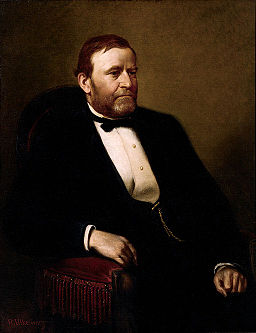
Ugrant

Official Presidential Portrait of President Grant

Grant’s greatest problem as president was his trusting nature. Though honest himself, he surrounded himself with others who were not. He also felt inferior to intellectuals and tended to follow Congress’ lead. As a result his presidency was marked by multiple scandals. For example, his secretary of war was accused of accepting bribes from merchants who traded at army posts with Native Americans.

After two terms in office the administration’s scandals prevented him from trying for a third term. His trusting nature failed him again when he became a victim of Wall Street fraud.

Knowing that Grant was broke, his friend Mark Twain suggested that he write his memoirs in order to make money. Grant had just started writing when he developed throat cancer. He was determined to finish his memoirs before he died, however, and they are still selling today. Unsurprisingly, they focus on the time period that brought Grant the most success: the Civil War.