President Abraham Lincoln, The Moral Politician

In honor of Presidents’ Day weekend and African-American History Month, I am revisiting this post from last year on Abraham Lincoln.

Until the 1850s Abraham Lincoln was a frustrated one-term congressman who had decided to focus on his law practice. Lincoln was drawn into politics again during the Kanas Nebraska Act controversy. While he accepted slavery where it existed, he couldn’t abide its expansion into new territories.

He was not in favor of giving blacks full citizenship, however. In 1840 he criticized Martin Van Buren for voting to enfranchise blacks, and he did not support giving blacks the vote in his bid for the U.S. Senate against Stephen Douglas. He believed that blacks had the right to earn their own living without it being taken away by their masters. Though he lost to Douglas, the debates helped raise Lincoln’s political profile.

Although he did not officially campaign for the nation’s highest office, Lincoln cleverly placed himself in the public eye. Prior to the election he had the debates with rival Stephen Douglas published; the volume became a national bestseller. He also travelled to New York so people in that part of the country could listen to his arguments and see his talent as a public speaker.

256px-Abraham_Lincoln_-_Clara_Barton_Centenary

Photo of President-elect Abraham Lincoln, 1860

While in New York he had his photograph taken so it could be handed out just in case his name was mentioned at the Republican convention. After he was elected, more than sixty photos were taken of Lincoln, making him the most photographed president up to that time. Though opponents often made fun of his plain, slightly unkempt appearance, Lincoln also poked fun at himself. After being called two-faced, Lincoln said, “If I had another face, do you think I would wear this one?”

Unlike Buchanan, who claimed that he could do nothing if a state wanted to leave the Union, Lincoln refused to bargain with secessionists and sent supplies to the federal fort in South Carolina. He also rejected the idea that the president could do nothing about slavery. While maintaining the Union was his first objective, he said that if freeing the slaves would save the Union he would free them.

Lincoln remained a great politician during the Civil War. He gave out contracts and government offices in exchange for votes. Yet he also knew how to unite people behind a moral cause such as the constitutional amendment that abolished slavery.

As the war drew to an end, he offered friendship to the defeated Southerners “with malice toward none, with charity to all.” Americans can only imagine what Lincoln would have accomplished during his second term in office. On April 14, 1865, he was the first president to be assassinated.
Comments on Narrative of the Life of Frederick Douglass

In the Narrative of the Life of Frederick Douglass, the slave Douglass searches for a sense of identity on a Maryland plantation. He is unsure of even the most basic things such as his birthday because slaveowners did not want to tell their slaves when their birthdays were. Even as a child this bothers Frederick. He estimates his age as about 27 or 28 years when he’s writing this narrative. Douglass also has a crisis of identity because he is half black and half white. While his mother was black and a slave, his father was white and also very possibly one of his former masters. He suggests that mixed-race children have a particularly difficult time fitting in in 19th-century society. For one thing, their mistresses resent them because they are a constant reminder of their husbands’ unfaithfulness. As a result, few children of slave owners can please their mistresses.

Douglass is also deprived of having a relationship with his mother, which would give him a sense of self. He is separated from her when he is a baby and only sees her a few times in his entire life. As a result, he reacts to his mother’s death the same way that he would react to hearing about the death of the stranger. Cutting family ties was another way that slave owners used to deprive slaves of their identity.

Slaves could not even distinguish themselves through their clothing since they all received the same clothing allowance. As a child Frederick and the other slave children only had two coarse linen shirts each year. When they outgrew them, children went naked until the next allowance came around.

One of the only ways that a slave on the plantation could distinguish him or herself was by being chosen to run an errand at the main building on the plantation. It was called the Great House Farm. Douglass states, “Few privileges were esteemed higher, by the slaves of the out-farms, than that of being selected to do errands at the Great House Farm…A representative could not be prouder of his election to the American Congress than a slave on one of the out-farms would be of his election to do errands at the Great House Farm. They regarded it as evidence of great confidence reposed in them by their overseers; and it was on this account as well as a constant desire to be out of field from under the driver’s lash, that they esteemed it a high privilege, one worth living for.” It’s difficult to imagine feeling one’s life worth living simply to run an errand, but such was the state of slaves on Col. Lloyd’s plantation.

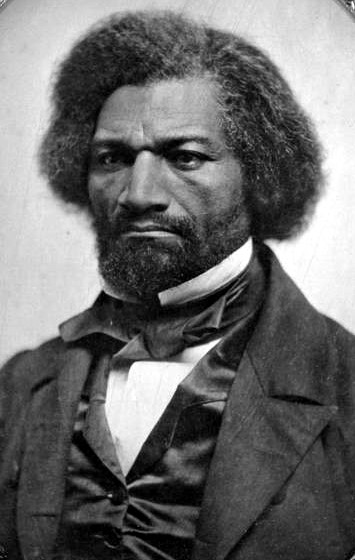
motto_frederick_douglass_2

Frederick Douglass, 1856

Slaves were almost always illiterate. They did have other ways of expressing themselves however, particularly through their singing. Douglass notes that slaves did not, as some whites thought, sing because they were happy. In fact, they sang most often when they were unhappy. He writes, “every tone was a testimony against slavery and a prayer to God for deliverance from chains. The hearing of those wild notes always depressed my spirit, and filled me with ineffable sadness.”

At around seven years old, Douglass leaves the Lloyd plantation to live with his master’s son-in-law in Baltimore. He is now a town rather than a plantation slave, which gives him a few more privileges such as additional food. His mistress teaches Douglass his ABC’s and he learns a few short words. She is stopped, however, by her husband, who suggests that Douglass would not be fit to be a slave if he learned to read and write. “He would at once become unmanageable and of no value to his master. As to himself, it could do him no good, but a great deal of harm. It would make him discontented and unhappy.” Douglass writes, “from that moment I understood the pathway from slavery to freedom.” Douglass understands that he’ll be able to forge a new life and identity for himself if he learns how to read. He can’t use his mistress as a teacher, but he manages to get reading lessons from the poor white children in the city. He had one advantage over them. Bread was given freely to him, and so he exchanged bread for as he calls it the bread of knowledge.

To some extent, his master is right. The ability to read does make Douglass more unhappy as a slave. “It had given me a view of my wretched condition, without the remedy.” He now has knowledge but is powerless to use it just yet. He dreams of escaping from his master but in the meantime determines to learn how to write. Again he uses the boys in the town to help them accomplish this by challenging them to write more words than he can. By the time he is between 10 and 11 years old, Douglass can read and write. He now has two of the tools he’ll need to forge his new identity as an escaped slave.

Why it Matters that Donald Trump did not Mention Jews on Holocaust Remembrance Day

Fact: Donald Trump failed to mention Jews in his statement on International Holocaust Remembrance Day. Question: does his failure to mention Jews make a difference?

In an opinion piece, The Jewish Journal says that since Mr. Trump asked a descendent of Holocaust survivors to write the statement, it must be acceptable. It is possible that the original draft might have mentioned Jews and Mr. Trump simply decided not include them in the final statement. Yet historically what presidents say, or fail to say, does have consequences.

For example, in the 1940s some of FDR’s staff members urged him to make statements emphasizing the importance of rescuing Jews, but he would either have those words buried in a later paragraph of his speech or chose not to use them at all. FDR’s prevarications ensured that the rescue of Jews would not be a priority.

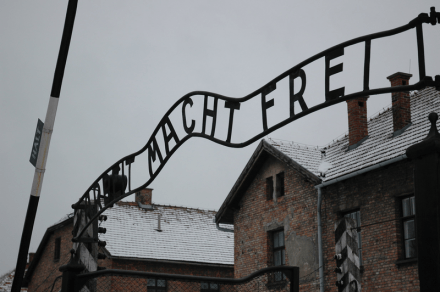
800px-arbeit_macht_frei

Entrance to Auschwitz Concentration Camp Photographer: Jochen Zimmerman

Even when nearly all the Jews had been murdered, FDR preferred to use the term “victims of enemy oppression” rather than refer to Jews specifically when he created the War Refugee Board, an agency that was designed to help victims of the Holocaust from 1944-1945. Most of the victims, though certainly not all, were Jews.

The Jewish Journal suggests that Mr. Trump deserves an apology from his critics. After all, he is not Jewish, so how could he be expected to know that more Jews died in the Holocaust than any other group, or that the Nazis employed “unprecedented resources” to “identify and annihilate the Jews?” Well, I am not Jewish, and yet I know these facts.

I might be more willing to give Mr. Trump the benefit of the doubt if he had shown any love or tolerance for any other group of people than rich white men during his campaign and thus far, his presidency. Yet he fails to denounce the Ku Klux Klan and threatens to create a Muslim registry. These are not hopeful signs. Should Mr. Trump change course, however, I would be happy to acknowledge it.

Sources:

Statement by the President on International Holocaust Remembrance Day January 27, 2017.

https://www.whitehouse.gov/the-press-office/2017/01/27/statement-president-international-holocaust-remembrance-day

#Never again by Jonathan Greenblatt CEO of the Anti-Defamation League January 29, 2017.

HTTP://blog.ADL.org/Greenblatt/neveragain

Back story behind the Holocaust statement proves Trump’s a mensch. By Rabbi Dov Fischer, Jewish Journal opinion, January 31, 2017.

http://jewishjournal.com/opinion/214118/back-story-behind-Holocaust-statement-proves-trumps-mensch/