Book Review of The Island of Sea Women by Lisa See

The Island of Sea Women is a story of friendship, heartache, and forgiveness. Young-sook and Mi-ja are childhood best friends. As they grow up on Jeju, an island that is now part of South Korea, Young-sook’s mother teaches them to dive. The girls became haenyeo–female divers who catch sea creatures like abalone, sea urchins, and even octopus to sell and help feed their families. Experienced haenyeo have no oxygen tanks but can stay submerged in the sea for twenty or more meters.

Lisa See’s novel covers both the friendship of the two girls and the history of Jeju from 1938 to 2008. Young-sook is the daughter of a respected haenyeo chief, but Mi-ja is an orphan. Though Young-sook’s mother shows Mi-ja kindness, others in their village do not. In 1938, the Japanese occupy Korea, and Mi-ja’s father worked for the Japanese. Thus Mi-ja is marked as a collaborator–a curse that haunts her throughout her life.

Early on, the girls learn the dangers of the sea. As Young-sook’s mother explains, “Every woman who enters the sea carries a coffin on her back. In this world, in the undersea world, we tow the burdens of a hard life. We are crossing between life and death every day.” Both Mi-ja and Young-sook will lose people they care about in the sea.

In the late 1940s, however, the young women learn that being on land can be equally dangerous. Young-sook and Mi-ja are now both married and have children. As they are living their lives, the Japanese are replaced by American occupiers. Eventually the desire for Americans and the Koreans they’ve placed in charge to root out communism causes unimaginable tragedy for the people of Jeju, and the friendship of Young-sook and Mi-ja is tested like never before.
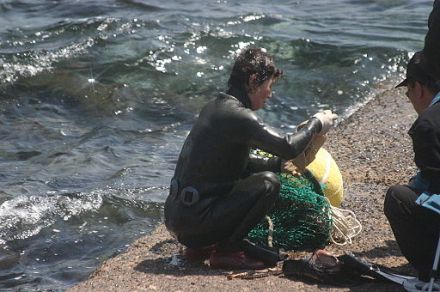
Korea-Jeju-Haenyeo-02

Photo of a haenyeo April 17, 2007 by karendotcom127 https://www.flickr.com/photos/karendotcom127/463077860/

I enjoyed learning about the non-traditional gender roles on Jeju. Men stayed home with the children while women dove or worked in the fields to gather food. As Young-sook’s daughters points out later in the book, in some cultures Jeju men would be called wives. I had not heard about the haenyeo before reading this book and have so much respect for their skills. Lisa See’s beautiful descriptions of the world underwater made me feel as though I was right there with the divers.

If you’ve read any of her other books, then you know that See is an expert at depicting female relationships. Young-sook and Mi-ja stand by each other through sorrows, such as the death of Young-sook’s mother early in the novel. Yet the events of history and their own actions/inactions begin to tear them apart. See explores the importance of forgiveness and what each woman loses without it.

Though I thoroughly enjoyed learning about Jeju and its history of strong women, I would not recommend this as a relaxing read. Pick up The Island of Sea Women if you are interested in the subject matter, but keep in mind that history is often ugly.

The Early Life of President Richard Nixon

Most people remember Richard Nixon for being the only President of the United States to resign from office. Yet when I was researching this blog post, I realized that I knew almost nothing about his childhood and education. Like most leaders, his early experiences shaped what he did later in life.

256px-Richard_M._Nixon,_ca._1935_-_1982_-_NARA_-_530679

Official White House Photo of President Richard Nixon

Richard Nixon was born in 1913 in Yorba Linda, a small town east of Los Angeles. His father Frank planted lemon groves, but these failed and the family moved to Whittier, California. Here Frank ran a grocery store and gas station. Richard Nixon said of his childhood, “we were poor, but the glory of it was we didn’t know it.”

Although Frank and Hannah Nixon had five children, they lavished most of their attention and what little money they had on their oldest son, Harold. They bought Harold a Boy Scout uniform but couldn’t afford to get one for Richard. Richard and his other brothers stayed home while Harold was sent to a Christian boarding school in Massachusetts.

Harold and Richard were opposites. Harold was popular with other kids and girls “swooned over him.” In contrast, Richard felt uncomfortable around people he didn’t know well and the other boys teased him. Instead of fighting the bullies, Richard kept his anger bottled up. Realizing he would never be as popular as Harold, Richard threw himself into his schoolwork. He became his grammar school’s valedictorian and joined the debate team in high school. Richard also had big dreams. His grandmother gave him a framed portrait of Abraham Lincoln, which he hung over his bed.

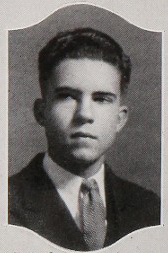
Richard_Nixon_HS_Yearbook

Photo of Richard Nixon as a senior in high school, 1930

While Richard Nixon could literately look up to Abraham Lincoln, his parents’ volatile personalities had the most influence on him. Frank Nixon had a terrible temper. Richard and his brothers were rapped on the head by their father at various times. At his grocery store, Frank subjected customers to his conservative political opinions whether they wanted to hear them or not. He also blamed others for his bad luck.

In contrast, Richard’s mother, whom he called “a saint,” smiled and bottled up her frustrations. Hannah Nixon had a gentle voice but punished her children by not speaking to them. Though deeply religious, she was not affectionate.

As a result of his childhood experiences, Richard developed a dislike of conflict and a sense that he was not good enough, especially when compared with Harold. When Harold died of tuberculosis in 1933, Frank Nixon said, “Why is it, that the best and finest of the flock has to be taken?” Richard, as the second oldest son, would always be trying to live up to his dead brother’s potential.

After high school, Richard was offered a scholarship to Harvard but ended up at Whittier College to save money on living expenses. Determined to distinguish himself, Richard participated in school debates and was eventually elected president of the student body. While he excelled in debates and in his studies, Richard remained somewhat of a loner. One former classmate recalled that “I don’t think he had anybody you would call a close friend.” He had an on and off relationship with a young woman which she described as “stormy.” Even she said she didn’t feel that she really knew him.

At the end of college, Nixon received and accepted a scholarship to Duke University Law School. He told his girlfriend that he hoped to do something important with his life. Clearly, Richard Nixon was ready to make his mark on the world.

Sources:

Being Nixon: A Man Divided by Evan Thomas

The American President by Phillip B. Kunhardt, Jr., Phillip B. Kunhardt III, Peter W. Kunhardt

https://www.biography.com/people/richard-nixon-9424076