A Short History of American Opposition to Immigration

New Colossus: Emma Lazarus' poem at base of Statue of Liberty

New Colossus: Emma Lazarus’ poem at base of Statue of Liberty

“Give me your tired, your poor/Your huddled masses yearning to breathe free.” The words of Emma Lazarus inscribed at the base of the Statue of Liberty must have sounded ironic to many hopeful American immigrants. Even Lazarus’ poem hinted that immigrants would not be completely welcome, however. The poem’s next verse refers to them as “The wretched refuse of your teeming shore.” Refuse is another word for garbage. Immigrants throughout America’s history have been treated like garbage—often turned away from the country they saw as their only hope for a better life.

In the late nineteenth and early twentieth centuries, Asian and European immigrants trying to enter the U.S. faced strict immigration laws. The 1882 Chinese Exclusion Act, for example, suspended all Chinese immigration for ten years.

During the 1930s, Jews fleeing the Nazis received little aid from the U.S. government. In 1939, the St. Louis, a ship carrying over 900 Jewish refugees, was not allowed to land in Cuba. For weeks, the ship hovered near the U.S. coast, but President Franklin Roosevelt refused to give the passengers even temporary sanctuary. The ship returned to Europe, and many passengers later died in Nazi concentration camps.

Any immigrants who managed to come to America still experienced discrimination. Ironically, other immigrants who arrived in  America somewhat earlier often mistreated newcomers. In 1890, Jacob Riis wrote in How the Other Half Lives, “the once unwelcome Irishman has been followed in his turn by the Italian, the Russian Jew, and the Chinaman, and has himself taken a hand at opposition…against these latter hordes.”

Anti-Semitism was prevalent in the U.S. during the 1930s and 1940s. A poll from 1938 showed that Americans not only opposed Jewish immigration, but they disliked Jews more than any other minority. Even Jewish children were unwelcome. In response to a Congressional bill that would allow Jewish children to enter the country under the immigration quota, FDR’s cousin, Laura Delano, stated, “twenty-thousand charming children would all to soon turn into twenty-thousand ugly adults.”

Today many people still object to the immigration of people who are fleeing from poverty and violence in their home countries. Immigration reform is a hot-button issue in political campaigns across the U.S. Even with the background checks, fines, the requirement to learn English and having to wait in line for years behind legal immigrants under the comprehensive immigration reform bill, some Americans want to deport the eleven million immigrants who are living in the United States illegally. That number includes children who were brought to the U.S. by their parents.

The mindset of Americans toward immigration hasn’t changed much since the nineteenth century. The immigrants that some are seeking to keep out or deport may look different, but the desire to turn them away remains the same.
President Franklin Roosevelt and Few Civil Rights for African Americans

Despite the efforts of his wife Eleanor and African American leaders, President Franklin Roosevelt’s administration made little progress on civil rights.

New Deal programs discriminated against blacks. For example, under the Works Progress Administration, blacks received less pay than whites for the same work. This was especially true in the South. The discrimination was somewhat eased by the intervention of Eleanor Roosevelt, who personally viewed the struggles of blacks during visits to WPA projects. She wrote, “It is all wrong to discriminate between white and black men!”

FDR agreed to sign an executive order barring discrimination in the WPA. One million black families benefited from WPA wages. However, discrimination in other parts of the New Deal persisted. The Federal Housing Authority refused to help blacks trying to buy houses in white neighborhoods. The National Recovery Administration persisted in paying black workers less than whites. Even the Social Security Act excluded the menial jobs that most blacks held.

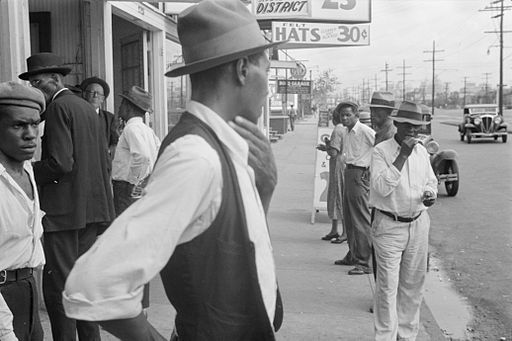
Applicants waiting for jobs in front of Federal Emergency Relief Administration office

Applicants waiting for jobs in front of Federal Emergency Relief Administration office, 1935

For black leaders, however, the most frustrating issue was FDR’s stance on the anti-lynching bill introduced in Congress in early 1934. Although twenty-six African Americans were killed by mobs the year before, FDR took no stance whatsoever on the bill. The Amsterdam News commented on FDR’s lack of support for the bill using the headline “Here’s Mr. Roosevelt’s Message on Lynching.” The article contained one sentence, “In his annual message to Congress last Friday President Roosevelt had the following to say about lynching:” That sentence was followed by a large blank space.

FDR tried to explain to African American leaders why he could not back the bill. He told NAACP Executive Secretary Walter White, “I did not choose the tools with which I must work.” In order get votes for New Deal programs, FDR felt he couldn’t antagonize Southern Democrats by supporting a bill they found offensive. He told critics “you have to wait, even for the best of things, until the right time comes.” Apparently FDR never thought there was a right time to support an anti-lynching bill. Although members of Congress proposed other anti-lynching bills during his long presidency, he never backed them.

In contrast to her husband, Eleanor publicly backed the anti-lynching campaign. When Walter White asked her to attend a NAACP art exhibit called “A Commentary on Lynching,” Eleanor lent her support. Interestingly, FDR did not attempt to stop his wife’s actions. Perhaps FDR agreed with her privately, but Eleanor’s actions also encouraged to blacks to switch their allegiance from the Republican party of Abraham Lincoln to FDR and the Democrats. Ever the politician, FDR was likely happy to have his wife express her feelings to get the African American vote while he placated Southern voters by saying nothing.

Sources:

The Eleanor Roosevelt Papers Project at George Washington University

The Roosevelts: An Intimate History by Geoffrey Ward and Ken Burns

No Ordinary Time by Doris Kearns Goodwin

The Little Rock Nine and the Integration of Central High School

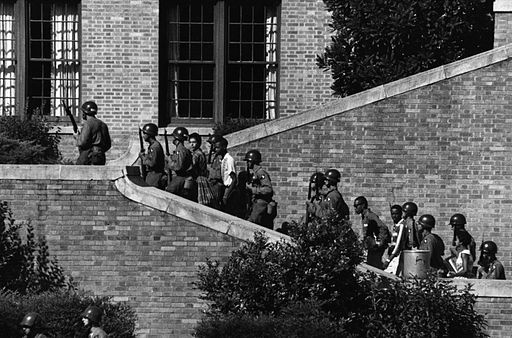
On September 25, 1957, nine African American students entered the front doors of Little Rock Central High School. They were accompanied by federal troops from the 101st Airborne Division so they would not be assaulted or otherwise prevented from entering the building. The experiences of the Little Rock Nine, as the African American students were later called, demonstrate that religion is often used to promote very different viewpoints.

Soldiers from 101st Airborne escort Little Rock Nine students into Central High School

Soldiers from 101st Airborne escort Little Rock Nine students into Central High School, 1957. Source: US Army

In the late 1950s, the idea of integrating white schools was still new. The 1954 Supreme Court ruling, Brown vs. Board of Education, said having separate schools for blacks was illegal. Both sides, the integrationists who wanted African American students to have the same access to the better funded schools that whites attended, and the segregationists who wanted to keep things the same, thought they were right. In fact, they used the same religion, Christianity, to support their causes.

Days before the paratroopers arrived, African American students tried to enter Central High, but were blocked by National Guardsmen, citizens from Little Rock, and even students. Some white students used their religion to explain their attitudes. One of these students was Hazel Bryan, a white girl who photographers captured shouting in anger behind black student Elizabeth Eckford. Hazel later said, “I was very religious at that time. I attended church every Sunday morning and night…while no one at the church said that we should protest school integration, we got the feeling that it would be a good thing to do.”

Many white ministers believed that God sanctioned segregation. Some referred to the passage from Genesis 9:20-27 that said one of Noah’s sons was dark-skinned and was cast out as proof that God did not want white and black people to be near each other.

During the 1956 Arkansas governor’s race, candidate Jim Johnson appealed to voters by saying that the South, “one of the last patriotic and Christian strongholds,” would be ruined if the schools were integrated. While Johnson didn’t win the election, he convinced Governor Orval Faubus that he could not support integration of the public schools. Faubus, who had previously taken a more moderate stance on race issues, sent the Arkansas National Guard out to block African American students from entering the high school on September 4, 1957.

In contrast, some Christians and white ministers supported integration of the state’s public schools. On September 4, 1957, three white ministers joined two black ministers and NAACP chairperson Daisy Bates to walk with the African American students on what was supposed to be their first day of school. Unfortunately, only seven of the students heard about this plan. The seven students who did were still turned away by National Guardsmen, but unlike Elizabeth Eckford, they did not have to fend for themselves.

When the Little Rock Nine finally started school, they faced ridicule and sometimes violence from white students. However, other students like Glennys Oakes were members of churches that supported integration. She said that her minister told the young people that the segregationists’ interpretation of the story of Noah’s son was ridiculous. She said, “Our whole perspective was that this [integration] was the right thing to do.” Despite harassment from segregationists, Glennys and five other white students invited black students to sit at their table during lunch.

Edith Carow Roosevelt: Future First Lady

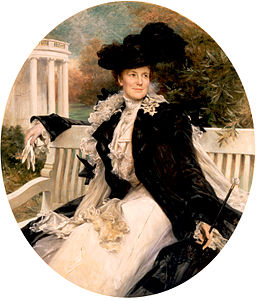
Official Portrait of First Lady Edith Roosevelt

Official Portrait of First Lady Edith Roosevelt

Although Edith Carow spent much of her childhood with Theodore Roosevelt and was best friends with Corrine Roosevelt, her family life and fortunes differed from theirs. During the Civil War, Edith’s father’s shipping business became less profitable. When he wasn’t away on business or drinking to forget his troubles, he doted on Edith. He told her tales of Sinbad the Sailor and instilled in her a love for literature that remained throughout her life.

Unfortunately, the shipping business remained unprofitable and the Carows had to depend on relatives. The family moved in with Edith’s aunt when Edith was a toddler. Her aunt’s home in New York was close to Theodore Roosevelt’s grandfather’s house, and Edith was soon welcomed into the Roosevelt circle. She was especially close to Corrine, Theodore’s younger sister, and adored Theodore as well. A sensitive child, Edith hid her broken toys whenever Corrine and Theodore came to her aunt’s house.

Theodore and Edith both loved books from an early age. Edith attended the home school taught by Theodore’s Aunt Gracie, and the two friends read everything they could, including the novels of Louisa May Alcott. Both the Roosevelt children and the adults treated Edith like part of the family, which relieved some of Edith’s anxiety as her alcoholic father went bankrupt and her mother succumbed to depression. Edith also spent time at the Roosevelt’s summer home, named Tranquility. The young friends recited their favorite poems during picnics and Theodore and Edith often danced together at parties.

After Theodore left for Harvard, Corrine and Edith started a literary society in which members contributed short stories and poems while other members critiqued them. Theodore hadn’t forgotten Edith, though. He invited his sisters, brother, and Edith to visit him during his freshman year. After Edith and his siblings left, Theodore told Corrine that he never saw “Edith looking prettier” and that everyone “admired her little Ladyship intensely, and she behaved as sweetly as she looked.”

When Theodore and Corrine’s father died, Edith spent time with both of them, and often went sailing with Theodore. On August 22, 1878, the two had a private conversation which neither ever discussed in public. It was clear that their relationship was damaged afterwards, however. By the winter, Theodore was engaged to Alice Lee. Edith did a good job of keeping her feelings to herself, though her friends noticed that she out-danced everyone at Theodore and Alice’s wedding.

Alice died after a difficult childbirth. Theodore was crushed, but he also instructed his sisters, who were still close to Edith, not to invite her over during his visits. He remembered the happy times they had together and feared he might still have feelings for her. However, they encountered each other one day in October of 1885 as Edith was leaving his sister Bamie’s house. Theodore and Edith, old friends and childhood sweethearts, secretly got engaged the following month.

Doing Research at the Franklin D. Roosevelt Library

Statue of FDR's dog, Fala at the visitor's center in Hyde Park, NY

Statue of FDR’s dog, Fala at the visitor’s center in Hyde Park, NY

Two years ago this week, I was conducting research for my book at the FDR Library. Well, that’s not entirely true. I was in Hyde Park, New York and I was using the library’s resources, but both the library and the museum were undergoing renovations. The library was off-limits to visitors, but the library staff set up a cozy room in the visitor’s center for researchers to view the library’s archives. Every morning the other patrons and I arrived early to request the boxes of materials we needed, and one of the archivist’s assistants brought them in on carts.

Sometimes I wish I had the chance to see the actual library, but that didn’t bother me at the time. I was too focused on reading documents from the War Refugee Board files and taking pictures of them with my digital camera (photocopying was not allowed because some of the documents were fragile). I also remember thinking that the presidential library might be large and intimidating. Frankly, doing research for my first book was intimidating enough, so I was content with the smaller room.

The visitor’s center also had a statue of FDR’s dog, Fala, near the entrance. I love dogs and missed my beagle mix who stayed with my mother in Illinois. The staff at the center may have thought I was a little odd when I said, “good morning, Fala” and “see you tomorrow, Fala” every day, but then they were probably used to eccentric researchers.

The best part of the library/visitor’s center was Virginia, the archivist. The library had a great online finding aid, so I knew which documents I needed and the boxes they were located in. Unfortunately, there were two documents that I had only seen cited in other history books, and I had no idea how to locate them. Virginia didn’t, either because the filing system was changed after those books were written, making the citations almost worthless. Fortunately for me and my book, Virginia was determined to find what I needed. She seemed to take it personally when she couldn’t find a document. I thought, this woman is a researcher’s dream come true. I still can’t figure out how she located those documents, but she managed it somehow and I went back to Illinois with all the sources I needed.

Some day I want to return to Hyde Park as a tourist, but I enjoyed almost every minute that I spent researching my book.

The Origins of American Symbol Uncle Sam

World War I Uncle Sam Recruiting Poster

World War I Uncle Sam Recruiting Poster

When Samuel Wilson moved to Troy, New York in 1789, he had no idea that he would become the inspiration for an American symbol. Four years after arriving in Troy, Samuel and his brother started a meatpacking business called E. and S. Wilson. They also produced the barrels that transported the meat. In Troy, Sam Wilson was known for his pleasant personality and his jokes. Since he was so likeable, the townspeople called him Uncle Sam.

During the War of 1812, the Wilson brothers were under contract to send food supplies to northern troops stationed in Troy. Every barrel of meat bore the stamp “U.S.” Sam Wilson meant the abbreviation to represent United States, but back then the only abbreviation for the country was “U. States.” Troy residents joked that the U.S. stood for Uncle Sam Wilson, who was supplying the army with food. The joke was told so often that all rations sent to the government were called Uncle Sam’s.

In 1813 references to Uncle Sam as a nickname for the United States appeared on local broadsides and in the Troy newspaper.

Images of Uncle Sam were drawn as early as 1830, but his physical traits varied with each artist. Some historians believe that a key factor in the development of Uncle Sam’s likeness occurred after the assassination of President Lincoln. Like Lincoln, the new Uncle Sam was tall, skinny, had a beard, and wore a top hat.

Cartoonist Thomas Nast gave Uncle Sam red-and-white-stripped pants and stars on his coat. In 1914 James Montgomery Flagg created the most famous version of the American icon. Flagg’s Uncle Sam has a stern face and points at observers. Beneath Uncle Sam are the words “I want YOU for U.S. Army.”

Samuel Wilson, the original Uncle Sam, became a wealthy businessman after the War of 1812. He remained popular in his community until his death in 1840. Eventually, Congress made Wilson’s connection with the symbol of Uncle Sam official. Congress signed a Joint Resolution on September 15, 1961 recognizing “Uncle Sam Wilson of Troy, New York, as the progenitor of America’s national symbol of Uncle Sam.”

The Detroit Race Riots of 1943

The riot that broke out on the evening of June 20, 1943 at a popular beach park wasn’t the first sign of racial tensions in Detroit. During World War II, Detroit, a town already known for its manufacturing plants, produced one-third of America’s military equipment. The demand for blue-collar workers grew, and thousands of Southern African Americans flooded the city. They wanted better pay and better treatment than they received in the South’s sharecropping system.

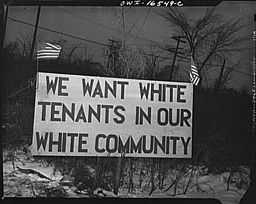
By the early 1940s, one major problem existed: the manufacturing plants provided jobs but not housing. Where would the new migrants live? White workers made it clear that they didn’t want to live next door to African Americans. Across town signs like “we want white tenants in our white community” were put up. Detroit Mayor Edward Jeffries finally succeeded in obtaining some additional housing for blacks, but his efforts required a show of force. Blacks moved in to their new neighborhood only after the Detroit police and the National Guard escorted the new tenants.

256px-White_sign_racial_hatred.

Life Magazine printed an article in August 1942 that predicted a larger clash between whites and blacks. The article said, “If machines could win the war, Detroit would have nothing to worry about. But it takes people to run machines and too many of the people of Detroit are confused, embittered and distracted by factional groups that are fighting each other harder than they are willing to fight Hitler. Detroit can either blow up Hitler or it can blow up the U.S.” The article proved to be prophetic.

On a hot summer day in 1943, tensions between the two races boiled over again. To escape the heat, over 100,000 Detroit residents went to an integrated beach called Belle Isle. The majority of the beachgoers were black. At first, small fights broke out among black and white teenagers. Black youths mugged whites, and white and black teens got into fistfights. By evening, however, the situation escalated. People tried to leave the island for the mainland, causing traffic jams. Stuck on the Belle Isle Bridge, a fight started between 200 blacks and white sailors. On the mainland, thousands of whites threatened blacks trying to cross. Though the Detroit police arrested dozens, rioting had already spread to other parts of the city.

Rumors only made the riots worse. Among whites, a rumor spread that blacks had murdered a white woman on the bridge. Among blacks, a similar rumor claimed that whites threw a black woman and her baby off the bridge. Whites attacked patrons exiting a theater patronized by African Americans. Streetcars filled with black people trying to go to work were stopped and passengers were thrown out. African Americans smashed windows of white owned stores and attacked anyone with white skin, including a doctor responding to an emergency call.

After nearly twenty-four hours of chaos, Michigan Governor Harry Kelly finally asked President Franklin Roosevelt to send in National Guard troops. Federal troops arrived the following morning and restored order. The riots left twenty-five African Americans and nine whites dead. Almost 1,000 people were injured.

How Thanksgiving Became a National Holiday

Although the 1621 Pilgrim celebration at Plymouth Colony in Massachusetts is usually regarded as the first Thanksgiving, other states disagree. Maine claims to have the held the earliest Thanksgiving fourteen years before the Plymouth holiday. The celebration had much in common with Plymouth’s, since English settlers shared a large meal with local Native Americans near the Kennebec River. Virginia held a religious service in 1619 after colonists landed safely at a place called Berkeley Hundred, located up the river from Jamestown. Neither the Maine nor the Virginia settlements survived, which is likely why the Plymouth Colony gets credit for the first Thanksgiving.

The colonists at Plymouth didn’t plan on making Thanksgiving an annual holiday, however. Instead, they held days of thanksgiving whenever they felt especially grateful to God. For example, in 1623, Plymouth’s crops withered. When rain fell, the colonists held a day of thanksgiving prayer. Basically, in bad times the Pilgrims fasted, and in good times they gave thanks.

Even in the eighteenth century, governors of various states proclaimed days of Thanksgiving irregularly. Some skipped the custom altogether. During the Revolutionary War, leaders in Congress sometimes proclaimed a day of thanksgiving following a military victory. As president, George Washington named November 26, 1789 as a day to give thanks for the new U.S. Constitution. For the most part, however, states chose when or if they wanted to hold a thanksgiving celebration.

Sarah Hale portrait

Sarah Hale Portrait by James Reid Lambdin

By the nineteenth century, Sarah Hale led a campaign for an annual Thanksgiving Day. Hale was the editor of Godey’s Lady’s Book, and she used her public position to write editorials and send letters to government officials. Gradually, governors of various states proclaimed annual days of thanksgiving. Even President Abraham Lincoln declared a day of thanksgiving after the Battle of Gettysburg.

Yet Sarah Hale still remained dissatisfied. She wanted Thanksgiving to be a national holiday, not one celebrated for military victories by the government or selected by individual states. She found a sympathetic listener in President Lincoln. He proclaimed a nationwide Thanksgiving Day for the last Thursday of November 1863. Lincoln’s proclamation stated, “I do, therefore, invite my fellow citizens in every part of the United States…to set apart and observe the last Thursday in November next as a day of Thanksgiving and praise to our beneficent Father who dwelleth in the heavens.” The new holiday offered hope for the future of a nation torn apart by civil war. After the war, the former Confederate states joined in the national celebration.

Only one president tried to change the date of Thanksgiving. In an effort to help the struggling economy, President Franklin Roosevelt moved Thanksgiving to the third Thursday in November of 1939 so consumers had more shopping days before Christmas. The public disagreed so strongly with the change that Congress adopted a resolution firmly establishing Thanksgiving on the fourth Thursday of November.

How was the First Thanksgiving Different from Today’s Celebrations?

If you live in the U.S., you are probably looking forward to Thanksgiving with your family. Maybe Grandma or Mom will serve turkey, cranberries, and pumpkin pie and you’ll watch football on TV. Although the first Thanksgiving included food, sports, and a large number of people, it was also different from present day celebrations.

While Americans today see Thanksgiving as a time to reconnect with family members, the Pilgrims had a very basic reason for giving thanks in 1621—the fact that they managed to survive in a strange land. When the Pilgrims arrived at Plymouth, they had little idea what crops would thrive there. They planted acres of wheat and peas, neither of which survived.

The Pilgrims’ survival depended on the aid of a Native American named Squanto. He taught them how to plant a new crop—corn–so that by harvest they had twenty acres of it. The colony’s governor William Bradford wrote that the Pilgrims “began to plant their own corn, in which service Squanto stood them in great stead, showing them both the manner how to set it, and after how to dress and tend it.” Squanto also told them how to fertilize their crop: “Also he told them, except they got fish and set with it in these old grounds it would come to nothing.” The first harvest wasn’t huge, but the Pilgrims could double each person’s food ration by adding corn.

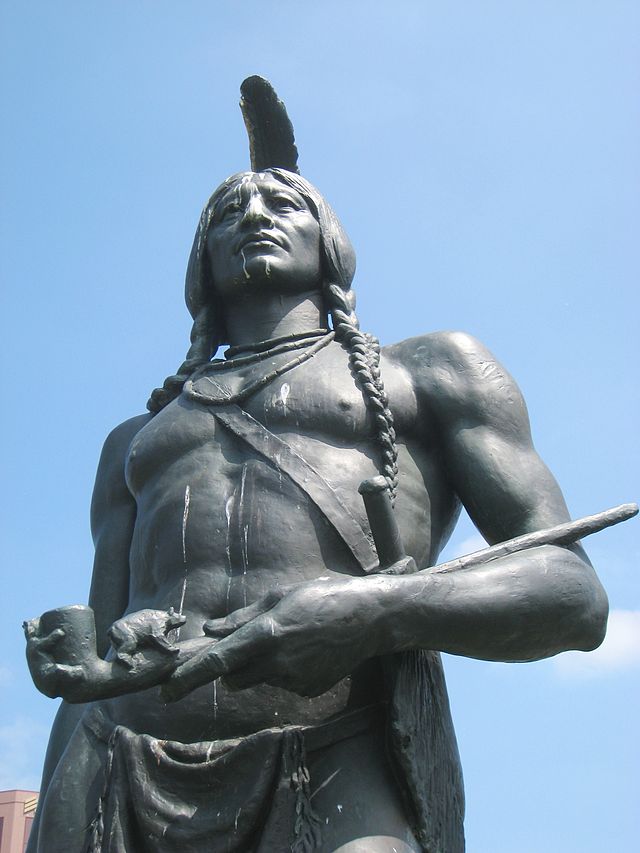
Massasoit,_KC_MO_-_detail

Chief Massasoit Sculpture Kansas City, MO

As a result of the successful harvest, the Pilgrims decided to celebrate. The colonists invited Squanto and members of neighboring Native American tribes, including the Wampanoag chief Massasoit. One colonist, Edward Winslow, described “many Indians coming amongst us, and amongst the rest their greatest king, Massasoit with some 90 men, whom for three days we entertained and feasted.” While Americans today celebrate for one day, the Pilgrims feasted for three days! The menu was large and included fowl (duck and goose) shot by the colonists and deer brought by the Native Americans. Seafood, corn bread, and greens were also served. For dessert, the participants ate wild fruit. Although turkey was available to the colonists, there is no evidence that it was eaten on the first Thanksgiving. There was no pumpkin pie, either, though pumpkins were available in their raw form.

Sports and games also were a part of the first Thanksgiving. The Pilgrims did not play football, but they engaged in other games with the Native Americans. They played a game similar to croquet and competed in running and jumping games. The English showed off their skill with guns, and the Native Americans showed their talent for shooting with bows and arrows.

When you see your relatives on Thanksgiving, see if they can guess what food was eaten and what sports played during the first Thanksgiving.