U.S. President Woodrow Wilson

Since I did a post on Teddy Roosevelt’s successor and friend William Howard Taft last year, I decided to skip to Taft’s successor President Wilson.

Woodrow Wilson, whose real first name was Thomas, had an impressive rise in politics. He had only been governor of New Jersey for two years when he was approached by Democrats to run for president.

In another time period voters might have thought that the former president of Princeton University was a snob. Wilson always thought he was right. When a friend told him that there were two sides to every issue, he replied, “Yes, a right side and a wrong side.” His stubbornness would lead to trouble during his second term.

In the election of 1912, however, voters thought his commitment to high ideals refreshing. It also helped that Republican support was split between Taft and third party candidate Theodore Roosevelt.

512px-Presidentwoodrowwilson

Official Presidential Portrait of Woodrow Wilson

Wilson hoped to focus on domestic issues while president. His New Freedom programs included restraints on banks and big business as well as child labor laws. Yet in other ways he resisted change. Born a Southerner, Wilson gave cabinet positions to Southerners. He violated the rights of black workers by allowing several racist members of his cabinet to segregate their offices. Wilson was also slow to support women’s suffrage, though he eventually did so.

When World War I began in Europe, Wilson wanted to maintain peace. He was re-elected as the man who kept the country out of war. In 1917 Wilson finally decided that America needed to join its allies to “make the world safe for democracy.”

After the war ended, Wilson worked hard to ensure that the First World War would also be the last. He proposed a League of Nations in which countries would pledge to protect each other in the future. He travelled to Europe for the peace talks, making him the first president to visit that continent while in office. Wilson was not happy with the peace treaty and he still needed more support for the League.

Returning to the U.S., Wilson embarked on a speaking tour to promote the League of Nations. While on his trip Wilson suffered a stroke. Wilson became an invalid for the last year of his presidency, though he communicated with lawmakers by writing letters. Unfortunately, the Senate was still debating the League of Nations. His stroke made the stubborn president even less willing to compromise, and he refused to make any concessions on his beloved League. Though the Senate rejected the League of Nations, Wilson’s ideals live on in the United Nations.


Making Progress: U.S. President Theodore Roosevelt

As a young boy, Roosevelt often struggled to breathe at night because of his asthma. Although modern doctors would be appalled, Roosevelt’s doctors suggested that the boy smoke cigars to improve his symptoms.

His family thought Roosevelt’s brother, Elliot (later father of Eleanor Roosevelt), was most likely to succeed. Elliot struggled with alcoholism, however. Theodore soon outpaced his brother both physically and mentally. He was a voracious reader and would read almost anywhere about almost any subject. Even as president he snuck a few minutes between appointments to read nature books.

512px-Theodore_Roosevelt_in_1918

Photo of Theodore Roosevelt 1918

After McKinley’s death the presidency was thrust upon Roosevelt. He was one of the few men who genuinely enjoyed the job. While in office he expanded the authority of the president. Roosevelt believed that the president could do whatever the law didn’t specifically prohibit him from doing.

Roosevelt engaged in a number of presidential firsts. He was the first president to understand and use the press to gain public support for his programs. In fact, Roosevelt enjoyed talking with the press so much that he spoke to a reporter during his morning shave. Roosevelt was also the first president to invite an African American (Booker T. Washington) to dinner at the White House.

Roosevelt’s administration was the first to actually apply the anti-trust law signed under President Benjamin Harrison. Roosevelt believed that while successful businesses could merge, their mergers needed to be regulated. By the time he left office, Roosevelt had brought over 20 anti-trust suits.

Although he loved being president, Roosevelt was disappointed to preside over the country in a time of peace. He believed that he could not be a great president without steering the nation through a great crisis. He also regretted that he promised not to serve for a third term. That did not stop him from running for the office several years later, however.

U.S. President William McKinley

One of many presidents who grew up in Ohio, William McKinley always believed he would be president someday. He inherited a poor economy from President Cleveland and wanted to focus on America’s domestic problems.

256px-Wmckinley

Official Presidential Portrait of William McKinley

Instead, he ended up presiding over a war with Spain. Having already witnessed the Civil War, McKinley had no desire to involve the country in Cuba’s fight for independence. Once the U.S. warship Maine exploded in Havana’s harbor, however, McKinley was pressured by the public to declare war. He finally gave in.

Once committed to a war, McKinley set out to win it. He set up the first modern war room in a corner office of the White House. By the war’s end the U.S. emerged for the first time as a world power. The United States not only served as protector of Cuba, but also took Puerto Rico and Guam from the Spaniards.

A confident president McKinley also sought to take the Philippines from Spain, but the Filipinos fought back. In order to subdue them, U.S. soldiers resorted to tactics such as burning villages in which innocent people, including children, were killed. McKinley disliked the atrocity stories but believed strongly in Manifest Destiny. He saw it as America’s duty to civilize the Filipinos and convert them to Christianity.

The bullet of an assassin ended the president’s second term during a cross-country tour. That trip was the last time a president traveled without the Secret Service.


Frequently Forgotten President Benjamin Harrison

In 1888 President Cleveland lost the election to Benjamin Harrison. Harrison ran on a pro-business platform and hailed from Indiana, a state that had a healthy number of electoral votes. The election was so close that without states like Indiana and New York, Harrison could not have won.

Throughout his life Benjamin Harrison wanted to be known as an individual. He did not want his presidential campaign to mention his grandfather, former President William Henry Harrison. Against his wishes his campaign supporters used references to “Tippecanoe” and his grandfather’s allegedly humble origins.

They also pointed out that the grandson had inherited his grandfather’s reputation as a fighter. During the Civil War Harrison fought in as many battles as possible. In 1864 he joined General Sherman’s Atlanta campaign.

Benjamin_Harrison_(official_Presidential_portrait,_1895)

Official Presidential Portrait of Benjamin Harrison

Harrison’s actions as president included generous pensions for Civil War veterans and the signing of an anti-trust law. Under Harrison and the next few presidents, the law, meant to prevent the establishment of monopolies, remained mainly symbolic. Harrison did not wish to anger the businessmen who helped elect him.

The American voters were unimpressed by Harrison’s spending of millions of dollars on pensions and his pro-business stance. As a result his opponent (former President Grover Cleveland) was re-elected in 1892.

Harrison’s personality did nothing to endear him to voters either. Nicknamed “The Icebox” for his cold manner, he disliked having to deal with people outside his family. In public he often looked up at the sky so he would not have to greet others, even if he knew them! He was, however, very devoted to his wife, who died of tuberculosis during his re-election campaign. Harrison personally nursed her through her illness and didn’t care at all when he lost the election.

After his wife’s death he went home to Indiana. In his loneliness he married his wife’s niece, a circumstance that shocked his older children. The couple had a daughter, and Harrison doted on her until he died.


Frequently Forgotten U.S. President Chester Arthur

As President Garfield lay dying, his vice-president Chester Arthur tried to avoid being seen in public. Arthur was initially blamed for Garfield’s death. Of course it didn’t help that Garfield’s killer wrote to congratulate him on becoming president!

In addition, Arthur and Garfield had a strained relationship. As vice-president he opposed Garfield’s defiance of Roscoe Conkling. Conkling had helped Arthur get a post as New York’s Customs Collector during the Grant administration. While Arthur was never charged with corruption, he cheerfully allowed it. When he was fired from his post by the reform minded President Hayes, Arthur became the president of New York’s Republican committee.

256px-Carthur

Official Presidential Portrait of Chester A. Arthur, 1885

Despite the rumors Arthur didn’t want to become president. He genuinely wept when Garfield died. The job bored him so much that he lived for fishing and vacations.

Yet Arthur was determined to clean up his image. He decided to break with his old cronies and actually expanded civil service reform. He also took an interest in preserving the country’s natural resources and was especially concerned with deforestation in the West.

One of the few things Garfield enjoyed about being president was entertaining. He sold almost anything in the White House in order to pay for redecorating projects and hired Tiffany’s to help. Once he thought the place was presentable, the president held black tie dinners every week. The dinners included up to 14 courses and various wines. He had no hostess, though. His wife died before he became president.

Arthur could not run for re-election because he had contracted Bright’s disease. He died soon after leaving office.

Frequently Forgotten President James A. Garfield

James Garfield was raised by a single mother in Ohio (his father died when he was two years old). He managed to save enough money to get through school. After college Garfield had various jobs as a preacher, professor, and college president. Garfield was never satisfied with any of these occupations or with having just one girlfriend. He courted his future wife Lucretia for so long that she was ready to give him up, but he finally grew into a devoted family man.

When the Civil War began Garfield served as the country’s youngest major general. President Lincoln convinced him to resign his commission, however, when his home state elected him to Congress. Garfield never lost an election and served for nearly two decades.

256px-Jgarfield

Official presidential portrait of James Garfield

During the 1880 Republican convention Garfield’s name was put forward, though he tried to object. In a crowded field that included former President Grant, Garfield won the nomination. With the help of powerful Republican Senator Roscoe Conkling he narrowly won the presidency, too.

Ironically, Garfield and Conkling were soon pitted against each other in an argument over federal appointments. Though Garfield had nominated some of Conkling’s friends for other positions, he appointed one of Conkling’s rivals to the New York Customs House.

Garfield surprised Conkling and almost everyone else when he refused to back down. “This…will settle the question whether the President is registering clerk of the Senate or the Executive of the United States,” he said. It seemed that the country had finally found a strong chief executive.

Only a few month into his presidency, a young man who had unsuccessfully sought a position in the government shot Garfield. Garfield lingered for months. An early air conditioning unit was installed in the White House to keep Garfield cool in the summer. Alexander Graham Bell even tried to find the location of the bullet, which remained inside the president, with a new electrical invention. After being moved to the Jersey shore, however, Garfield died.

Frequently Forgotten President Rutherford B. Hayes

256px-Rhayes

Official Presidential Portrait of Rutherford B. Hayes 

Rutherford B. Hayes is the first in my new series of frequently forgotten U.S. Presidents.

Like President Grant, Hayes had personal integrity, but his presidency was tainted by the very corruption he deplored. During the 1876 presidential election Hayes’ Republican supporters disputed the electoral votes in a few southern states. Republicans promised that Hayes would withdraw federal troops in those states if elected, which he did.

The southern states did not keep their promise to grant civil rights to blacks, however. Though he made other reforms, Hayes’ troop withdrawal delayed the civil rights movement until the 20th century.

The circumstances of his election caused some to label Hayes as “His Fraudulence.” Hayes did gain some support from the public by promoting civil service reform. He signed an executive order that stated that people in public office would be fired only in the best interest of the government regardless of their political affiliations. Hayes followed through on this by firing future Republican president Chester Arthur who used his position at the New York Customs House to help other Republicans.

Though he had pledged to serve only one term, he couldn’t have run again if he wanted to because so many Republicans were angered by his efforts to root out corruption. He managed to accomplish some changes, however.

He had the first telephone installed and was the first president to have a college-educated wife. He and “Lemonade Lucy” banned alcohol from White House dinners. After leaving office he became one of the most active ex-presidents, supporting causes like black education and prison reform.

Lincoln’s Former General: The Presidency of Ulysses S. Grant

As a young man Grant hated working in his father’s leather business. He didn’t especially want to go to West Point either but thought it a better alternative to manufacturing. The “S.” in his name was a typo made on his application to West Point. Grant kept the initial and was affectionately known as U.S. Grant during the Civil War.

Although West Point graduates were in demand, Grant had a tough time getting a position in the army due to his heavy drinking. His talents outweighed his faults, however. Grant was the first man since George Washington to earn the permanent rank of lieutenant general. That rank gave him the responsibility for the Union’s strategy.

Though he was a hero to Northerners at the end of the war, Grant still had to earn a living. With a family to support, he reluctantly went to work for the family leather business. In 1868 Republicans and Democrats both wanted the hero of the Civil War to run for president. He ran as a Republican. Though he was a great leader during the war, Grant had no political experience. It’s one thing to fight a war with a clear enemy–quite another to determine who one’s enemies are in the game of politics.

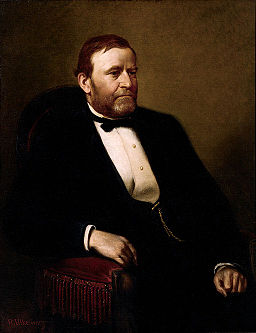
Ugrant

Official Presidential Portrait of President Grant

Grant’s greatest problem as president was his trusting nature. Though honest himself, he surrounded himself with others who were not. He also felt inferior to intellectuals and tended to follow Congress’ lead. As a result his presidency was marked by multiple scandals. For example, his secretary of war was accused of accepting bribes from merchants who traded at army posts with Native Americans.

After two terms in office the administration’s scandals prevented him from trying for a third term. His trusting nature failed him again when he became a victim of Wall Street fraud.

Knowing that Grant was broke, his friend Mark Twain suggested that he write his memoirs in order to make money. Grant had just started writing when he developed throat cancer. He was determined to finish his memoirs before he died, however, and they are still selling today. Unsurprisingly, they focus on the time period that brought Grant the most success: the Civil War.


Lincoln’s Replacement: The Controversial Presidency of Andrew Johnson

Like Abraham Lincoln, Andrew Johnson was self-educated. He was the only senator from a state that left the Union (Tennessee) to stay in Washington. Because of his loyalty he was chosen as Lincoln’s vice-president in 1864. It was soon obvious that the choice was a mistake. Johnson showed up drunk to the inauguration and harangued Lincoln’s cabinet in his acceptance speech.

The main reason the Democrat Johnson stayed a Unionist was because he hated plantation owners whose wealth and resources hurt opportunities for small farmers. Unfortunately for the newly freed slaves, Johnson hated them just as much. After Lincoln was assassinated and Johnson took over, he stated, “This is a country for white men, and by God, as long as I am President, it shall be a government for white men.”

Ajohnson

 Official Presidential Portrait of Andrew Johnson

Yet Johnson proved that he couldn’t get along with many white men either, at least not if they happened to be Republicans. His policy towards the former Confederate states was so liberal that these states elected Confederate leaders to Congress. Furious Republicans refused to seat the delegates.

Johnson especially fought with Radical Republicans who favored equality for blacks. He vetoed the 1866 Civil Rights Act, which stated that everyone in the U.S. should have “full and equal benefit of all laws.” Congress overturned this veto and several others during Johnson’s presidency. During his fights with congressional leaders Johnson was nicknamed “The Grim Presence.”

Johnson is best known for being the first president to have an impeachment trial. Fortunately for him, a few Republicans thought that his disagreements with Congress did not add up to the “high crimes” required by the Constitution to oust a president. He escaped impeachment by one vote.

Though his presidency was a failure, Johnson later became the only former president elected to the U.S. Senate. After hearing the news, Johnson said, “Thank God for the vindication.”