Abraham Lincoln: The Moral Politician

Until the 1850s Abraham Lincoln was a frustrated one-term congressman who had decided to focus on his law practice. Lincoln was drawn into politics again during the Kanas Nebraska Act controversy. While he accepted slavery where it existed, he couldn’t abide its expansion into new territories.

He was not in favor of giving blacks full citizenship, however. In 1840 he criticized Martin Van Buren for voting to enfranchise blacks, and he did not support giving blacks the vote in his bid for the U.S. Senate against Stephen Douglas. He believed that blacks had the right to earn their own living without it being taken away by their masters. Though he lost to Douglas, the debates helped raise Lincoln’s political profile.

Although he did not officially campaign for the nation’s highest office, Lincoln cleverly placed himself in the public eye. Prior to the election he had the debates with rival Stephen Douglas published; the volume became a national bestseller. He also travelled to New York so people in that part of the country could listen to his arguments and see his talent as a public speaker.

256px-Abraham_Lincoln_-_Clara_Barton_Centenary

Photo of President-elect Abraham Lincoln, 1860


While in New York he had his photograph taken so it could be handed out just in case his name was mentioned at the Republican convention. After he was elected, more than sixty photos were taken of Lincoln, making him the most photographed president up to that time. Though opponents often made fun of his plain, slightly unkempt appearance, Lincoln also poked fun at himself. After being called two-faced, Lincoln said, “If I had another face, do you think I would wear this one?”

Unlike Buchanan, who claimed that he could do nothing if a state wanted to leave the Union, Lincoln refused to bargain with secessionists and sent supplies to the federal fort in South Carolina. He also rejected the idea that the president could do nothing about slavery. While maintaining the Union was his first objective, he said that if freeing the slaves would save the Union he would free them.

Lincoln remained a great politician during the Civil War. He gave out contracts and government offices in exchange for votes. Yet he also knew how to unite people behind a moral cause such as the constitutional amendment that abolished slavery.

As the war drew to an end, he offered friendship to the defeated Southerners “with malice toward none, with charity to all.” Americans can only imagine what Lincoln would have accomplished during his second term in office. On April 14, 1865, he was the first president to be assassinated.


American Politicians and Immigration Policy: A Troubled History

Inscribed on the base of the Statue of Liberty are these words: “Give me your tired, your poor / Your huddled masses yearning to breathe free, / The wretched refuse of your teeming shore. / Send these, the homeless, tempest-tost to me, / I lift my lamp beside the golden door!” The poet should have put an asterisk after these lines that read “unless politicians find it inconvenient to admit certain refugees; in that case the door is closed.”

U.S. IMMIGRATION POLICY DURING WORLD WAR II

In the 1930s and 1940s, the door to the United States was closed to Jewish immigrants fleeing the Nazis. With the exception of the work done by the War Refugee Board in 1944 (by which time most of Europe’s Jews were dead), President Franklin Roosevelt’s administration stood by while 6 million Jews were murdered in the Holocaust.

U.S. State Department excuses for not loosening immigration quotas included the possibility that Jews might be acting as spies for the Nazi government. Despite this theory, the record indicates that only one enemy agent entered the country as a refugee, and that refugee was not Jewish.

In order to enter the U.S., Jewish refugees had to endure so much government red tape that by the time the State Department approved a visa, the applicant had often been deported to a concentration camp. Even a congressional bill to accept 20,000 Jewish children was rejected because, as President Franklin Roosevelt’s cousin Laura Delano stated, “twenty thousand charming children would all too soon grow into 20,000 ugly adults.”

Women_and_children_among_Syrian_refugees_striking_at_the_platform_of_Budapest_Keleti_railway_station._Refugee_crisis._Budapest,_Hungary,_Central_Europe,_4_September_2015._(3)

Syrian Refugees at Budapest Railway Station, 4 Sept. 2015. Photo by Mstyslav Chernov

CURRENT U.S. POLICY ON IMMIGRATION

At the moment, Syrian refugees are the most unpopular group in the United States. A few months ago, Mexican immigrants, all of whom politicians like Donald Trump seem to think are rapists or drug dealers, were enemy Number One, but opinions change quickly. The terror attacks in France gave U.S. politicians who did not want immigrants entering the country the perfect excuse to say, “We do not want Syrian immigrants in America. They are coming to attack us.”

Yet out of 784,000 refugees that have entered the U.S. since September 11, 2001, only three were arrested for planning terrorist activities. Only one of the three spoke of targeting the U.S., and even he had no specific plan. People risking their lives to get out of their country (and plenty, including young children, have died in the attempt) are unlikely to target a country that provides them with food and shelter.

Despite the fact that the U.S has pledged to admit only 10,000 Syrian refugees in 2016, even this number is too large for some politicians. Last week in the House of Representatives, 47 Democrats and 242 Republicans voted to put new security limits on those immigrants. Apparently these representatives are unaware that the security screening process is already so complicated that it takes 18-24 months (more than a year) before a refugee from Syria can ever enter the U.S.

In contrast to the reluctance of the U.S. to admit Syrian refugees, Germany is projected to take in 800,000 refugees by the end of this year. Germany–a country Jewish refugees tried to flee from in the 1930s and 1940s–is now taking in hundreds of thousands more refugees than the U.S. ever planned to welcome.

France, the country with the most recent terror attacks and the country that gave the U.S. the Statue of Liberty, has promised to continue accepting immigrants from Syria. America, the nation of immigrants, is becoming the nation of exclusion.

President James Buchanan: Career Politician

James Buchanan had more political experience than most presidents. He had served in Congress for 20 years and was President Polk’s secretary of state. He was more effective socializing in small groups rather than making public speeches, however.

256px-James_Buchanan

Portrait of James Buchanan

As the only president who never married, he asked his niece Harriet Lane to be White House hostess. She ably presided over dinners with Buchanan’s cabinet members whom he thought of as his family.

President Buchanan was a Northerner who thought the Constitution supported slavery. Before his inauguration he convinced a Supreme Court Justice to vote pro-slavery in the Dred Scott case. The case decided that slaves taken to the North for a period of time were still slaves if their owners brought them back to a slave state.

Buchanan responded to the vote on secession in South Carolina by saying that while secession was wrong, the Constitution gave him no power to tell states what to do. He thought he could preserve the Union by making concessions to the South, but he only succeeded in angering anti-slavery and pro-Union voters.

Eager to let someone else deal with the country’s problems, Buchanan refused to run for a second term. He also refused to back Stephen Douglas in the presidential election. By causing a rift within the Democratic Party, he ensured that Abraham Lincoln would be elected.

Moving Toward Civil War: The Presidency of Franklin Pierce

As a young congressman, Franklin Pierce was fond of socializing and drank heavily. To please his wife who hated both Washington, D.C. and his drinking, he agreed to go back to his law practice in New Hampshire. He displeased her when he signed up for the Mexican War. Pierce wanted to serve his country but was a terrible general who suffered from multiple injuries and fainted often.

Portrait of Franklin Pierce

Portrait of Franklin Pierce

When the Democrats nominated him for president in 1852, his main advantage was that he had been out of politics for years and had no enemies. His journey to Washington turned tragic when he and his family were involved in a train wreck. He and his wife were unharmed, but their young son died. Mrs. Pierce refused to accompany her husband to his inauguration and returned to New Hampshire to grieve.

Though he was from a non-slave state, Pierce believed that the Constitution supported slavery. He made Jefferson Davis, future president of the Confederacy, a member of his cabinet. As president he enforced the Fugitive Slave Act that Northerners hated.

He also supported the Kanas Nebraska Act, which allowed people in the Kansas and Nebraska territories to decide whether they wanted slavery in those territories or not. Slave owners and abolitionists rushed into Kansas in an effort to influence the vote on slavery. The clashes between the slave owners and the abolitionists turned violent. Pierce was unable to unite the country or his party while the fighting continued.

Democrats passed over Pierce and nominated James Buchanan for the next election. When the South left the Union, Pierce wrote a letter of support to his friend Jefferson Davis. The letter became public and Pierce was viewed in his own state as a traitor. The increasingly reclusive former president drank so much after his wife’s death that he also died.

Not What their Party Ordered: The Surprising Presidencies of Zachary Taylor and Millard Fillmore

Zachary Taylor

Official White House Portrait of Zachary Taylor

Official White House Portrait of Zachary Taylor

Taylor was best known as a general rather than a politician. In fact, he had never voted in a presidential election. That was somewhat understandable since he was usually busy fighting battles. He earned his nickname “Old Rough and Ready” during the Seminole War in Florida. His men admired the fact that he fought beside them on the front lines. They also liked his independent spirit. Instead of a uniform Taylor wore a straw hat and civilian clothes.

At age sixty-one he led troops into Mexico in the fight for Texas. A new invention, the telegraph, was used for the first time to provide daily progress of the war. News of Taylor’s victories in the Mexican American War made him very popular. Despite or perhaps because his opinion on most issues was unknown, the Whigs chose him as their candidate in 1848.

Since Taylor was a slave owner, southerners expected him to support the expansion of slavery in the new territories of California and New Mexico. Taylor surprised almost everyone. He resolved to leave slavery in states where it existed but opposed its expansion. When Congressmen tried to work out a compromise, Taylor threatened to veto it. He said of the Union, “Whatever dangers may threaten it, I shall stand by and maintain it.”

Taylor never had a showdown with Congress. After a July 4th celebration he drank some tainted milk and died days later of gastritis.

Millard Fillmore

256px-Mfillmore

Official White House Portrait of Millard Fillmore

Taylor’s vice-president Millard Fillmore took office after Taylor’s death. Fillmore grew up in extreme poverty. He was mostly self-educated, but he was encouraged by a schoolteacher named Abigail to study law. Later, Abigail became his wife. Ironically, he was chosen to balance the Whig ticket as a non-slave owner from New York. Yet, unlike Taylor, he was prepared to allow the spread of slavery.

He supported the Compromise of 1850 under which California was made a free state while the New Mexico and Utah territories were left open to slavery. Slavery was abolished in the District of Columbia, but a new fugitive slave law offered $10 to anyone who handed over an African-American to federal authorities. Although Fillmore disliked slavery, he thought that states and not the federal government should decide where it would or would not exist.

After the passage of the Compromise of 1850, Fillmore thought the slavery issue was resolved. Yet both North and South were dissatisfied with the Compromise. The Whigs chose not to nominate Fillmore in the next election. Fillmore looked forward to a happy retirement with his beloved Abigail. Sadly she died before he left Washington.

Fillmore lived for over twenty years after his presidency. He even ran for the office one more time as a third party candidate but lost. During the Civil War he supported the Union. Nevertheless, some never forgot his support of the Fugitive Slave Law. After President Lincoln’s assassination a mob tried to paint Fillmore’s home black.

Presidential Workaholic James K. Polk

Before the election of 1844 former president Andrew Jackson requested James K. Polk to visit him. He told Polk that he wanted someone who favored the annexation of Texas to run for president and promised to back Polk for the job.

Polk had experience serving as governor of Tennessee and as a congressman, but more famous names were being considered. Still, Polk was nominated by the Democrats and won the election with his promise to acquire both Oregon and Texas for the U.S. At his inauguration “Hail to the Chief” was played for the first time.

Portrait of President James K. Polk

Portrait of President James K. Polk

Polk is well-known for accomplishing his expansionist goals. Under his administration Britain ceded Oregon to the U.S. After a costly war with Mexico, Texas, California, and New Mexico became part of the United States, too.

Not everyone was pleased with Polk’s tactics, however. Polk claimed that war with Mexico was forced upon the U.S. because Mexican forces attacked the American troops that, on Polk’s orders, happened to be near the border of the two countries. A new congressman named Abraham Lincoln introduced “spot resolutions,” demanding that Polk identify the spot where American blood was shed on American soil. Indeed, it was unclear whether the troops led by Zachary Taylor had been in Mexican or American territory when fired upon.

Polk’s pro-slavery views offended others who did not want slavery to extend to new U.S. territories. More anti-slavery northerners began to leave the Democratic Party and join the Whigs.

Polk had promised to serve only one term and refused to run for another. He couldn’t have run for office again anyway because he was physically drained by his four years as president. He believed that “No president who performs his duty conscientiously can have any leisure.” Polk refused to delegate tasks and was the first president to insist on staying all summer in the White House despite the heat in Washington. His nearly non-stop work ethic contributed to his death three months after he left office.

Tippecanoe and Tyler, too: U.S. Presidents William Henry Harrison and John Tyler

William Henry Harrison

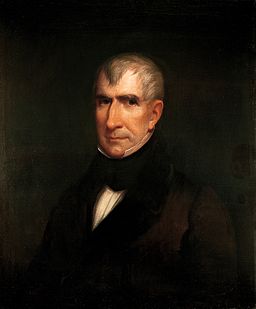
In the 1840 election William Henry Harrison’s Whig party supporters got some extra help from a Democratic newspaper. The paper claimed that if he got his pension and a barrel of cider, Harrison would retire to a log cabin in Ohio. As a result people thought of Harrison as a common man, despite the fact that he was the son of a wealthy Virginian who signed the Declaration of Independence. Supporters nicknamed Harrison “Tippecanoe” after a battle he had fought against a confederation of Native Americans. “Tippecanoe and Tyler, too” made a catchy campaign slogan.

Official White House Portrait of William Henry Harrison

Official White House Portrait of William Henry Harrison

The election also gave birth to the American expression “O.K.” Democrats used O.K. as affectionate shorthand for Harrison’s opponent, Martin Van Buren, who was known as “Old Kinderhook” after the town in New York where he grew up.

Harrison was the first Whig party candidate to win a presidential election. The Whig party had formed out of opposition to President Jackson’s policies. Whigs wanted a strong federal government and social reforms.

Harrison was mainly nominated and elected because he had few political enemies and didn’t share his personal opinions. No one knows what kind of president he would have been because he died from pneumonia one month after his inauguration. He was the first president, though not the last, to die in office.

John Tyler

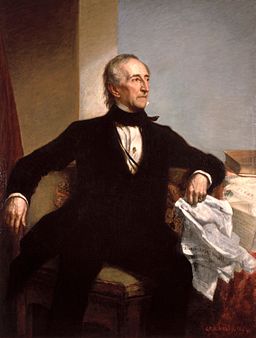
Tyler’s succeeding Harrison established the precedent of the vice-president taking over for a deceased president. Yet, since the Constitution didn’t specifically state what the vice-president’s role was in case a president died, not everyone thought Tyler should become president. John Quincy Adams referred to Tyler as “His Accidency.”

Official White House Portrait of John Tyler

Official White House Portrait of John Tyler

Shortly after taking the oath of office, Tyler’s wife died, which made him the first president to become a widower in office. Tyler soon married Julia Gardiner, a young woman thirty years younger than he.

In many ways, Tyler seemed like a natural fit for the presidency. At fifty-one he already had political experience serving as a governor and a congressman. His tall, thin frame made him stand out in a crowd, and he had an excellent speaking voice.

Tyler was a former Democrat who had switched over to the Whig party during Jackson’s presidency. Yet he still felt strongly about states’ rights. This feeling got him into trouble with his party, which favored a strong federal government. He vetoed bills that Whigs in Congress and in his cabinet wanted.

After vetoing a tariff bill introduced by Whigs, the first ever impeachment resolution of a president was made against Tyler. The resolution failed. Nevertheless, Tyler remained a mainly ineffectual executive.

Though he supported the annexation of Texas, the Senate would not approve it until Tyler’s successor James Polk was elected so that Tyler’s administration could not take credit. Tyler stated, “A Vice President, who succeeds to the Presidency by the demise of the President…has no party at his heels to sustain his measures.”

Andrew Jackson’s Apprentice: U.S. President Martin Van Buren

Martin Van Buren was the first president born in the official United States of America. His ancestors were Dutch. Van Buren’s father managed a tavern in Kinderhook, New York. Politicians often dropped by for a drink and talked about their ideas. Listening to them gave young Martin an early interest in politics. His family couldn’t afford to send him to law school, but he studied on his own while he worked as law office clerk. Soon he entered state politics.

Van Buren got his nickname “The Little Magician” for his talents as a shrewd negotiator and political organizer. By the election of 1836 Van Buren had already helped to organize the new Democratic Party. His former party, the Democratic-Republicans, was crammed with members who just wanted to argue with each other. The new Democratic platform extended Andrew Jackson’s policies of limited federal government and promotion of states rights.

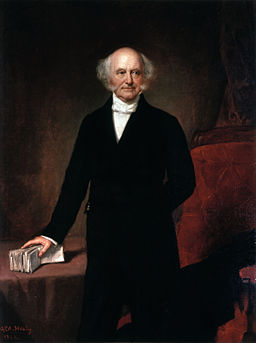
Official White House Portrait of Martin Van Buren

Official White House Portrait of Martin Van Buren

Though Van Buren was a gifted politician, he is largely regarded as a failure as president.

The economic crisis he inherited from Jackson only got worse under his watch. Not all of the factors were within his control: for example, England also had an economic depression and English banks stopped dealing with the United States. Unemployment among American workers soared and so did poverty.

Unlike future democratic president Franklin Roosevelt, Van Buren never offered the American people federal assistance. He thought the government should leave people alone. He did, however, want to make sure that the government had money. He proposed an independent treasury so the government wouldn’t have to keep its money in struggling individual banks.

The establishment of the U.S. Treasury would have been a victory for Van Buren, but it took him years to convince Congress to pass the bill. By then the public blamed him for the economic crisis and Van Buren was not re-elected.

U.S. President Andrew Jackson: Surprising Facts about the Man on the Twenty Dollar Bill

When Andrew Jackson was elected president in 1828, he was the first to reach that office as a self-made man. He was born into a poor family in South Carolina. During the American Revolution, Jackson lost his mother and two brothers and was wounded by a British officer.

Family tragedy seemed to follow Jackson throughout his life. As he ran for president, his detractors claimed that Jackson had lived with his wife before their marriage. Actually, they were married for two years before they realized that Rachel’s divorce from her previous husband had not been finalized. Rachel Jackson died from an illness before her husband’s inauguration. Jackson blamed her death on the nasty comments made during the campaign.

Historians have dubbed Jackson’s presidency the “age of the common man.” He was certainly unlike any other president the country had elected.

White House Portrait of Andrew Jackson

White House Portrait of Andrew Jackson

After his inauguration Jackson invited members of the public to attend a reception at the White House. To the dismay of the staff, so many people tried to cram into the White House that items were broken. Shortly after becoming president, Jackson indulged his fondness for chewing tobacco by installing twenty spittoons in the East Room.

Despite his dislike of formalities, Jackson’s terms as president had little impact on the common man. It’s true that more people (at least white, taxpaying males) got to vote in the election that sent Jackson to the White House. Through the Indian Removal Act he gave more white men the opportunity to acquire Native American land.

He did not, however, believe that social or economic equality was desirable. He stated, “Distinctions in society will always exist under every just government. Equality of talents, or education, or of wealth cannot be produced by human institutions.”

Jackson established the office of president as the chief power in American government for the first time. He made it obvious that he was not going to allow others to tell him what to do. He used the presidential veto more often than any previous president. For example, he vetoed the re-charter of the National Bank and federal support for internal improvements.

His ignorance of financial matters led to an economic crisis which harmed his successor, Martin Van Buren.