
Forgotten First Lady Lucy Hayes

American First Lady Lucy Webb Hayes is most remembered as “Lemonade Lucy,” a nickname she received after banning alcohol from the White House. In fact, Lucy Hayes was much more than an advocate for abstinence.

Lucy was the first First Lady to graduate from college. She met Rutherford B. Hayes when she was a student at Ohio Wesleyan University, but at fifteen she was to young to be courted. Fortunately they met again in 1850 and married in 1852.

Despite her education, Lucy told Hayes that she thought she was “too light and trifling for you.” Hayes, though acknowledging his love for her, saw her as much more than a pretty face. He wrote in his diary, “Intellect she has too, a quick and spritely one, rather than a reflective and profound one. She sees at a glance what others study upon, but will not, perhaps, study what she is unable to see at a flash.”

Her college essays show that Lucy took a great interest in the issues of her time, including temperance and women’s rights. In one essay, Lucy compared men to women, with women coming out favorably. she wrote, “It is acknowledged by most persons that her (woman’s) mind is as strong as a man’s…Instead of being considered the slave of man, she is considered his equal in all things and his superior in others.”

Throughout their marriage, Lucy did not hesitate to share her opinions with her husband. An ardent abolitionist, she wrote to Hayes during the Civil War that President Lincoln was not doing enough to get rid of slavery. “The protection of slavery is costing us many precious lives,” she wrote. One of the lives she worried about was Hayes’s, since he was wounded more than once. Lucy traveled with Hayes, who was a Union officer, as much as she could during the war. She even brought two of their youngest children along, which may have contributed to their deaths before the age of two.

She developed an abiding interest in veteran’s causes as a result of her war experiences. When Hayes was elected governor of Ohio, Lucy established a soldier’s orphan’s home. Though she struggled to get the home funded, it became a state institution in 1870.
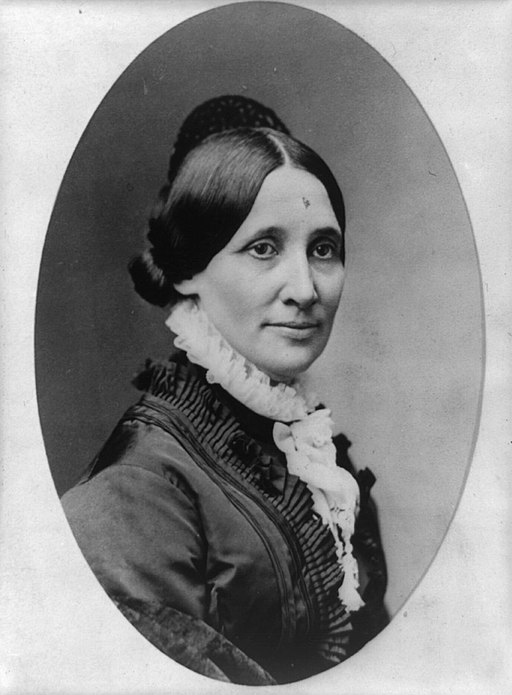
Lucy Hayes, circa 1877

In 1877, Hayes was narrowly elected President of the United States. Lucy’s excellent skills as a hostess helped her husband entertain both political parties at the White House. Her love of music led Lucy to invite vocalists and musicians to the White House. The first black opera singer Marie Selika sang arias in the Green room. On more informal occasions, guests were invited to sing gospel songs with the First Lady.

Though Lucy later took the blame for it, Hayes announced that alcohol would not be served at the White House after spring 1877. He may have partly been trying to please his wife, but Hayes also disliked the way male visitors behaved when drinking. Although some colleagues accused the First Couple of being stingy, they still entertained lavishly. During one dinner, hundreds of guests were treated to expensive foods like salmon, turkey and truffles, ham, lobster salads, and oysters among other dishes.

Since she had no social secretaries to help her entertain, Lucy invited young friends and family to the White House. Though she claimed she was getting an unfair reputation as a matchmaker, more than one politician met his future wife at one of the Hayes’s parties. Even the press acknowledged Lucy as a warm hostess. One reporter wrote of Lucy that “she is so vivacious and so responsive that everybody leaves her presence with a vague idea that he is the one person whom she was longing to see.” To most contemporaries, Lucy was known as a good conversationalist and hostess.

Lucy disappointed some women’s groups by not joining their causes. Despite the fact that the White House no longer served alcohol, Lucy never officially joined the Women’s Christian Temperance Union. She also remained neutral on women’s suffrage.

Lucy Hayes took a more traditional view of the role of First Lady, preferring to support her husband’s decisions rather than making public statements. Yet through her example of a college education and her private influence on issues, Lucy Hayes paved the way for more progressive First Ladies.

Sources:

Greer, Emily Apt. “Lucy Webb Hayes and Her Influence Upon Her Era.” https://www.rbhayes.org/hayes/lucy-webb-hayes-and-her-influence-upon-her-era/

Hoogenboom, Ari. Rutherford B. Hayes: Warrior and President.

O’Brien, Cormac. Secret Lives of the First Ladies.

Trefousse, Hans. Rutherford B. Hayes.

Frequently Forgotten President James A. Garfield

James Garfield was raised by a single mother in Ohio (his father died when he was two years old). He managed to save enough money to get through school. After college Garfield had various jobs as a preacher, professor, and college president. Garfield was never satisfied with any of these occupations or with having just one girlfriend. He courted his future wife Lucretia for so long that she was ready to give him up, but he finally grew into a devoted family man.

When the Civil War began Garfield served as the country’s youngest major general. President Lincoln convinced him to resign his commission, however, when his home state elected him to Congress. Garfield never lost an election and served for nearly two decades.

256px-Jgarfield

Official presidential portrait of James Garfield

During the 1880 Republican convention Garfield’s name was put forward, though he tried to object. In a crowded field that included former President Grant, Garfield won the nomination. With the help of powerful Republican Senator Roscoe Conkling he narrowly won the presidency, too.

Ironically, Garfield and Conkling were soon pitted against each other in an argument over federal appointments. Though Garfield had nominated some of Conkling’s friends for other positions, he appointed one of Conkling’s rivals to the New York Customs House.

Garfield surprised Conkling and almost everyone else when he refused to back down. “This…will settle the question whether the President is registering clerk of the Senate or the Executive of the United States,” he said. It seemed that the country had finally found a strong chief executive.

Only a few month into his presidency, a young man who had unsuccessfully sought a position in the government shot Garfield. Garfield lingered for months. An early air conditioning unit was installed in the White House to keep Garfield cool in the summer. Alexander Graham Bell even tried to find the location of the bullet, which remained inside the president, with a new electrical invention. After being moved to the Jersey shore, however, Garfield died.

The Origins of American Symbol Uncle Sam

World War I Uncle Sam Recruiting Poster

World War I Uncle Sam Recruiting Poster

When Samuel Wilson moved to Troy, New York in 1789, he had no idea that he would become the inspiration for an American symbol. Four years after arriving in Troy, Samuel and his brother started a meatpacking business called E. and S. Wilson. They also produced the barrels that transported the meat. In Troy, Sam Wilson was known for his pleasant personality and his jokes. Since he was so likeable, the townspeople called him Uncle Sam.

During the War of 1812, the Wilson brothers were under contract to send food supplies to northern troops stationed in Troy. Every barrel of meat bore the stamp “U.S.” Sam Wilson meant the abbreviation to represent United States, but back then the only abbreviation for the country was “U. States.” Troy residents joked that the U.S. stood for Uncle Sam Wilson, who was supplying the army with food. The joke was told so often that all rations sent to the government were called Uncle Sam’s.

In 1813 references to Uncle Sam as a nickname for the United States appeared on local broadsides and in the Troy newspaper.

Images of Uncle Sam were drawn as early as 1830, but his physical traits varied with each artist. Some historians believe that a key factor in the development of Uncle Sam’s likeness occurred after the assassination of President Lincoln. Like Lincoln, the new Uncle Sam was tall, skinny, had a beard, and wore a top hat.

Cartoonist Thomas Nast gave Uncle Sam red-and-white-stripped pants and stars on his coat. In 1914 James Montgomery Flagg created the most famous version of the American icon. Flagg’s Uncle Sam has a stern face and points at observers. Beneath Uncle Sam are the words “I want YOU for U.S. Army.”

Samuel Wilson, the original Uncle Sam, became a wealthy businessman after the War of 1812. He remained popular in his community until his death in 1840. Eventually, Congress made Wilson’s connection with the symbol of Uncle Sam official. Congress signed a Joint Resolution on September 15, 1961 recognizing “Uncle Sam Wilson of Troy, New York, as the progenitor of America’s national symbol of Uncle Sam.”

Lincoln and the Emancipation Proclamation

One hundred and fifty years ago on New Years Day, Abraham Lincoln signed the Emancipation Proclamation. Lincoln never liked slavery, and he recognized that having slaves gave the southern states advantages in the Civil War. For example, southern slaves worked as cooks or nurses on the sidelines to save soldiers energy for fighting.

In the summer of 1862, Lincoln decided to write an emancipation proclamation. The document declared that any slave in a state that was fighting Union soldiers would be free on January 1, 1863.

Before issuing his proclamation, Lincoln asked his cabinet members to listen to a rough draft. He told them he would use his powers as president in wartime to free slaves who might otherwise help the Union cause. His Secretary of State, William Seward, supported the idea of freeing slaves, but warned Lincoln that the Union army’s losses during the year might influence the public’s opinion. He suggested that the president wait for a battle victory before announcing the emancipation proclamation. Lincoln agreed.

When the South’s General Lee retreated from the North after the battle at Antietam, Lincoln publicly announced his intention to sign the proclamation on January 1, 1863. Some people doubted that he would follow through on his promise, but they were wrong. On the morning of January 1, Lincoln made a major change in the proclamation. Though it still said that “all persons held as slaves” within the rebel southern states “are, and henceforth shall be free,” he added that African Americans could join the Union army. Lincoln knew the Union needed the manpower. In fact, though they served in all black units, between 180,000 and 200,000 black men fought for the Union during the war.

Before he could sign the document, Lincoln and his wife Mary hosted a New Years Day reception at the White House. First government officials mingled with the president, and then the public was invited to stand in a line to shake the president’s hand. Afterwards, Lincoln went back to his office to sign the emancipation proclamation. Lincoln said, “I never, in my life, felt more certain that I was doing right, than I do in signing this paper.” His hands were so stiff after three hours of shaking hands that he waited before signing his name. He said, “If my hand trembles when I sign the Proclamation, all who examine the document hereafter will say, ‘He hesitated.’” After a few moments, Lincoln’s hand felt less numb and he put his signature on the historic document.

The Emancipation Proclamation didn’t free any slaves right away. It only declared the slaves in the rebel states free—something Lincoln could not enforce in 1863. The document was important because it changed the way people thought about the war. Now soldiers in the Union army were fighting not only to bring the southern states back to the Union, but also to free the slaves.

From Preserving the Union to Emancipation: President Lincoln’s Views on Slavery

President Lincoln believed that he would be best remembered for writing the Emancipation Proclamation. Although many people remember him as the president who freed the slaves, some of the facts surrounding that achievement have been clouded with the passing of time.

Although Abraham Lincoln hated slavery, his goal was not to free the slaves at the beginning of his presidency. Instead, he wanted the Southern states to remain in the Union and tried to prevent them from pulling out. He promised Southerners that he would not interfere with slavery in states where it already existed, but this assurance was not enough to prevent the Civil War.

As the war dragged on, however, Lincoln realized that freeing the slaves and preserving the Union were inseparable issues. Lincoln informed his cabinet of his plan to issue emancipation for the slaves in summer 1862, but was advised to wait for a Union army victory. When victory came, he pulled the proclamation out of his desk drawer. In his message to Congress in December 1862, he explained his actions: “In giving freedom to the slave, we assure freedom to the free—honorable alike in what we give, and what we preserve.”

Lincoln signed the Emancipation Proclamation on January 1, 1863. It stated that from that date “all persons held as slaves within any state or states, wherein the constitutional authority of the United States shall not then be practically recognized…shall then, thenceforward, and forever, be free.” Criticism came from within his own party. Conservative Republicans thought it was too radical, while the radicals complained that the proclamation only freed slaves in Southern states that the Union army had no authority to help.

In the military, some soldiers resented having to fight a war for the slaves and others did not want blacks to have the opportunity to join the Union army. Lincoln, however, felt that the former slaves had a stake in fighting for their freedom.  He was also impressed by the abilities of black troops on the battlefield. He wrote that when peace came, “there will be some black men who can remember that, with silent tongue, and clenched teeth, and steady eye, and well-poised bayonet, they have helped mankind on to this great consummation [eliminating slavery and saving the Union]; while…there will be some white ones unable to forget that, with malignant heart, and deceitful speech, they have strove to hinder it.” In just a few years, Lincoln transformed from a politician who wanted little to do with the issue of slavery, to a statesman who wanted to destroy it.

Fort Sumter and the Start of the Civil War

Imagine that you have just become President of the United States. You gave your first speech to the nation and attended the inaugural ball. After the ball, you are handed a note that says that one of the remaining federal forts in the South is in danger. Abraham Lincoln had to deal with a crisis almost from the moment he became president.

The letter Lincoln read was from Major Robert Anderson, commander of the Federal troops at Fort Sumter in South Carolina. Members of the newly formed Confederacy had surrounded the fort with ships and cannon. Anderson implored Lincoln to send more supplies to the fort.

Members of Lincoln’s cabinet all gave different opinions as to what the President should do. Some said the fort should be evacuated to avoid a civil war with the South, while others said he should send extra troops to protect the fort. Lincoln decided to do neither—he would send a boat with supplies to the fort but troops and warships were instructed to stand by and respond only if the Confederates fired the first shot. He sent a messenger to inform the governor of South Carolina “to expect an attempt will be made to supply Fort Sumpter [sic] with provisions only; and that, if such attempt be not resisted, no effort to throw in men, arms, ammunition will be made…[except] in case of an attack on the Fort.”

The South Carolina Confederates, however, saw the fort as an example of a foreign nation (the Union) trying to stick around in the newly independent Confederate States. They also believed that war would bring the upper Southern States, like Virginia, to their aid. On April 12, 1861, Confederates opened fire on the fort. The supply ship had not yet arrived and other nearby boats were prevented from aiding Anderson’s men by the high seas. As a result, Federal forces were outmanned and had limited gun power. After over a day of bombardment that destroyed parts of the fort, Federal forces surrendered it to the Confederates. Ironically, no one was killed in the first confrontation of the Civil War that later took so many lives.